

The year 2025 was the third warmest on record globally, according to the Global Climate Highlights report 2025 from ECMWF which operates the Copernicus Climate Change Service (C3S) and Copernicus Atmosphere Monitoring Service (CAMS) on behalf of the European Commission.
Global temperature in 2025 was only marginally (0.01°C) cooler than 2023, and 0.13°C cooler than 2024, which remains the warmest year on record.
According to ECMWF’s ERA5 reanalysis, global temperatures from the past three years (2023–2025) have averaged more than 1.5°C above the pre-industrial level (1850–1900), marking the first time a three-year period has exceeded the 1.5°C limit. The report also shows that the past 11 years have been the 11 warmest on record.
The UNFCCC Paris Agreement, adopted in 2015, aims to hold the increase in the global average temperature to well below 2°C above pre-industrial levels, and to pursue efforts to limit the temperature increase to 1.5°C above pre-industrial levels.
ECMWF Director-General Florian Pappenberger said: “This report confirms that Europe and the world are in the warmest decade on record and that the European Commission’s investment in Copernicus continues to be critical. As an international organisation serving 35 nations, ECMWF provides the world-leading science for informed decisions to be made, and ultimately action taken, to adapt to climate change, because every year and every degree counts. Preparedness and prevention remain possible but only when action is guided by robust, scientific evidence.”
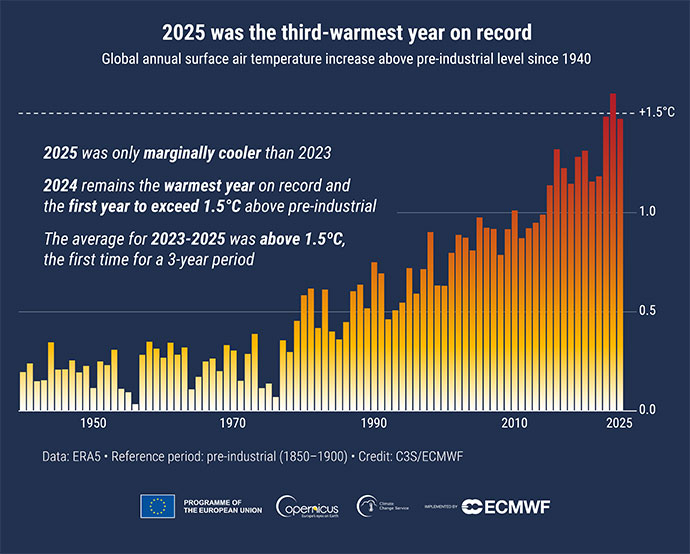
Global surface air temperature (ºC) increase above the average for the 1850–1900 designated pre-industrial reference period based on the ERA5 dataset, shown as annual averages since 1940. Credit: C3S/ECMWF.
Widespread warmth across the globe
The global average surface air temperature of 14.97°C was 1.47°C above the pre-industrial level, following 1.60°C in 2024. January 2025 was the warmest January on record, while March, April and May were each the second warmest for the time of year. Every month except February and December was warmer than the corresponding month in any year before 2023.
Air and sea-surface temperatures in the tropics were lower than in 2023 and 2024, yet still much above average in many areas outside of the tropics. Temperatures over the tropical Atlantic and Indian Ocean were also less extreme in 2025 than in 2024.
The lower tropical temperatures were partly due to the persistence of near-average (‘ENSO-neutral’) or weak La Niña conditions in the equatorial Pacific throughout the year.
In contrast, the polar regions saw higher temperatures. Antarctica recorded its warmest year on record, while the Arctic experienced its second warmest.
Record-high annual temperatures were also observed in regions including the northwestern and southwestern Pacific, the northeastern Atlantic, far eastern and northwestern Europe, and central Asia.
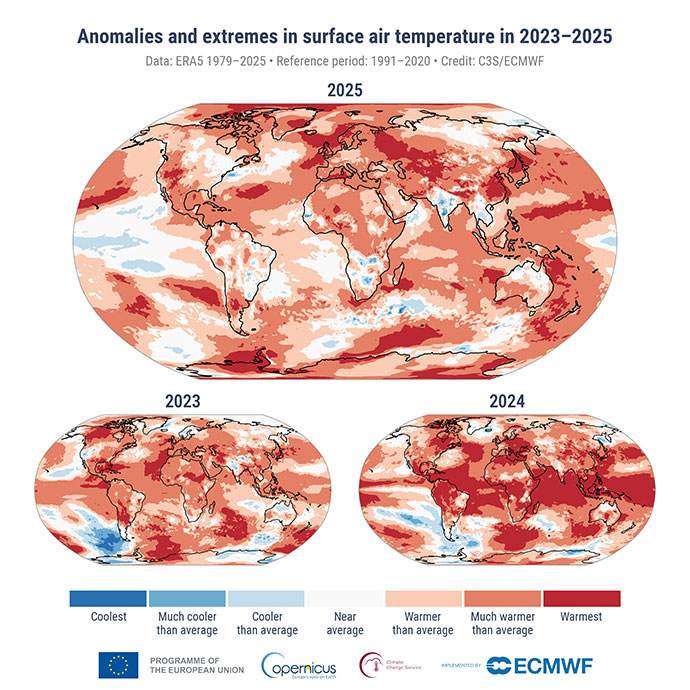
Anomalies and extremes in surface air temperature for 2025, 2023 and 2024. Colour categories refer to the percentiles of the temperature distributions for the 1991–2020 reference period. The extreme (“Coolest” and “Warmest”) categories are based on rankings for the period 1979–2025. Data source: ERA5. Credit: C3S/ECMWF.
European temperatures
In Europe, 2025 was also the third-warmest year on record, with an average temperature of 10.41°C, 1.17°C above the average for the 1991–2020 reference period and 0.30°C cooler than the warmest year 2024.
March was the warmest month in Europe with an average temperature of 6.03°C, 2.41°C above the 1991–2020 average for March and 0.26°C warmer than the previous warmest March in 2014.
Long-term warming and three years of exceptional warmth
Using several methods, the current level of long-term global warming is estimated to be around 1.4°C above the pre-industrial level. Based on the current rate of warming, the Paris Agreement’s limit of 1.5°C for long-term global warming could be reached by the end of this decade – over a decade earlier than predicted based on the rate of warming at the time the agreement was signed.
The exceptional warmth of the last three years has been primarily driven by two factors. Firstly, rising concentrations of greenhouse gases – mainly from human activities – in the atmosphere and secondly, exceptionally high sea-surface temperatures, associated with an El Niño event and other ocean variability factors. Additional factors include changes in the amounts of aerosols and low cloud and variations in atmospheric circulation.
Monitoring by CAMS continues to support climate mitigation policies by tracking emissions and atmospheric concentrations.
Director of CAMS at ECMWF Laurence Rouil said: "Atmospheric data from 2025 paints a clear picture: human activity remains the dominant driver of the exceptional temperatures we are observing. Atmospheric greenhouse gases have steadily increased over the last ten years. We will continue to track greenhouse gases, aerosols, and other atmospheric indicators to help decision makers understand the risks of continuing emissions and respond effectively, reinforcing synergies between air quality and climate policies. The atmosphere is sending us a message, and we must listen."
Heat stress and extreme events
In 2025, half of the global land area experienced more days than average with at least strong heat stress. According to the WHO, heat stress remains the leading cause of weather-related fatalities worldwide.
High temperatures, combined with dry and windy conditions, contributed to widespread wildfires. Europe recorded its highest annual wildfire emissions. Significant fire activity also occurred in parts of North America. These events released large amounts of carbon and degraded air quality at local and regional scales, according to CAMS.
The year was also marked by a range of notable extreme weather events, including record heatwaves and severe storms across Europe, Asia and North America.
Carlo Buontempo, Director of C3S at ECMWF, said: "The fact that the last 11 years were the warmest on record provides further evidence of the unmistakable trend towards a hotter climate. The world is rapidly approaching the long-term temperature limit set by the Paris Agreement. We are bound to pass it; the choice we now have is how to best manage the inevitable overshoot and its consequences on societies and natural systems.”
Other highlights of the report
Air temperature above global land areas was second warmest, 0.20ºC cooler than 2024 and 0.01ºC above 2023.
Global sea-surface temperature (extrapolar) was 20.73ºC and third warmest after 2024 and 2023.
In February 2025, the combined sea ice cover from both poles fell to its lowest value since at least the start of satellite observations in the late 1970’s.
In the Arctic, the monthly sea ice extent was the lowest on record for the time of year in January, February, March, and December, and the second lowest in June and October. March marked the lowest annual maximum on record, while the September minimum ranked only 13th lowest.
In the Antarctic, the monthly extent reached its fourth-lowest annual minimum in February and its third-lowest annual maximum in September.