


Image: © punyafamily / AdobeStock
2026 has been a year of heatwaves. Temperature records have been repeatedly broken during the European spring and summer, leading to thousands of excess heat-related deaths.
But while we regularly hear about the dangers of dehydration, heat exhaustion and heatstroke, one health impact of heatwaves is often overlooked: ozone pollution.
Atmospheric ozone – a gas consisting of molecules made of three oxygen atoms – increases at ground level during warmer periods, creating air pollution that can damage the respiratory and cardiovascular systems, cause shortness of breath, and worsen lung conditions such as asthma and chronic obstructive pulmonary disease (COPD).
According to one global estimate, around 500,000 deaths every year can be attributed to long-term ozone exposure. Ozone pollution also impacts ecosystems, damaging vegetation and reducing crop yields by, for example, slowing photosynthesis and accelerating leaf ageing.
Information on atmospheric ozone concentrations is therefore crucial for researchers and policymakers across environmental and public health sectors. To this end, the EU’s Copernicus Atmosphere Monitoring Service (CAMS), implemented by ECMWF, is creating detailed ozone forecasts for up to five days ahead.
“Once an ozone pollution event begins, it is impossible to stop,” says Laurence Rouil, Director of CAMS at ECMWF, “but our forecasts provide advance warning of how intense the event will be and which areas will be most affected.”
Good and bad ozone
Ground-level ozone accounts for only a small proportion of the ozone in our atmosphere. Around 90% of atmospheric ozone is found in the ‘ozone layer’, between around 15 and 30 kilometres above the Earth’s surface in the stratosphere.
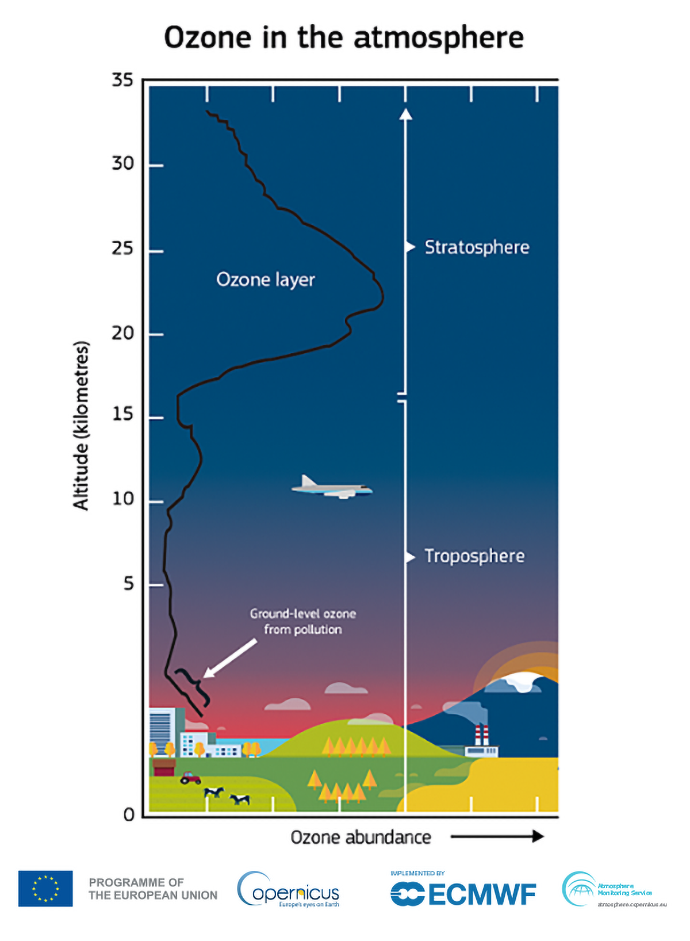
Vertical profile of ozone. Credit: CAMS/ECMWF, graphic adapted from Salawitch et al., WMO, 2019.
This is sometimes called ‘good ozone’ because it absorbs most of the Sun’s medium- and high-frequency ultraviolet (UV) radiation, which would otherwise damage life on Earth.
The remaining 10% of ozone lies in the atmospheric layer closest to our planet’s surface: the troposphere.
The ozone here plays a number of roles – both positive and negative – but, at ground level, is a ‘bad’ pollutant. Unlike stratospheric ozone, which is created directly through reactions between solar radiation and oxygen molecules, ground-level ozone is a ‘secondary pollutant’ that only forms in the presence of certain chemical ‘precursors’.
Nitrogen oxides (NOx, from combustion sources including motor vehicles and power plants) and volatile organic compounds (VOCs, from sources including industrial processes and chemical solvents) mix in the troposphere, where solar radiation can trigger a chemical chain reaction that results in ozone.
Summer provides the perfect conditions for tropospheric ozone formation.
“The low winds and stagnant air associated with areas of high atmospheric pressure encourage the build-up of precursor chemicals,” says Mark Parrington, CAMS Senior Scientist at ECMWF, “while the increased sunlight and heat speed up the reactions.”
A typical European summer ozone concentration is 40 –60 μg/m3, but levels can double or even triple during heatwaves. The recent heatwaves saw concentrations as high as 180 μg/m3, which, according to EU guidelines, represents “extremely poor” air quality.
Forecasting air quality
Ground-level ozone is constantly in flux. Depending on atmospheric conditions, the pollution can last from a few hours to a few weeks, and there is a marked daily cycle, with concentrations rapidly falling as night sets in.
Ozone pollution can also travel thousands of kilometres from its initial source – there is a background ozone level in Europe that comes from as far afield as China and the US, onto which the local, heatwave-related peaks are superimposed.
To help keep track of pollution, CAMS produces global forecasts of atmospheric composition, including ozone concentration at 137 vertical levels, twice a day using a version of ECMWF’s Integrated Forecasting System (IFS) that includes an atmospheric chemistry component.
The initial conditions for each forecast are calculated by combining up-to-date satellite observations of atmospheric composition with a previous forecast – a process called data assimilation.
To provide more detailed European forecasts, CAMS inputs these global forecasts into a higher resolution system. This comprises a suite of 11 regional chemical transport models, with assimilated surface observations, which output daily forecasts of air quality across Europe, including concentrations of ozone, ozone precursor chemicals (NOx and VOCs), pollen, carbon monoxide and dust. This ‘ensemble’ approach – calculating the average of multiple models – tends to be more accurate than using one model alone.
“It also provides a measure of model variability,” says Mark, “which is helpful if, say, you’re looking at whether the ozone level in a particular city is likely to breach the pollution threshold.”
CAMS also publishes near-real-time data and visualisations on its air quality policy portal, aimed at those involved in national and city management.
“This supports policymakers in monitoring pollution events and measuring progress against EU air quality standards,” says Laurence, “and it can also feed into short-term decision-making.”
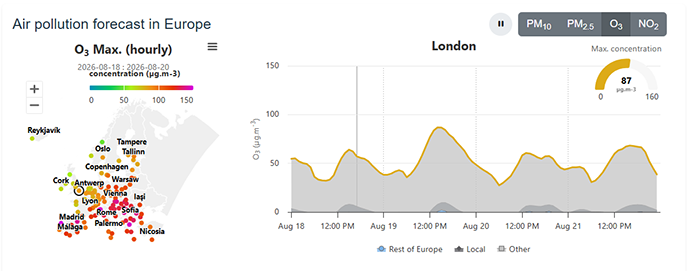
Screenshot of an air pollution forecast from the CAMS air quality policy portal.
Temporary policies to reduce precursor chemicals and mitigate ozone pollution during a heatwave could include limiting vehicle speeds in urban areas, or dialling down industrial activity (this already happens in the Étang de Berre area near Marseille in south-east France).
The future of ozone
In the stratosphere, levels of ozone are increasing thanks to the 1987 Montreal Protocol, which phased out the use of ozone-depleting chemicals such as chlorofluorocarbons (CFCs).
This is good news: the ‘ozone hole’ that occurs over the Antarctic every year is predicted to have fully healed by around 2066, which will bolster the Earth’s protection against UV radiation.
However, tropospheric ozone is also expected to increase as our planet warms and heatwaves become more frequent and intense.
The precursor chemicals required for the formation of ozone pollution come mostly from anthropogenic sources, so a long-term reduction in emissions from vehicles, factories and power plants, for example, could help. But this will require a two-pronged approach.
“Reducing NOx alone can have the converse effect of increasing ozone pollution,” says Mark, “because these chemicals can also react with existing ozone to remove it from the atmosphere. Tackling ozone pollution will therefore require limiting emissions of both NOx and VOCs.”
As our climate shifts, decision-makers will need accurate and timely information about the quality of the air we breathe. Ozone is just one part of the picture, but tracking this gas’s journey through the atmosphere has never been more important.