

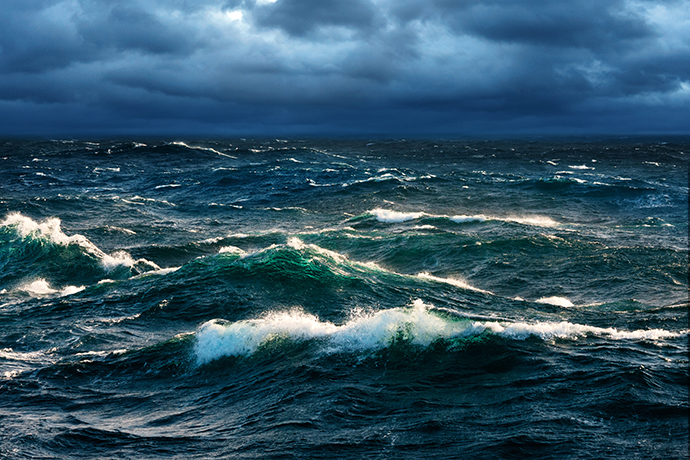
Image: © oporkka / Adobe Stock
Ocean wave forecasts play a vital role in safeguarding lives at sea and supporting the global maritime economy. From shipping and offshore operations to fisheries, coastal protection and marine recreation, reliable information on sea conditions can help save lives and limit the damage caused by severe storms.
But forecasting ocean wind waves is not simply about predicting how high the sea will be. It involves capturing the constantly changing interactions between winds, ocean currents and, in some regions, sea ice across the globe.
Ocean waves sit at the boundary between the atmosphere and the ocean, exchanging momentum and energy and influencing both. As a result, wave forecasting is not just a marine service – it is an essential part of understanding and predicting the Earth system as a whole.
A complex sea surface
The ocean surface is far from uniform. At any moment, it is made up of many waves of different sizes, speeds and directions, all overlapping and interacting with one another.
Some waves are generated locally by nearby winds and are known as wind sea. Others, known as swell, originate elsewhere, often travelling thousands of kilometres.
These different wave systems combine into a constantly changing sea state, ranging from calm conditions to extreme storms and, occasionally, producing unusually large “freak waves”.
Capturing this complexity is challenging.
“We cannot track every single wave over the global ocean, so we have to use a statistical representation of it,” explains Jean Bidlot, Consultant Senior Research Scientist at ECMWF.
Instead, ECMWF’s wave forecasting system represents the sea surface using a statistical description known as a wave spectrum. This describes how wave energy is distributed across waves of different sizes, lengths and directions.
This makes it possible to represent the overall state of the sea without modelling each individual wave.
One of the quantities derived from this approach is significant wave height – a standard indicator used to describe overall sea conditions.
“If you roughly average the one third highest distance between the troughs and crests of the waves, that gives you what we call the significant wave height,” Jean said.
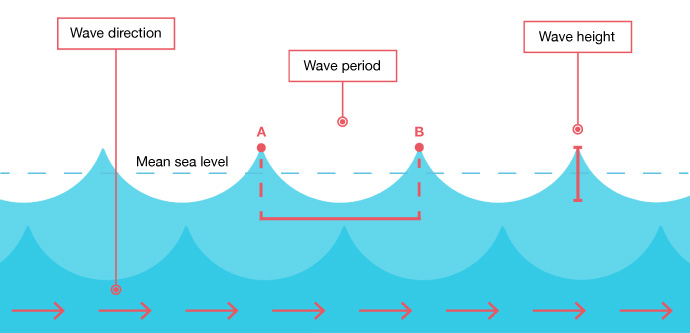
Illustration of key wave parameters.
Although individual waves may be much larger or smaller, significant wave height provides a reliable estimate of the overall state of the sea and is widely used in marine forecasting and observations.
How ECMWF forecasts waves
Ocean waves are simulated within ECMWF’s Earth system model, using the ecWAM wave modelling component.
Rather than modelling individual waves, ecWAM represents the sea surface as a two-dimensional spectrum of wave energy distributed across frequencies and directions. The model then calculates how this spectrum evolves over time by representing key processes:
- how the wind generates waves
- how waves interact with each other
- how wave energy dissipates
- how waves propagate across the ocean
This enables the model to describe how waves grow, travel and decay across the global ocean.
A fully coupled Earth system
Forecasting waves accurately, however, also depends on understanding how waves interact with the wider Earth system. A key feature of wave forecasting at ECMWF is that waves are not treated in isolation. Instead, they are part of a fully coupled Earth system model.
“The wave model is not something that sits by itself – it’s fully integrated into our Earth system modelling approach. The wave model really sits at the interface between the atmosphere above and the ocean below,” said Jean.
“That’s what makes us somewhat unique at ECMWF, or at least at the forefront of science. There are still not many operational forecasting centres that use a fully coupled system in an operational setting.”
The ecWAM wave model component interacts continuously with ECMWF’s atmospheric, ocean and sea-ice models. Winds from the atmosphere generate waves, while ocean currents influence how waves evolve and travel. In polar regions, sea ice also affects wave evolution.
“Wave–sea ice interactions are becoming increasingly important as polar regions continue to change,” explains Josh Kousal, Scientist for Wave Modelling at ECMWF. “By allowing waves to propagate into sea-ice-covered areas, we are moving towards a more realistic representation of the polar ocean environment in ECMWF forecasts.”
The interaction also works in the opposite direction. Waves influence the roughness of the sea surface, affecting exchanges of momentum, heat and moisture between the ocean and atmosphere. Breaking waves also contribute to exchanges of heat, moisture and gases between ocean and atmosphere.
“In polar regions, waves can also break up and transfer momentum to the sea ice," adds Josh.
Ongoing development work to model these two-way interactions is helping to move future forecasting systems towards greater physical consistency between the atmosphere, ocean and waves.
Observations and data assimilation
Accurate wave forecasts rely on observations from across the world. Satellite instruments known as altimeters can measure significant wave height over much of the global ocean.
James Steer, Scientist at ECMWF, explains how more modern satellites can also be used: “The European Space Agency’s Sentinel-1 satellites tell us in which direction and at what frequency waves are travelling, allowing us to improve our estimate of the swell that impacts coastlines.”
These observations are combined with previous forecasts through a process known as data assimilation, which provides the best possible starting point for each new forecast. Measurements from buoys and other in situ sources are then used to independently assess forecast quality.
Because waves are driven primarily by wind, accurate atmospheric forecasts are also essential for predicting sea conditions reliably.
Collecting observations over the open ocean remains a major challenge, however.
“The ocean is such an inhospitable place,” Jean said.
“It’s quite expensive to have all these instruments, which has historically limited the number of measurements available. Although technology has developed new instruments that are much cheaper, it's still a challenge to have global coverage.”
What the forecasts provide
The ECMWF wave forecasting system produces a broad range of outputs, from highly detailed spectral information to simpler indicators used by marine users.
Key parameters include:
- significant wave height
- mean and peak wave periods
- mean wave directions
Forecasts are provided both as:
- single deterministic forecasts
- ensemble forecasts that estimate uncertainty and the likelihood of extreme conditions
This allows users not only to see what is most likely to happen, but also to assess the range of possible scenarios.
The role of AI and future forecasting systems
Wave forecasting is continuing to evolve alongside wider advances in Earth system modelling and artificial intelligence (AI).
ECMWF recently introduced wave variables into its Artificial Intelligence Forecasting System (AIFS), allowing AI-based approaches to contribute to operational wave prediction.
However, physics-based modelling remains central to the forecasting system.
“We still rely on physics-based models because they contain all the details at the global scale,” Jean said.
One reason is the relative scarcity of wave observations compared with atmospheric data.
“We still don’t have a lot of wave observations from which we could derive something with AI that would be global,” he added.
Current AI systems are therefore often trained using large datasets generated by physics-based models, combining pattern recognition with decades of understanding of ocean wave behaviour.
Within initiatives such as the EU’s Destination Earth, ECMWF is also exploring how higher-resolution simulations and machine learning-based approaches could further improve forecasts of extreme ocean conditions.
Higher-resolution modelling allows scientists to better capture the fine-scale structure of storms and winds that generate the world’s most dangerous waves.
Waves in the Earth system
Ocean wave forecasting has come a long way from simple estimates of sea conditions based on the wind. Today, it reflects a sophisticated understanding of how waves interact with the wider Earth system.
As forecasting systems continue to evolve, waves are increasingly recognised as a key link connecting the atmosphere, ocean and climate, making them essential for understanding and predicting our changing planet.