

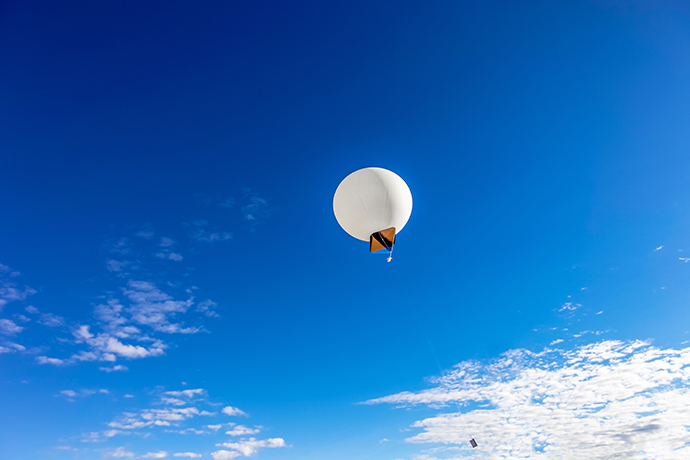
© Tolly65 / Adobe Stock
Authors: Niels Bormann, Sean Healy, Stephen English, Tony McNally
Every day, millions of observations from satellites, weather balloons, aircraft, ships, buoys and ground-based instruments flow into weather forecasts.
Despite this impressive volume of global observations, the reality is we can’t possibly observe everything, everywhere, all the time.
Large geographical gaps still exist globally, especially over oceans and sparsely populated land areas, and tomorrow’s weather often comes from these less-observed regions.
Choosing what to observe is also a major investment decision.
European countries invest approximately €3–3.5 billion per year in public satellite-based Earth observation, weather and climate infrastructure. This includes investment through ESA and EUMETSAT in missions and programmes such as Meteosat Third Generation (MTG), Metop Second Generation (Metop-SG), ESA Earth Explorers and Copernicus.
Similar large investments are made by other countries in the Americas and Asia.
ECMWF plays a significant role in guiding where to invest and helping turn that investment into substantial socio-economic impact.
Currently, we use a process called data assimilation to combine observations with numerical models to fill in the missing information. But if we could close a gap with a new observation, how would we decide what to observe, where, and how often?
To answer these questions, weather forecasting centres like ECMWF work closely with organisations that make and provide observations, in particular space agencies such as ESA, EUMETSAT, NASA, and JAXA. Yet assessing the value of future observations is challenging – how do you evaluate the impact of observations that do not even exist yet?
Several methods exist, but in truth no single method is perfect. The only way to know for certain is to have observations and measure their impact on forecasts. But satellites and other observing systems take years to design, build and launch, and decisions about them must be made long before their data can be tested in a real forecasting system.
We therefore use several approaches. Some help us to identify where the global observing system has fundamental gaps, while others allow us to simulate additional observations that do not yet exist and estimate their potential impact.
Together they provide evidence that can be used to help us decide what we should measure, where and how often.
"Decisions about future observing systems have to be made years, sometimes decades, before the observations become available. ECMWF’s role is to provide the scientific evidence to help ensure these investments deliver the greatest possible benefit for weather forecasting," says Stephen English, Deputy Director of Research at ECMWF.
Starting with gaps
The easiest approach to start with is the most obvious: check what we already have and look for gaps.
The World Meteorological Organization (WMO) has established the Global Basic Observation Network (GBON) for this very purpose. The GBON sets requirements for the availability and geographical distribution of key surface-based observations (Figure 1), providing a baseline for what the global observing system needs to deliver.
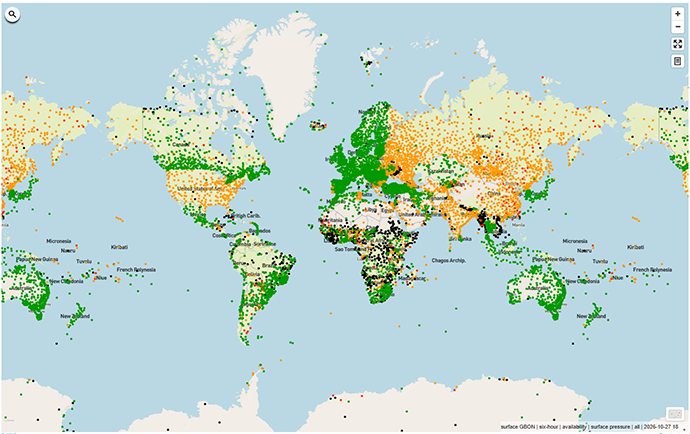
Figure 1: The WIGOS Data Quality Monitoring System (WDQMS) webtool, co-developed by ECMWF and WMO and hosted by ECMWF, monitors the availability, timeliness and quality of observations from land-based weather stations, helping identify gaps and issues in the global observing network. The image shows part of the WDQMS webtool daily monitoring page of GBON-affiliated land surface stations, for surface pressure measurements on 28 October 2026. The stations' GBON compliance is shown as either compliant (green), reporting below requirements (orange and red), or not reporting at all (black).
However, meeting that baseline is not equally straightforward everywhere, with some countries facing financial or technical barriers. The WMO therefore facilitated the UN Systematic Observations Financing Facility (SOFF) to help countries overcome such barriers, providing financial and technical support to improve and sustain their observing networks.
Identifying a gap tells us where observations are missing, but not how much filling it would improve forecasts. That improvement may be felt locally or, at medium range, far from the observation location.
Simulating the impact of future observations
Two methods have emerged which help us to assess the added value of new observations.
One is the so-called Observing System Simulation Experiments (OSSE). In this method, all observations, including existing ones, are modelled based on an estimate of truth. This is usually from a different model from the one that the impact is being assessed in.
An example of an OSSE is the so-called fraternal twin OSSE used by Rivoire et al. (2024), using the ARPEGE system at Météo-France (Figure 2).
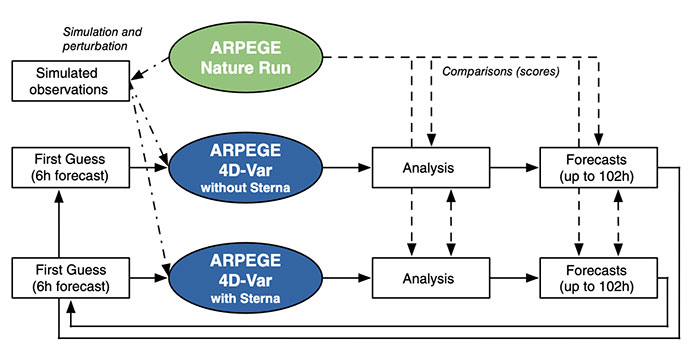
Figure 2: Fraternal twin OSSE. Credit: Reproduced with permission from the Royal Meteorological Society and Rivoire et al. (2024)
This estimate of truth is called the nature run. These observations are then assimilated as if they were real, and the resulting forecasts are compared to the nature run. The impact of existing observations can be compared to the impact of the simulated existing observations, which allows the system to be calibrated. This gives more confidence that the impact of the simulated future observations is correct.
The OSSE method provides a lot of information, but the results depend on whether the future observations are as good as assumed in the experiment. If errors are larger, the impact will be less.
Another consideration is that observing systems and forecasting methods evolve over time.
For instance, an OSSE run in the year 2000 might show that a new type of observation would be useful in the context of the observing system at that time. However, if the new observations take 20 years to develop, both the observing system and its maturity will have changed. The actual impact of the new observations in 2020 may therefore be very different from what the OSSE predicted.
The growing use of machine learning in forecasting is one example of how changes in forecasting methods could influence the value and impact of future observations.
OSSEs are also very expensive to run. These limitations make it desirable to find ways of assessing value that may be easier and cheaper to run, so that results can be updated more often as observing and forecasting systems advance.
An alternative approach is to use an ensemble data assimilation (EDA) system. An ensemble consists of multiple forecasts made with slightly different starting conditions. The amount by which these forecasts differ is known as the ensemble spread, and it provides an indication of forecast uncertainty.
We can then simulate future observations and measure the impact on the ensemble spread. If the ensemble spread is reduced, this indicates the observations are lowering forecast error.
In this EDA approach, only the future observations being assessed are simulated; otherwise, the approach is similar to an OSSE but much cheaper to set up.
However, EDA experiments have their own limitations. They can’t provide information on individual storms and primarily estimate short-range impact. Medium-range impact can also be estimated by initialising ensemble forecasts from the EDA, but to date, most studies have focused on short range impact only.
"Neither OSSEs nor EDA experiments can tell us exactly what will happen when a new observing system becomes operational, but they provide a way to assess the likely impact before investing years and resources in building the real thing," says Tony McNally, Head of Earth System Assimilation at ECMWF.
Do these methods really give useful guidance?
Given the obvious limitations of these methods, it is natural to ask whether past evaluations have, over time, been shown to provide useful guidance.
A good example is Doppler Wind Lidar (DWL). It has been known for a long time that the global observing system lacks sufficient information about wind. Weather balloons provide vertical profiles of wind, but their coverage is limited.
Over oceans, scatterometers provide information about near-surface wind. At higher altitudes, we can track features in consecutive satellite images, but this only gives information at the height of the tracked feature.
We therefore lacked wind observations. OSSEs and EDAs suggested that a DWL mission, even if only providing a modest number of wind observations, could have a very significant impact.
This was properly tested by ESA’s Aeolus satellite mission. For just over four years, Aeolus provided global wind profiles. Many forecasting centres tested the actual impact and found it to be very large. At ECMWF, Aeolus emerged as one of the most impactful satellite data types per observation made.
“Aeolus gave us an opportunity to test longstanding predictions about the value of a new type of observation against its real impact. The results showed that the wind observations could make a substantial difference to forecasts, particularly in the tropics and Southern Hemisphere," says Michael Rennie, Senior Scientist at ECMWF.
Reassured by this success, OSSEs and EDAs have since been applied to other questions, such as whether it would be valuable to have more radio occultation observations, a large constellation of microwave temperature and humidity sounders, or more in situ observations through the SOFF initiative.
The value of additional radio occultation observations has also been tested in an experiment called ROMEX, in which much larger amounts of data were made available for several months by commercial providers.
As a side effect of the impact evaluations, OSSE and EDA studies also prepare assimilation systems for using such new observations, both from a technical and a scientific perspective.
They can set up the data flow and, more importantly, allow us to develop and test how best to exploit the new observations. This is particularly relevant for completely new technology, for which current practices may not be directly applicable.
For instance, a recent EDA study has looked at hyperspectral microwave sounding observations, potentially giving us several orders of magnitude more channels than we are currently used to.
The EDA study not only looked at the expected impact of such an instrument but also developed and investigated efficient ways of dealing with all this data. The concepts will soon be put into practice with access to real data, allowing quicker exploitation of new observations after launch.
No single method can predict the impact of future observations with complete certainty. By combining evidence from observing network assessments, OSSEs and EDA experiments, however, we can make better-informed decisions about where new observations could have the greatest value.
This helps guide investment in future observing systems and prepares forecasting systems to make the most of new data as it becomes available.
"Ultimately, we want to make sure that the global observing system continues to evolve in ways that benefit everyone. That means identifying not just where we need more observations, but which new measurements are likely to make the greatest difference to forecasts," concludes Stephen English.
Further reading
Discover our series exploring how observations underpin weather, environmental and climate services and how ECMWF uses them:
- From space to forecast: how ECMWF turns satellite data into trusted weather predictions
- Behind every forecast: millions of observations we trust