
Machine learning (ML) is rapidly moving from the margins of research into the centre of weather forecasting.
Only a few years ago, ML models were largely experimental tools, tested alongside traditional numerical weather prediction (NWP) systems. Today, ML is becoming an increasingly important component of operational forecasting systems, complementing established numerical weather prediction.
The potential is significant. Machine learning offers the possibility of producing forecasts faster, timelier and potentially at lower computational cost. It opens the door to new capabilities, such as rapidly generating large, reliable ensembles or learning patterns directly from vast volumes of diverse data.
Yet moving from promising research to reliable operational forecasting systems is a far more complex challenge than developing a single ML model.
It requires the development of new data-driven methodologies in weather forecasting, including datasets, infrastructure and workflows, presenting European national weather services with a transformative challenge that cannot be tackled alone. This is where the ECMWF Machine Learning Project (MLP) comes in.
An international collaboration
The ECMWF Machine Learning Project (MLP) is a coordinated international collaboration, led by MET Norway and MeteoSwiss, to develop and integrate ML models into the full operational forecasting system.
Launched in 2024 under the umbrella of the EUMETNET E-AI programme, the project is a joint effort between ECMWF and 17 national meteorological services.
To achieve the integration of ML weather prediction into the operational environment of each participating national meteorological service, the project is not centred on a single model or algorithm.
Instead, it focuses on the joint exploration of the foundations needed for regional to global operational ML forecasting. Teams across Europe and beyond are contributing expertise in areas ranging from dataset preparation to model training, ensemble and initial state generation, and operational deployment.
The goal is to understand how ML can function within the full forecasting chain, delivering forecasts to users.
Rather than each organisation developing these capabilities independently, the MLP brings together expertise from across Europe and beyond, allowing participating meteorological services to share knowledge, establish common standards and accelerate development collectively.
As a result, there is no single central laboratory where all work takes place – development is distributed across participating organisations.
The project facilitates this cross-institutional collaboration by providing a common work plan, enabling the sharing of approaches and results, supporting working visits and project meetings to bring experts together, and providing shared access to ECMWF’s GPU resources.
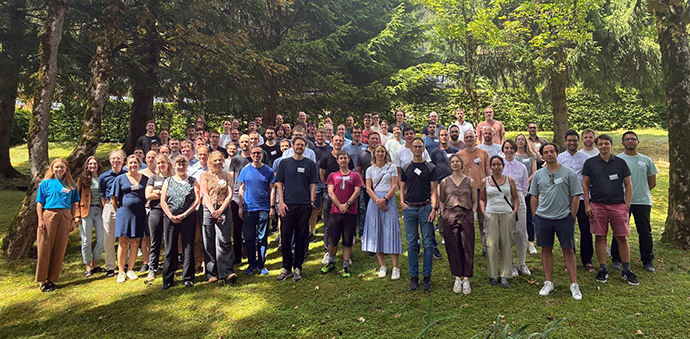
Project participants from 17 different national weather services.
ML transformation of the weather forecasting system
While ML weather prediction (MLWP) shares the same goals as current NWP systems – to provide reliable, accurate, and timely weather forecasts to support early warning decisions – MLWP introduces new requirements to datasets, models, software and infrastructure. Therefore, the MLP is organised around five interconnected work packages that cover the entire forecasting workflow.
One strand focuses on data-driven modelling, where teams are developing deterministic machine learning models capable of producing high-resolution forecasts at both regional and global scales. This includes limited-area models, stretched-grid systems and new approaches to downscaling forecasts to kilometre-scale resolution.
Another focuses on ensemble forecasting, exploring how ML can generate reliable probabilistic forecasts while taking advantage of the low inference cost of data-driven models.
While current operational MLWP systems rely on “classic” NWP data assimilation, there is increasing effort in establishing cutting-edge approaches to enable a fully data-driven NWP forecasting process from observations to predictions. The project is therefore also exploring a wide range of data assimilation methodologies, ranging from hybrid NWP/MLWP to fully machine-learned.
Supporting this are two cross-cutting work packages focused on operational deployment and knowledge sharing.
The MLOps and infrastructure work package addresses the significant technical challenges of deploying ML systems, while a dedicated training and support work package is helping to share expertise across the wider meteorological community, supporting organisations as machine learning becomes increasingly integrated into forecasting operations.
Shared infrastructure with Anemoi
The unifying software framework facilitating the MLP collaboration at scale is Anemoi, the open-source ML framework originally developed at ECMWF and now co-developed with European national meteorological services.
Anemoi provides an end-to-end framework for dataset curation, model training and graph selection, and inference (Figure 1).
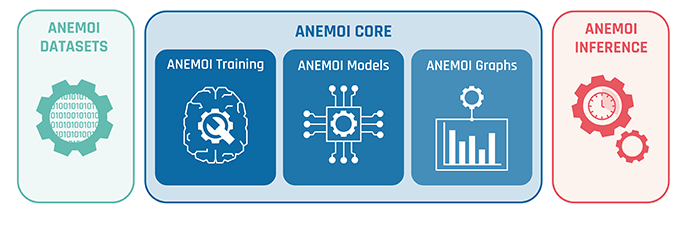
Figure 1: Overview of the Anemoi pipeline, from datasets through core components – training, models, and graphs – to inference.
This shared infrastructure helps improve reproducibility, supports collaboration and enables institutions to build on each other’s work more efficiently.
With a growing community and the first models progressing from experimental to operational status, the ambition of this collaboration is to seize the unique opportunity presented by these disruptive developments and create a sustainable European collaborative framework on data-driven weather forecasting.
Anemoi is co-developed with national meteorological services across Europe.
Early progress
After two years of successful implementation, the project is already generating results:
Comparison of ML modelling approaches
One example is the comparison of the two main modelling approaches explored for regional high-resolution forecasting: limited-area model (LAM) and the so-called stretched-grid model (SGM).
Using the European reanalysis dataset CERRA, both models were compared by collaborators from Belgium and the Netherlands. The results show that both approaches achieve similar forecasting accuracy, while LAM benefits from high-quality boundary forcing and SGM offers better scalability, self-contained operation, and stronger temporal generalisation for operational forecasting systems (Figure 2).
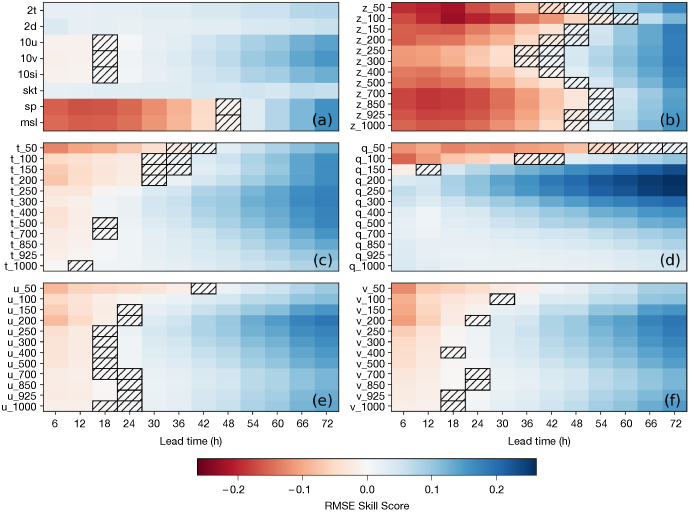
Figure 2: RMSE skill scores comparing the LAM and SGM approaches against the CERRA dataset at lead times from 6 to 72 hours. Blue indicates better performance by LAM, red indicates better performance by SGM, and hatched cells show no statistically significant difference. Taken from Wijnands et al., 2026.
Probabilistic modelling with the stretched-grid approach
Another area of development is probabilistic modelling.
With a probabilistic version of their model “Bris”, MET Norway spearheaded the work on probabilistic forecasting in the project. By combining stochastic forecasting with spectral Continuous Ranked Probability Score (CRPS) loss, it generates spatially coherent ensemble forecasts competitive with operational numerical weather prediction systems while greatly reducing computational cost (Figure 3).
As an example for the acceleration of model development cycles, MET Norway was able to move from deterministic to probabilistic to advanced probabilistic fast Fourier transform (FFT) within two years.
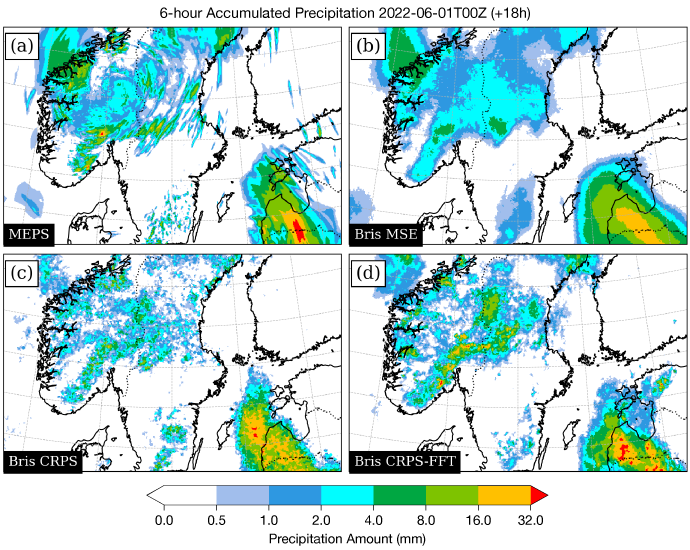
Figure 3: Comparison of 6‑hour accumulated precipitation forecasts over the Nordic region from MetCoOp Ensemble Prediction System (MEPS) and three versions of the Bris machine-learning model. Taken from Nordhagen et al., 2025.
Challenges and early lessons
Alongside its potential, ML weather prediction presents substantial technical challenges which the project addresses.
One such challenge is data quality and reliability. Models require large volumes of high-quality (e.g. reanalysis) data, robust training pipelines and careful validation.
To train reliable models, weather services have started to systematically build high-resolution regional datasets (e.g. CERRA), and to share pre-trained models among each other. The common use of resource-intensive assets such as pre-trained models is one promising way to reduce operational cost at each service in the future.
Reproducibility is another major challenge. Ensuring that results can be reproduced across different systems and computing environments requires careful management of software dependencies, datasets and configuration settings.
A challenge that arises naturally with the adoption of a new modelling approach is its integration and operational deployment in the existing production environment.
Machine learning operations (MLOps) maturity across participating meteorological services varies widely. Some organisations already have well-established ML pipelines, while others are still developing the necessary tools and workflows. Many workflows remain partly manual, particularly in areas such as data preparation and model validation. Automating these steps is essential for achieving reliable and scalable operations.
High-performance computing (HPC) constraints also shape many design decisions. Training large ML models requires significant computational resources, and integrating these workflows into existing HPC environments is not always straightforward.
These challenges highlight the strong need for shared standards, common infrastructure and clear best practices across the community.
What comes next?
Machine learning is steadily moving closer to operational use in weather forecasting. Projects like the MLP are helping to transform promising research into practical, reliable systems.
Since 2024, several machine learning models have become operational (e.g. ECMWF's Artificial Intelligence Forecasting System (AIFS) and the German National Meteorological Service's (DWD) Artificial Intelligence ICON (AICON)) or have entered production, such as MET Norway's Bris.
The next phase will likely see more ML models becoming part of operational workflows alongside traditional models, as well as progress regarding machine-learned data assimilation (such as AI-DOP) and ensemble generation to fully harness the advantages this new methodology presents to weather forecasting.
This transformation will not happen overnight. It will require sustained collaboration, continued investment in HPC infrastructure and ongoing refinement of tools and methods.
But the direction is clear. Machine learning is not just an experimental technology – it is becoming an integral part of the future forecasting landscape.
The value of collaboration lies in helping weather services adopting these new methodologies while effectively saving resources in the face of transformative change. The aim of the MLP is to leverage the community that has formed around Anemoi into a sustainable framework on data-driven weather forecasting.
Banner image credit: Based on © NicoElNino / iStock / Getty Images Plus