

A hybrid workshop titled ‘Artificial Intelligence and earth observation: From innovation to services' took place on 9–10 March in Brussels and online, bringing together Copernicus and Destination Earth (DestinE) users, Earth observation and digital service providers, policymakers, industry professionals, researchers, and IT experts to explore how artificial intelligence (AI) and machine learning (ML) are transforming Earth observation and environmental services.
ECMWF staff hosted dedicated sessions and presented keynotes on AI activities carried out in partnership with Member States, including in the EU’s DestinE initiative and Copernicus services. These activities span operational AI forecasting and downscaling capacities, AI-based Earth system modelling, open-source AI software frameworks, and the integration of AI workflows into high-performance computing (HPC) environments.
The workshop was jointly organised by the European Commission Directorate-General for Defence Industry and Space (DG DEFIS), the Directorate-General for Communications Networks, Content and Technology (DG CNECT), with the support of the Space Research Unit of the European Health and Digital Executive Agency (HaDEA).
Across two days of keynote talks, technical briefings, panel discussions and live demonstrations, participants discussed the opportunities and challenges related to AI/ML, big data and HPC, as well as changing user needs and expectations, including the demand for trustworthy AI-enabled products.
A recurring theme throughout the workshop was how Europe is accelerating the use of AI in weather prediction, Earth system modelling and environmental monitoring, building on strong public datasets, advanced computing infrastructure and collaborative research programmes.
AI at scale for weather and climate
During a keynote in the session ‘AI/ML Revolution’, Matthew Chantry, Strategic Lead for Machine Learning at ECMWF, delivered a presentation titled “Modelling and monitoring the Earth System: the AI revolution”. He spoke following opening remarks from Deputy Director-General Thomas Skordas (DG CONNECT) and Director Christoph Kautz (DG DEFIS). Matthew outlined how ECMWF and national meteorological services across Europe are harnessing the AI revolution to advance operational weather forecasting, through the development of Anemoi, an open-source, end-to-end software framework that enables building AI-based weather and climate applications.
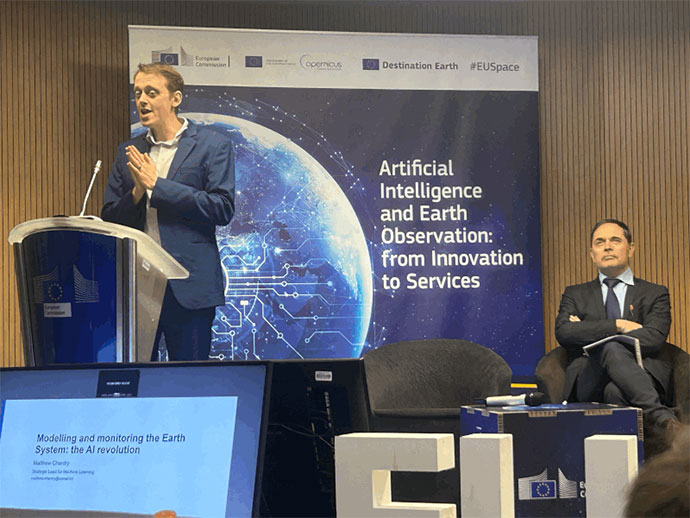
Matthew Chantry delivering a keynote on how ECMWF and European partners are driving the AI revolution in operational weather forecasting.
Anemoi provides the tools to transform trusted datasets – such as the Copernicus Climate Change Service ERA5 reanalysis – into AI-ready training data, to construct and train machine learning models, and to deploy them in operational environments.
Copernicus reanalyses, such as ERA5 and EAC4, have played a key role in enabling the recent surge of AI innovation in weather and atmospheric composition prediction. Anemoi already underpins several AI forecasting systems across Europe, including ECMWF’s Artificial Intelligence Forecasting System (AIFS), the German Meteorological Service's (DWD) AICON or MET Norway’s Bris, supporting their operational use.
Tiago Quintino, Head of the Development Section at ECMWF, spoke during the session ‘Big Data and HPC’.
His presentation focused on how ECMWF is expanding its software tooling and data engineering capabilities to build an end-to-end AI stack for weather and climate. Building on decades of expertise in numerical weather prediction and large-scale data management and processing, ECMWF transforms vast Earth system datasets into AI-ready training datasets and constructs and deploys scalable training and inference AI workflows across advanced supercomputing environments, including the EuroHPC systems in the context of DestinE. This ensures that AI models for weather forecasting and Earth system modelling can be trained, run and maintained reliably.
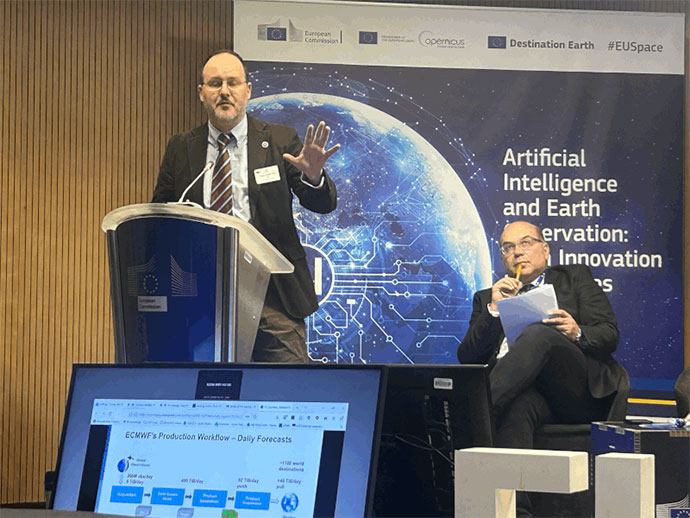
Tiago Quintino presenting on how ECMWF is building an end-to-end AI stack for weather and climate.
DestinE and Copernicus as central themes
DestinE and Copernicus were central themes throughout the workshop. The programme highlighted how Copernicus datasets such as the ERA5 reanalysis have provided the foundation for the AI revolution and that recent innovations, such as DestinE’s digital twins and the AI Earth system model components can be leveraged to drive further progress.
Sara Hahner, Machine Learning Scientist at ECMWF, presented DestinE’s AI Earth system approach during a session on digital twins and AI. She outlined how DestinE’s Digital Twins – on climate change adaptation and weather induced extreme events – generate high-resolution datasets that support the development of a new generation of AI models. Sara showcased how AI components for land, ocean, hydrology, sea ice and waves are being developed in DestinE and coupled with atmospheric models such as AIFS – paving the way towards a first AI-based Earth system model.
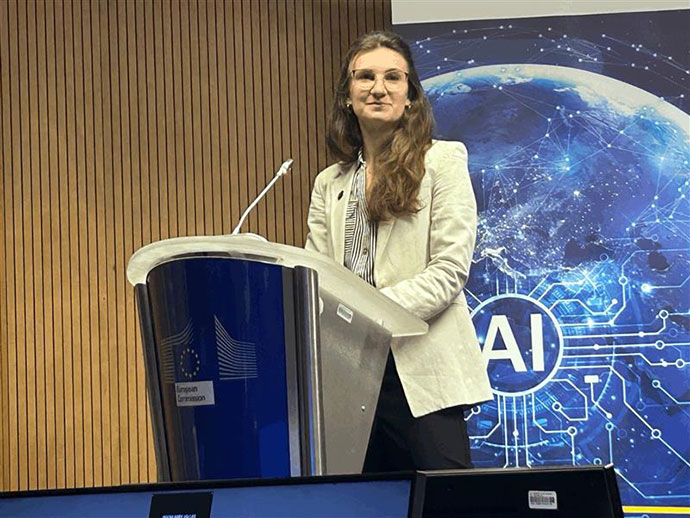
Sara Hahner presenting on DestinE's Digital Twins.
The workshop concluded with a session on the digital transformation of Earth observation services, chaired by Vincent-Henri Peuch, ECMWF Director for Engagement with the EU. Jenny Konkanen from CSC also contributed to this session, highlighting how DestinE’s Climate Change Adaptation Digital Twin supports both advanced climate simulations and the creation of AI-ready datasets that enable new applications for adaptation and resilience.
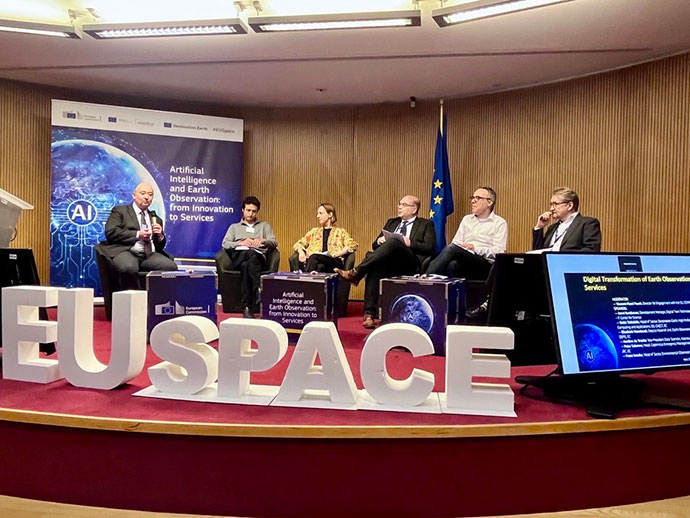
Vincent-Henri Peuch chairing a session on the digital transformation of Earth observation services.
Workshop discussions examined how the combination of reference datasets, high-resolution digital twins, AI modelling and HPC and software infrastructures enables more precise climate and weather simulations, providing stronger support for adaptation planning, risk assessment and policy design. The discussions also explored ways to further strengthen the synergies between Copernicus and DestinE, ensuring Europe remains at the forefront of this rapidly evolving field.