

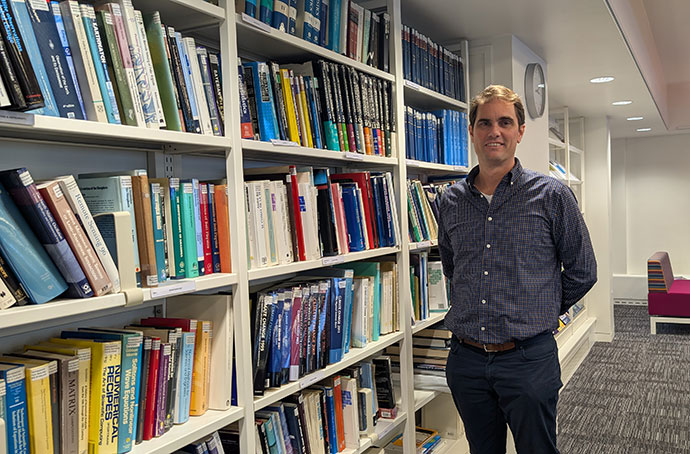
For almost a decade, David Lavers has been part of ECMWF’s Forecasts and Services Department, where he works as a scientist in the Climate Intelligence Team. His research spans the global water cycle, from evaluating precipitation forecasts to using observational campaign data to diagnose model performance for atmospheric rivers and extratropical cyclones.
In addition to this, he contributes to climate monitoring activities through the Copernicus Climate Change Service (C3S), including the monthly Climate Bulletins and the annual European State of the Climate (ESOTC) report.
A career journey shaped by weather and people
David’s fascination with meteorology began early. “I’ve always been interested in the outdoors and the weather,” he says. Growing up, a neighbour who had served on weather ships in the 1940s would recount stories about launching weather balloons in the North Atlantic. “He was very inspiring,” David remembers. “I still have a copy of his meteorology book.”
That early curiosity led him to study Meteorology at the University of Reading, followed by an MSc in Applied Meteorology and Climatology at the University of Birmingham. After a brief period working as a forecaster in Abu Dhabi, he returned to the UK to pursue a PhD in hydrology based at the Centre for Ecology and Hydrology (CEH) in Wallingford. During his doctoral studies, he spent nine months at Princeton University, working with the late Professor Eric Wood, who would later introduce him to the topic of atmospheric rivers. “There are many things that Eric taught me that still influence my work today,” David says.
Upon completion of his PhD, David undertook postdoctoral positions at the University of Reading, the University of Iowa, and the Scripps Institution of Oceanography in California, before joining ECMWF full-time in 2016. Each role added a new layer of experience and connection. “I’ve been very lucky to work with great people across different parts of the world,” he says. “Their advice still rings in my ears today.”
From rivers to atmospheric rivers
When David joined ECMWF in 2016, he worked on the Horizon 2020- funded IMPREX project, which aimed to improve forecasting of hydrological extremes such as river discharge across Europe. His role then expanded to broader forecast diagnostics, identifying model errors and evaluating forecasts, not just for rivers but for the global water cycle.
That shift has taken him from Europe’s river basins to the vast expanse of the North Pacific Ocean. David is now involved in a field campaign known as Atmospheric River Reconnaissance (AR Recon), which aims to improve the prediction of landfalling atmospheric rivers. Atmospheric rivers are long, narrow features that transport vast quantities of water vapour through the atmosphere, often driving heavy rain and flooding when they make landfall.
The campaign involves deploying dropsondes from aircraft, as well as ocean buoys that measure key parameters across the North Pacific. These data feed into ECMWF’s Integrated Forecasting System (IFS) and others worldwide, helping to improve the initial conditions for weather predictions.
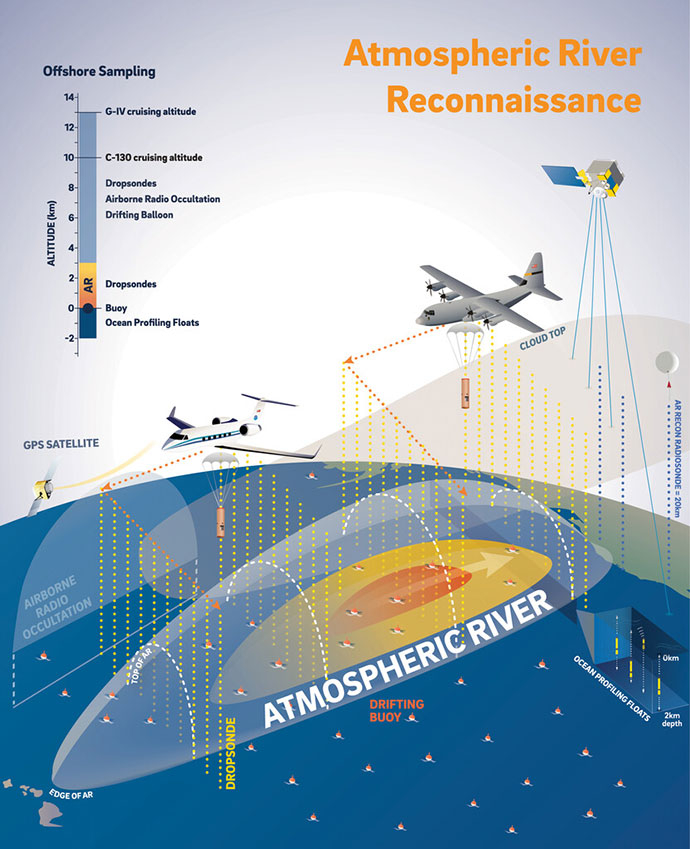
A schematic illustrating the Atmospheric River Reconnaissance program. This is taken from Lavers et al. (2024) and is updated from a schematic first published in Zheng et al. (2021).
Bridging science and impact
Today, David splits his time equally between forecast diagnostics and climate monitoring.
On the climate monitoring side, David has served as an editor for the European State of the Climate (ESOTC) report for the past five years, contributing to sections on precipitation, river discharge, soil moisture, atmospheric circulation, clouds and solar radiation. He also helps produce the monthly C3S Climate Bulletins, which are shorter updates summarising the state of global and European temperatures and other key variables. “They’re like a health check for the planet,” he says.
His research also looks at how accurately current datasets measure precipitation and how such information can be better communicated. “Some of these datasets are the best we have, but it’s important to understand their limitations and how to express that clearly,” he explains.
A highlight at sea
A highlight of David’s came recently through collaboration between American and European teams to fill observational data gaps in the Mediterranean, a region prone to extreme weather but with relatively few in situ measurements.
Working with partners, ECMWF supported the release of 15 drifting buoys into the Ionian Sea and central Mediterranean. These buoys can operate for up to two years, depending on ocean currents and eddies, and provide valuable sea-level pressure data that feed directly into ECMWF’s IFS, improving forecast accuracy for the region.
“I’m really proud of this work,” he says. “It gives me great joy being part of a group that is making a real impact.”
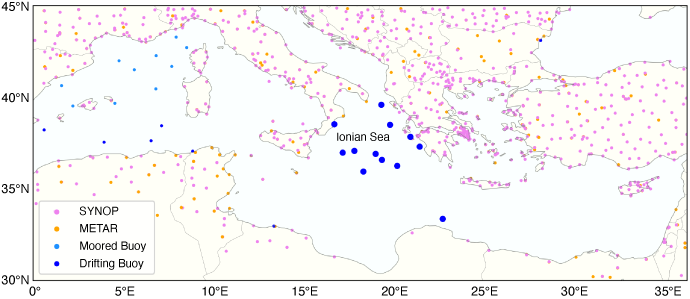
Surface pressure observations, excluding those from ships, in the Mediterranean on 27 November 2025, 00 UTC. The large dark blue markers refer to the seven newly deployed drifting buoys in the Ionian Sea and central Mediterranean.
Looking ahead
The next few years promise to be especially active for David and his collaborators. The AR Recon programme continues to expand across the North Pacific and beyond, and will be joined in 2026 by other campaigns in North America and Europe. “Each campaign has its own science aims,” he says, “but together they are forming a global effort to see whether these additional observations can really make a difference to forecasting skill, whether that’s on a hemispheric scale, regionally, or for specific extreme events.”
As for what’s changed most in his field, he points to the rise of artificial intelligence. “AI has been a huge change – it’s grown tremendously,” he says.