

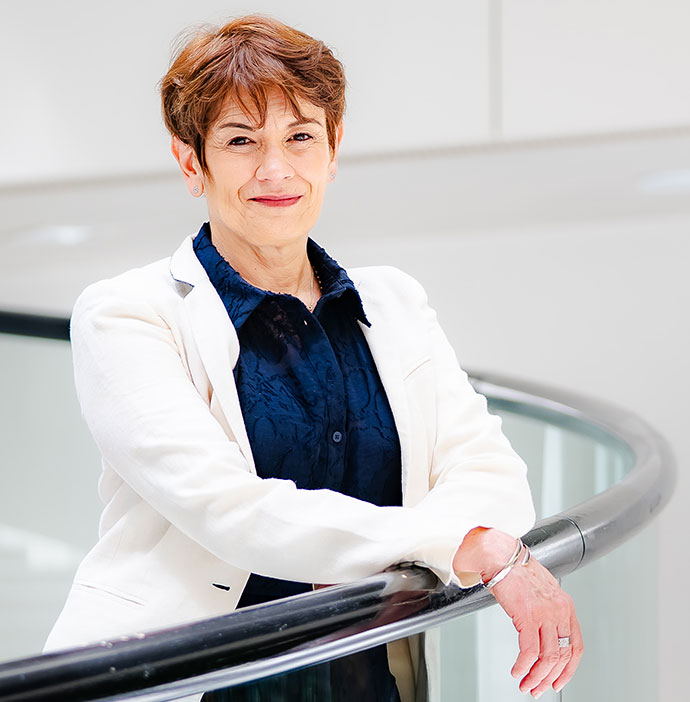
On International Day of Women and Girls in Science (11 February 2026), we spoke to Laurence Rouil, Director of the Copernicus Atmosphere Monitoring Service (CAMS), about her less-than-conventional route into atmospheric science and the advice she has for women and girls considering a career in STEM.
The conversation comes shortly after the release of the Global Climate Highlights report, published last month, which included key input from CAMS and underlined the role of greenhouse gases in driving climate change.
A career that didn’t begin with science
A career in science was not an obvious choice for Laurence at first. Growing up in France, she imagined herself becoming a teacher – “and not even a science teacher,” she says – and was drawn instead to subjects such as history, geography and archaeology.
What set her on a different path was her aptitude for maths and science. “I was always good at maths and science, and at that time in France, if you were good at those things, it was important you did something with it,” she explains.
She went on to engineering school, to university, and completed a PhD in applied maths. Reflecting on the journey, she says: “At school, the age-old question is, ‘how will I use this once school is over?’ But in my case, it’s been essential and I’ve made a career from it.”
An unconventional route into atmospheric science
Laurence’s early career did not follow the most direct route into atmospheric research. “I actually started working on military applications, mathematical questions, but for defence. I became a modeller, modelling physics."
“What is fascinating with numerical modelling is how with just a few equations and smart ways to solve them you can simulate stuff around you and when you compare it, through experiments to reality, it actually works!”
Eager to investigate other areas beyond defence, she started working for Électricité de France (EDF) on nuclear materials. From there, she joined INERIS, the French National Institute for Industrial Environment and Risks, where she would spend the next 25 years.
“At the time of starting that role, I didn’t know about atmospheric chemistry modelling, but it was again dealing with equations.” Laurence quickly built up a team dedicated to air quality modelling and engaged with researchers in France on behalf of the organisation.
Building networks and a national air quality forecasting system
Collaboration has been central throughout Laurence’s career. “We can’t do anything alone,” she says. Working closely with trusted colleagues, she helped create France’s first air quality forecasting system.
The breakthrough came during the 2003 summer heatwave, when Laurence and her team tested their early model. “The system worked very well to predict ozone concentrations,” she explains. Its success led the French Minister of the Environment to task INERIS, with whom Laurence still collaborates today via CAMS, with implementing it nationally – an achievement she remains proud of more than two decades on.
In 2014, Laurence was elected as the chair of the scientific programme of the regional UN Air convention, the Convention on Long-Range Transboundary Air Pollution, that deals with transboundary air pollution. She engaged in this role for more than 10 years and says the experience helped shape her mindset.
Leading CAMS
After more than two decades at INERIS, where she was the Director of Research and Strategy, Laurence spotted the vacancy for Director of CAMS. She hesitated. “I only knew a small part of the service” she admits. But she was drawn to the unique chance to work for ECMWF, the chance to engage with the space community and the opportunity to broaden her expertise and network. Encouraged by her family, she applied.
Advice for the next generation of scientists
Laurence wants to convey this message of taking opportunities to women and girls who may be reluctant to take the next step in their science journey, through uncertainty or lack of confidence in their abilities.
“My message is to stay open-minded and curious to new ideas and ways of working. Don’t be afraid of what you don’t know, ask someone to explain, stay fair and honest, and remember there’s no such thing as a stupid question.”
Laurence explains it’s also about not being afraid to rely on others.
“Being a director, you are not necessarily the best in all fields; you certainly have a broad overview of the stakes and perhaps you just know how to put things together and connect the dots. You must trust your team to help build up your knowledge, and sometimes that’s hard because you can’t control things, but then we always have the opportunity to learn from mistakes. It’s important to empower your team too, so they know the value of their role.”
A long-standing connection with CAMS
Although Director now, Laurence has been involved in CAMS right from its inception. While at INERIS, Laurence contributed to the development and implementation of some parts of CAMS.
“To see how CAMS has evolved since those early days is incredible,” she says. “The pace of development just keeps getting faster.”
“Monitoring atmospheric pollutants is crucial for human health and the environment, and to be involved in something so important is a privilege. New space missions, the enhancement of computing capacities and artificial intelligence bring fascinating opportunities, and it is really exciting to play a little role in shaping them.”
CAMS, implemented by ECMWF on behalf of the European Commission, monitors the presence of air pollutants and greenhouse gases in the atmosphere. It delivers forecasts, daily analyses and past re-analyses of air pollution events, whether they are driven by human activities such as road traffic, industry, residential heating or agriculture, or natural sources, such as dust storms or wildfires.
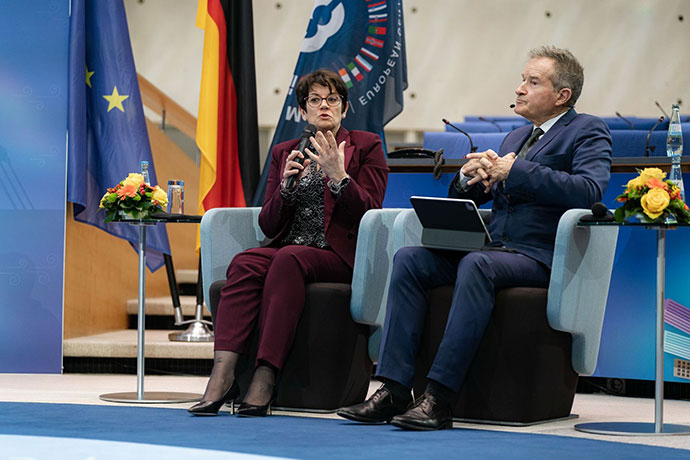
Laurence (left) speaking at the Clean Air Forum. Credit: European Commission, photographer Andreas Jahn.
Towards cleaner air
Laurence was recently a keynote speaker at the Clean Air Forum, hosted by ECMWF in Bonn, where she spoke about progress towards cleaner air and the importance of strong regulation, cleaner technologies and sustained international cooperation.
“There’s still a long way to go,” she says, “but I am confident that with this recipe of ingredients, we can continue to bring down the level of pollutants in the atmosphere. I am delighted that I continue to play my part in that goal and look forward to seeing where upcoming generations will take things in the future.”