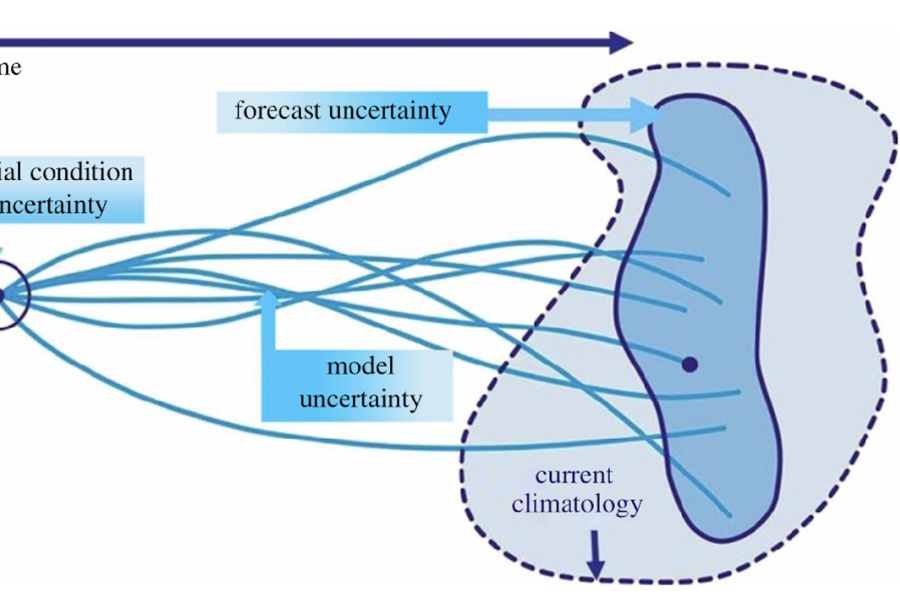
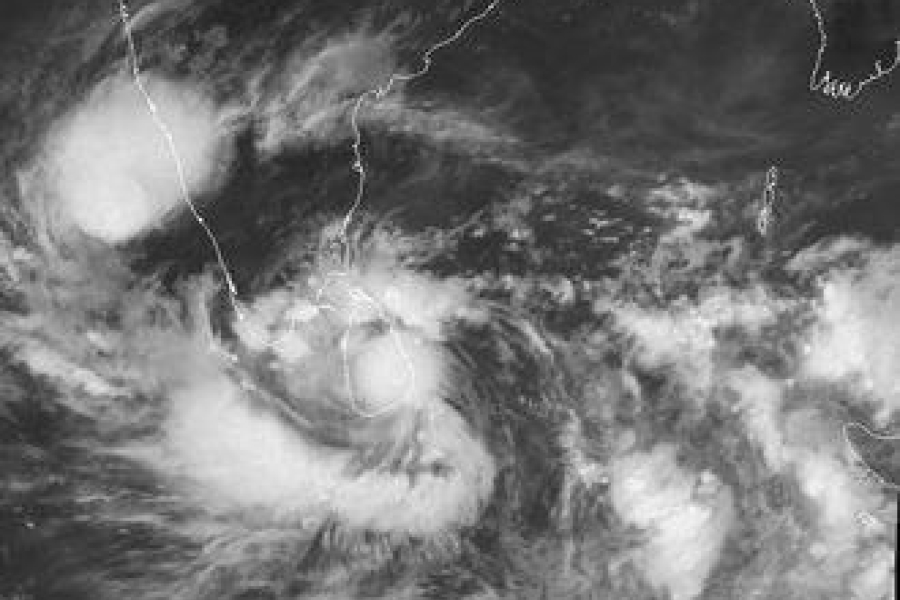
Learn about the main sources of uncertainty in weather forecasting and how they are addressed in early warning systems.
Learn about the various data sources, and strategies to find climate data: processing, choosing projections, scenarios, ensembles and variables.
This lesson teaches about sources of uncertainty in climate projections, what robust signals are, and when we can be confident in a change.
Learn how climate change will affect the energy sector, which energy-related data and indicators are available from the CDS, and how these can be used in applications.
This lesson covers key processes in ice and mixed-phase clouds and precipitation, and parametrization uncertainties.
This lesson will take you through what convection is and the phenomena it causes.
This lesson looks at the three classes of parametrization schemes and the main characteristics of the IFS scheme.
Explore the key microphysical and warm-phase processes of cloud and precipitation parametrisation and their use in NWP.
Explore sources of uncertainty in NWP and how this is represented in the IFS using stochastic physics.
This lesson focuses on ECGATE - ECMWF's server allocated for users' tasks, from submitting jobs to correcting errors.
Four case studies exploring the conditions that cause deep convection, considering predictability and forecast errors.
How SCM is used to investigate the physical processes of a global model in isolation, its applications and limitations.