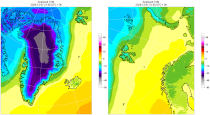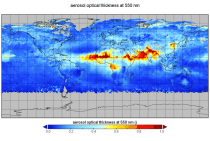
This data set provides observational records of aerosol properties obtained from observations collected by various satellite instruments. Aerosols are minor constituents of the atmosphere by mass, but critical components in terms of impact on climate. Aerosols influence the global radiation balance directly by scattering and absorbing radiation, and indirectly through influencing cloud reflectivity, cloud cover and cloud lifetime.

calendar_today Interval/period: Thu, 06/01/1995 - Thu, 07/31/2025
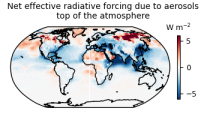
This dataset provides geographical distributions of the radiative forcing (RF) by key atmospheric constituents. The radiative forcing estimates are based on the CAMS reanalysis and additional model simulations and are provided separately for...

carbon dioxide
methane
tropospheric ozone
stratospheric ozone
interactions between anthropogenic aerosols and radiation
interactions between anthropogenic aerosols and clouds

calendar_today Interval/period: Wed, 01/01/2003 - Sun, 12/31/2017
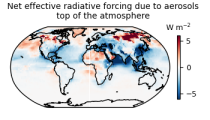
This dataset provides geographical distributions of the radiative forcing (RF) by key atmospheric constituents. The radiative forcing estimates are based on the CAMS reanalysis and additional model simulations and are provided separately for...
    - carbon dioxide
    - methane
    - tropospheric ozone
    - stratospheric ozone
    - interactions between anthropogenic aerosols and radiation

calendar_today Interval/period: N/A

EAC4 (ECMWF Atmospheric Composition Reanalysis 4) is the fourth generation ECMWF global reanalysis of atmospheric composition. Reanalysis combines model data with observations from across the world into a globally complete and consistent dataset using a model of the atmosphere based on the laws of physics and chemistry.

calendar_today Interval/period: Wed, 01/01/2003 - Thu, 10/31/2024
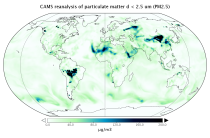
EAC4 (ECMWF Atmospheric Composition Reanalysis 4) is the fourth generation ECMWF global reanalysis of atmospheric composition. Reanalysis combines model data with observations from across the world into a globally complete and consistent dataset using a model of the atmosphere based on the laws of physics and chemistry.

calendar_today Interval/period: N/A

EAC4 (ECMWF Atmospheric Composition Reanalysis 4) is the fourth generation ECMWF global reanalysis of atmospheric composition. Reanalysis combines model data with observations from across the world into a globally complete and consistent dataset using a model of the atmosphere based on the laws of physics and chemistry.

calendar_today Interval/period: Wed, 01/01/2003 - Sun, 12/31/2023
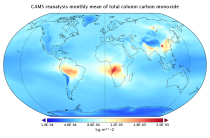
EAC4 (ECMWF Atmospheric Composition Reanalysis 4) is the fourth generation ECMWF global reanalysis of atmospheric composition. Reanalysis combines model data with observations from across the world into a globally complete and consistent dataset using a model of the atmosphere based on the laws of physics and chemistry.

calendar_today Interval/period: N/A

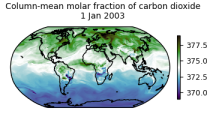
This dataset provides atmospheric CO₂ observations as derived from satellite radiances. It consists of two types of products each covering a different part of the atmosphere: (i) The average CO₂ mixing ratio of the entire atmosphere from the Earth’s surface to the top of the atmosphere. These column-averaged mixing ratio products are referred to as “XCO2” products. (ii) Mid-tropospheric (MT) CO₂ mixing ratio products. These products are referred to as "MTCO2" products. These products can be used to monitor the spatial distribution and temporal evolution of CO₂.

calendar_today Interval/period: Tue, 10/01/2002 - Mon, 06/30/2025
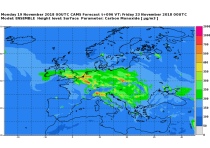
This dataset provides daily air quality analyses and forecasts for Europe.

calendar_today Interval/period: N/A

This dataset provides annual air quality reanalyses for Europe based on both unvalidated and validated observations.

calendar_today Interval/period: Tue, 01/01/2013 - Tue, 12/31/2024
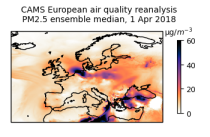
This dataset provides annual air quality reanalyses for Europe based on both unvalidated (interim) and validated observations.

calendar_today Interval/period: N/A

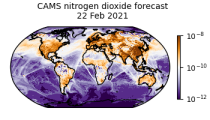
CAMS produces global forecasts for atmospheric composition twice a day. The forecasts consist of more than 50 chemical species (e.g. ozone, nitrogen dioxide, carbon monoxide) and seven different types of aerosol (desert dust, sea salt, organic matter, black carbon, sulphate, nitrate and ammonium aerosol). In addition, several meteorological variables are available as well.

calendar_today Interval/period: N/A

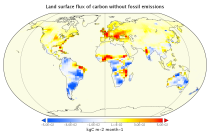
This dataset is part of the ECMWF Atmospheric Composition Reanalysis focusing on long-lived greenhouse gases: carbon dioxide (CO2) and methane (CH4). The emissions and natural fluxes at the surface are crucial for the evolution of the long-lived greenhouse gases in the atmosphere. In this dataset the CO2 fluxes from terrestrial vegetation are modelled in order to simulate the variability across a wide range of scales from diurnal to inter-annual.

calendar_today Interval/period: Wed, 01/01/2003 - Thu, 12/31/2020
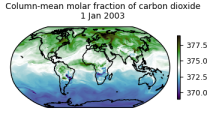
This dataset is part of the ECMWF Atmospheric Composition Reanalysis focusing on long-lived greenhouse gases: carbon dioxide (CO2) and methane (CH4). The emissions and natural fluxes at the surface are crucial for the evolution of the long-lived greenhouse gases in the atmosphere. In this dataset the CO2 fluxes from terrestrial vegetation are modelled in order to simulate the variability across a wide range of scales from diurnal to inter-annual.

calendar_today Interval/period: N/A

This dataset is part of the ECMWF Atmospheric Composition Reanalysis focusing on long-lived greenhouse gases: carbon dioxide (CO2) and methane (CH4). The emissions and natural fluxes at the surface are crucial for the evolution of the long-lived greenhouse gases in the atmosphere. In this dataset the CO2 fluxes from terrestrial vegetation are modelled in order to simulate the variability across a wide range of scales from diurnal to inter-annual.

calendar_today Interval/period: Wed, 01/01/2003 - Thu, 12/31/2020
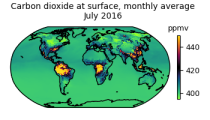
This dataset is part of the ECMWF Atmospheric Composition Reanalysis focusing on long-lived greenhouse gases: carbon dioxide (CO2) and methane (CH4). The emissions and natural fluxes at the surface are crucial for the evolution of the long-lived greenhouse gases in the atmosphere. In this dataset the CO2 fluxes from terrestrial vegetation are modelled in order to simulate the variability across a wide range of scales from diurnal to inter-annual.

calendar_today Interval/period: N/A

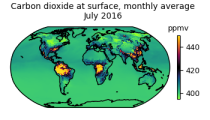
This data set contains net fluxes at the surface, atmospheric mixing ratios at model levels, and column-mean atmospheric mixing ratios for carbon dioxide (CO2), methane (CH4) and nitrous oxide (N20).

calendar_today Interval/period: Mon, 01/01/1979 - Wed, 12/31/2025
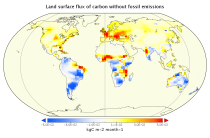
This data set contains net fluxes at the surface, atmospheric mixing ratios at model levels, and column-mean atmospheric mixing ratios for carbon dioxide (CO2), methane (CH4) and nitrous oxide (N20).

calendar_today Interval/period: N/A

The daily and monthly data of the C3S Arctic Regional Reanalysis (CARRA) dataset contains daily and monthly meteorological variables at 2.5 km resolution. This includes fields at the single levels (including surface) and on pressure, height, soil and model levels.
These daily and monthly data are pre-calculated and have the following types depending on the variables: daily and monthly averages, extremes and totals.

calendar_today Interval/period: Sat, 09/01/1990 - Sat, 02/28/2026
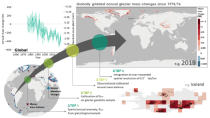
The dataset provides global annual glacier mass changes distributed on a global regular grid at 0.5° resolution (latitude, longitude) based on the Fluctuations of Glaciers (FoG) database of the World Glacier Monitoring Service (WGMS). Glaciers play a fundamental role in the Earth’s water cycles. They are one of the most important freshwater resources for societies and ecosystems and the recent increase in ice melt contributes directly to the rise of ocean levels.

calendar_today Interval/period: Wed, 01/01/1975 - Sun, 07/05/2026
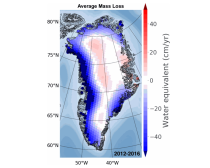
This dataset provides a complete archive of monthly mass change timeseries for the drainage basins of the Antarctic and Greenland Ice Sheets from NASA's Gravity Recovery and Climate Experiment (GRACE) and GRACE Follow On (GRACE-FO) mission, which have operated from 2002 to current data.

calendar_today Interval/period: Wed, 01/01/2003 - Sat, 12/31/2022
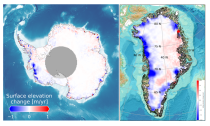
This dataset provides estimates of surface elevation change over the Greenland and Antarctic ice sheets since 1992, utilizing satellite radar altimetry from five missions: ERS-1, ERS-2, ENVISAT, CryoSat-2, and Sentinel-3A. The surface elevation change is modelled over successive, overlapping periods and reported monthly.

calendar_today Interval/period: Wed, 01/01/1992 - Sun, 07/05/2026
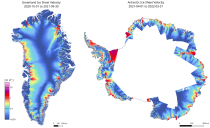
This dataset provides annual ice velocity maps of the Greenland and Antarctic Ice Sheets derived from Sentinel-1 data. The product represents the current state-of-the-art in Europe for satellite-based ice velocity data records. It follows from the European Space Agency (ESA) Climate Change Initiative (CCI) and is guided by the Global Climate Observing System (GCOS) targets for the Ice Sheets Essential Climate Variable (ECV).

calendar_today Interval/period: Sun, 10/01/2017 - Sun, 07/05/2026
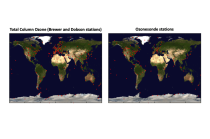
This dataset provides access to two types of ozone observations: total column ozone estimates and vertical profiles of ozone concentration.
The total ozone estimates are based on solar UV radiation measurements made by ground-based spectrophotometers (Dobson or Brewer type spectrophotometers).
The vertical profiles of ozone concentration are estimated primarily using ozonesonde observations.
Data are available for 159 Dobson stations, 109 Brewer stations and 135 ozonesondes stations.

calendar_today Interval/period: Tue, 01/01/1924 - Sun, 07/05/2026
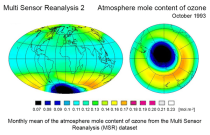
This dataset provides monthly averaged ozone values derived from a large set of satellite sensors with global coverage. Ozone is naturally formed in the atmosphere through the interaction between molecular oxygen and solar radiation. In the stratosphere, it acts as a shield protecting us from the UV radiation emitted by the Sun. At ground level however, it is a human health irritant and a component of smog. Ozone and climate change are strongly related.

calendar_today Interval/period: Wed, 04/01/1970 - Tue, 07/01/2025