
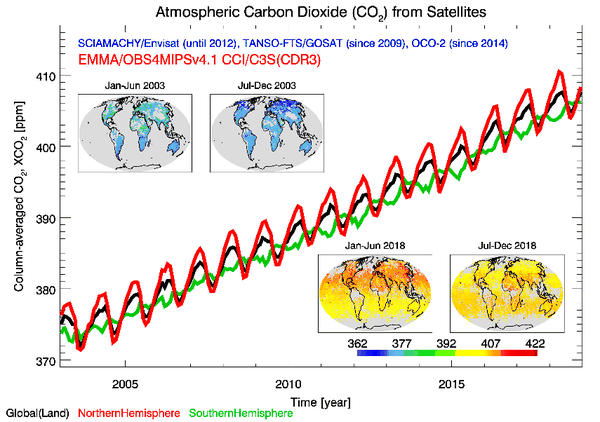
This dataset provides atmospheric CO₂ observations as derived from satellite radiances. It consists of two types of products each covering a different part of the atmosphere: (i) The average CO₂ mixing ratio of the entire atmosphere from the Earth’s surface to the top of the atmosphere. These column-averaged mixing ratio products are referred to as “XCO2” products. (ii) Mid-tropospheric (MT) CO₂ mixing ratio products. These products are referred to as "MTCO2" products. These products can be used to monitor the spatial distribution and temporal evolution of CO₂. This is important as CO₂ is the most important anthropogenic so-called greenhouse gas driving global warming and associated climate change. CO₂ time series show an annual cycle primarily due to uptake and release of CO₂ by the terrestrial biosphere (but also due to ocean uptake and release) and a general increase due to burning of fossil fuels (oil, gas, coal). The annual increase of CO₂ shows significant inter-annual variations, due to variations of the (e.g., weather related) uptake and release of CO₂ by the natural CO₂ sources and sinks. The dataset can be used for a number of climate related applications: It can be used in combination with appropriate modelling (e.g., inverse modelling) to obtain information on CO₂ sources and sinks, to assess the quality of climate models, to generate (e.g., forcing) input data as used by climate models, to determine the atmospheric CO₂ growth rate, etc.
The XCO2 and MTCO2 satellite-derived data products complement networks of surface observations. Typically, surface observations are more accurate, but they are also sparse whereas the satellite observations cover large parts of the world not observed from the ground. The XCO2 and MTCO2 datasets are generated by applying so called retrieval algorithms to satellite radiance measurements. The XCO2 products are based on measurements of reflected solar radiation in the short-wave near-infrared (SWIR) spectral region. These measurements are sensitive to CO₂ changes in the entire atmospheric vertical column down to the Earth surface. This implies that the observations are limited to essentially cloud-free conditions. Strict quality filtering is applied to the data products to achieve highest possible data quality. Whereas generation of the XCO2 products requires reflected solar radiation, i.e., daytime observation conditions, the MT products have been generated from radiance measurements in the thermal infrared (TIR) spectral region. These measurements can be conducted day and night and therefore have a much better spatio-temporal coverage compared to the XCO2 data. These measurements have maximum sensitivity for CO₂ variations in the mid-troposphere and only limited sensitivity to CO₂ changes near the ground. The two types of datasets are therefore highly complementary as they contain different information on atmospheric CO₂.
The dataset consists of 2 types of products:
column-averaged mixing ratios of CO₂, denoted XCO2
mid-tropospheric CO₂ columns, denoted MTCO2.
The XCO2 products have been retrieved from SCIAMACHY/ENVISAT, TANSO-FTS/GOSAT, TANSO-FTS2/GOSAT2 and OCO-2. The mid-tropospheric CO₂ product has been retrieved from the IASI instruments on-board the Metop satellite series and from AIRS. The XCO2 products are available as Level 2 (L2) products (satellite orbit tracks) and as Level 3 (L3) product (gridded). The XCO2 L2 products are available as individual sensor products (SCIAMACHY: BESD and WFMD algorithms; GOSAT: OCFP and SRFP algorithms; GOSAT-2: SRFP algorithm) and as a multi-sensor merged product (EMMA algorithm). The L3 XCO2 product is generated by gridding the corresponding EMMA Level 2 product and is provided in OBS4MIPS format. The IASI and AIRS Level 2 products are generated with the NLIS algorithm. The IASI Level 3 products are generated by merging and gridding the corresponding Level 2 products and are available in OBS4MIPS format. The XCO2 L3 dataset will be updated on a yearly basis, with each update cycle adding a new data version for the entire period, up to one year behind real time. The MTCO2 L3 dataset will be updated every 6 months. The L2 data ends in 2022.
This dataset is produced on behalf of C3S with the exception of the SCIAMACHY and AIRS L2 products that were generated in the framework of the GHG-CCI project of the European Space Agency (ESA) Climate Change Initiative (CCI).
The XCO2 and MTCO2 satellite-derived data products complement networks of surface observations. Typically, surface observations are more accurate, but they are also sparse whereas the satellite observations cover large parts of the world not observed from the ground. The XCO2 and MTCO2 datasets are generated by applying so called retrieval algorithms to satellite radiance measurements. The XCO2 products are based on measurements of reflected solar radiation in the short-wave near-infrared (SWIR) spectral region. These measurements are sensitive to CO₂ changes in the entire atmospheric vertical column down to the Earth surface. This implies that the observations are limited to essentially cloud-free conditions. Strict quality filtering is applied to the data products to achieve highest possible data quality. Whereas generation of the XCO2 products requires reflected solar radiation, i.e., daytime observation conditions, the MT products have been generated from radiance measurements in the thermal infrared (TIR) spectral region. These measurements can be conducted day and night and therefore have a much better spatio-temporal coverage compared to the XCO2 data. These measurements have maximum sensitivity for CO₂ variations in the mid-troposphere and only limited sensitivity to CO₂ changes near the ground. The two types of datasets are therefore highly complementary as they contain different information on atmospheric CO₂.
The dataset consists of 2 types of products:
column-averaged mixing ratios of CO₂, denoted XCO2
mid-tropospheric CO₂ columns, denoted MTCO2.
The XCO2 products have been retrieved from SCIAMACHY/ENVISAT, TANSO-FTS/GOSAT, TANSO-FTS2/GOSAT2 and OCO-2. The mid-tropospheric CO₂ product has been retrieved from the IASI instruments on-board the Metop satellite series and from AIRS. The XCO2 products are available as Level 2 (L2) products (satellite orbit tracks) and as Level 3 (L3) product (gridded). The XCO2 L2 products are available as individual sensor products (SCIAMACHY: BESD and WFMD algorithms; GOSAT: OCFP and SRFP algorithms; GOSAT-2: SRFP algorithm) and as a multi-sensor merged product (EMMA algorithm). The L3 XCO2 product is generated by gridding the corresponding EMMA Level 2 product and is provided in OBS4MIPS format. The IASI and AIRS Level 2 products are generated with the NLIS algorithm. The IASI Level 3 products are generated by merging and gridding the corresponding Level 2 products and are available in OBS4MIPS format. The XCO2 L3 dataset will be updated on a yearly basis, with each update cycle adding a new data version for the entire period, up to one year behind real time. The MTCO2 L3 dataset will be updated every 6 months. The L2 data ends in 2022.
This dataset is produced on behalf of C3S with the exception of the SCIAMACHY and AIRS L2 products that were generated in the framework of the GHG-CCI project of the European Space Agency (ESA) Climate Change Initiative (CCI).
Interval
-
DOI
10.24381/cds.f74805c8
Portal
Climate Data Store
Product Family
Data
Product Type
Satellite observations
Spatial Coverage
Global
Temporal Coverage
Past
Variable Domain
Atmosphere (composition)