
Numerical weather forecasting starts with estimating the current state of the atmosphere. At ECMWF, this is done through data assimilation, using four-dimensional variational data assimilation (4D-Var) to combine observations from satellites, weather stations, aircraft and other sources with a short-range forecast. This produces an analysis that initialises the next forecast.
Over the past few years, research carried out at ECMWF has explored a different approach, artificial intelligence (AI)-DOP (Direct Observation Prediction) investigating whether AI models can learn to forecast directly from observations, without relying on an atmospheric analysis. Experiments have demonstrated the potential of this observation-driven approach to produce skilful medium-range forecasts.
The next step is to move beyond research experiments, run on past cases, towards real-time forecasting. Instead of working with carefully prepared historical data, the model must handle observations as they arrive, including gaps, delays and quality issues.
Over the past year, we have developed a prototype that connects AI-DOP models directly to ECMWF’s real-time observation-processing infrastructure, allowing forecasts to be produced within minutes of the latest observations arriving. This brings exciting new opportunities for time-critical forecast delivery, but also presents challenges, from real-time observation quality control to handling planned and unplanned changes in the global observing system.
AI-DOP model
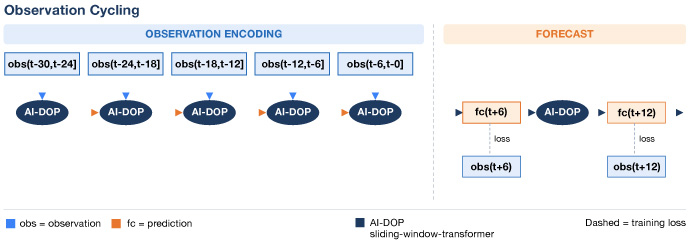
Figure 1: AI-DOP cycles through five 6-hour observation windows (30 h) before producing forecasts, which are trained directly on observations.
AI-DOP is an approach in which a machine-learning model learns to forecast directly from observations, without relying on a real-time atmospheric analysis from ECMWF’s Integrated Forecasting System (IFS) for initialisation, or historical reanalysis for training.
The AI-DOP model used currently is a version of the Artificial Intelligence Forecasting System (AIFS), trained exclusively on gridded observations using Anemoi, the open-source AI software infrastructure jointly developed by ECMWF and several national meteorological services across Europe. It is based on an encoder–processor–decoder architecture where the encoder maps observations into a latent representation, the processor learns how the atmospheric state evolves, and the decoder produces gridded predictions in observation space.
In the prototype configuration, the model steps through the latest 30-hours of observations in six-hour windows to establish an initial state from which the forecast is then initialised, as illustrated in Figure 1.
AI-DOP currently operates with only a limited subset of the available observations. These include microwave soundings from AMSU-A, ATMS and MHS; infrared soundings from IASI and CrIS; ASCAT scatterometer winds; GNSS radio occultation measurements; surface observations from SYNOP stations, buoys and ships; and upper-air observations from radiosondes, aircraft and atmospheric motion vectors (AMVs). Observations from microwave imagers will be added soon.
The system is highly configurable and computationally efficient. We run two models in parallel every day, one operating at coarser resolution, on an O96 grid (~100 km) and a version at higher spatial resolution, on the N320 grid (~30 km, same resolution as the AIFS and ERA5).
From an offline experiment to a real-time forecast
During its development, AI-DOP was tested and evaluated on past periods under controlled experimental conditions and with fixed observation inputs. However, for real-time forecasting, the model needs to work with whichever observations arrive, as they arrive, and not rely on a carefully prepared dataset in which all observations inputs are known in advance. Effectively, it must deal with the same continuously changing observing system faced by ECMWF’s operational forecasting systems, IFS and AIFS. To make this possible, we designed and built the real-time prototype around ECMWF's existing operational observation infrastructure.
Observations are acquired and pre-processed through the Scalable Acquisition and Pre-Processing System (SAPP). SAPP already provides a common way of consolidating the large number of observations arriving in different formats and is used as part of the operational workflow supporting 4D-Var. This infrastructure was adapted so that the same repository can provide observations to both 4D-Var and AI-DOP. For AI-DOP, the processing runs continuously, in step with SAPP's ten-minute cycle. The observations are transformed into the machine-learning-friendly format required by the model and made available for inference. This granularity means that, in principle, there is nothing fundamentally preventing the system from producing forecasts much more frequently, with hourly or even half-hourly updates possible.
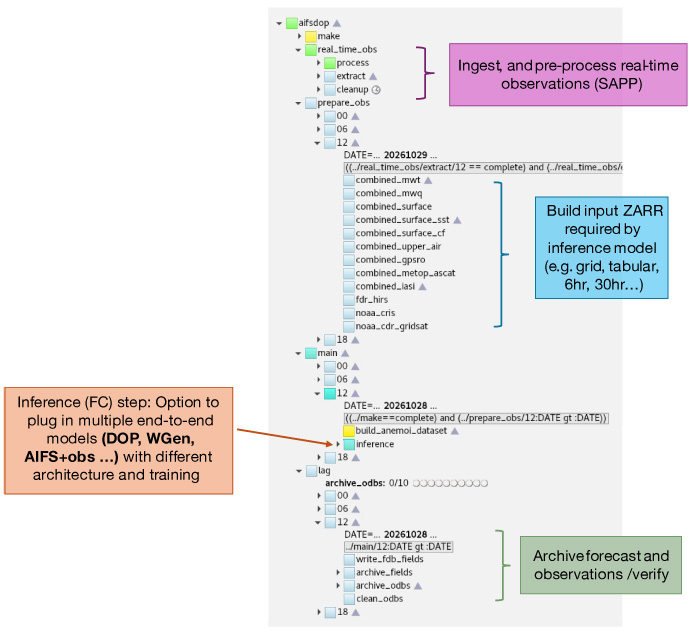
Figure 2: The ecFlow suite for real-time AI-DOP forecasts. Observations are ingested and pre-processed through SAPP (real_time_obs). They are then converted into the input datasets the model needs for each observation type (prepare_obs). These feed the inference step (main), which can run any end-to-end model from a checkpoint. Forecasts and observations are then archived for verification (lag).
The real-time workflow is run by an ecFlow suite (Figure 2). Observations pre-processed through SAPP are then converted into the input dataset the model expects. The inference step produces the forecast, and the forecasts and observations are archived for verification. In this setup, moving from research to operations (R2O) becomes much simpler. The inference task just points to a trained model checkpoint, so deploying a new version of AI-DOP means changing that pointer rather than re-engineering the workflow.
The same setup also makes it possible to plug in other end-to-end models with different architectures and training, such as Weather Generator or, in the future, AIFS with observations, and run them side by side using the same real-time observations for the initial state.
Challenges of real-time forecasting
Running an observations-only model like AI-DOP in real time introduces challenges. These include ensuring consistency between the data used for training and the observations available in real time, managing changes in the observing system, and maintaining robust quality control.
A key challenge is ensuring that the observations used during training are representative of those available during operational inference. For training, we have access to long, carefully prepared observational data records extending from 1981 to the present. These provide a consistent dataset for training the model, but not all data sources are available through the real-time observing system. Some datasets, such as GridSAT, are not directly available in the same form in real time, while instruments such as HIRS are no longer in orbit.
We therefore progressively introduce real-time-consistent data sources into the dataset, replacing older records where appropriate. For the final stage of training, in which the model is fine-tuned for longer rollouts, we use only the most recent ten years of data and exclude any observation types that are not available in real time. This ensures that the final stage of training is based on observations representative of the current observing system and consistent with those available during inference. Maintaining this consistency is important as instruments change, become unavailable or are replaced by new observing systems.
Another important consideration is observation quality control. Machine learning does not remove the need for observation expertise: careful quality control and physical understanding of the observations are needed both in training and at inference time. The training dataset uses manual quality control, known observations issues, and reprocessed or homogenised observations. In real-time inference, current measures include range checks and masking known problematic channels, stations and radiosondes.
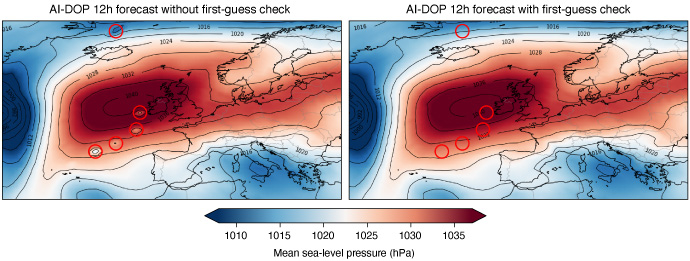
Figure 3: Mean sea-level pressure (hPa) +12h forecasts from AI-DOP initialised on 1 November 2026 00 UTC, without (left) and with (right) the first-guess check. Red circles mark spurious lows in the forecast without the check.
We have also introduced first-guess checks, which compare incoming observations with estimates from the preceding observation window (a previous short-range AI-DOP forecast) to identify potentially anomalous observations. Figure 3 shows an example of how this affects the AI-DOP forecast. During the observation window, several drifting buoys reported mean sea-level pressure over 10 hPa below the first guess. Without the check, they produce small isolated lows inside the anticyclone in the forecast. With the first-guess check these observations are rejected and the spurious lows disappear. Developing these procedures will be important for ensuring reliable forecasts as the observing system evolves.
A final challenge is the impact of the sudden loss of an instrument. In 4D-Var, the impact of losing an observation type can often be mitigated by the availability of other observations and the constraints provided by the background forecast. For AI-DOP, which learns directly from observations, missing data can have a more pronounced impact on forecast quality.
To investigate this sensitivity, we have started conducting observing-system experiments (OSEs), in which observations are deliberately removed to assess the resulting impact on forecast performance. Preliminary results indicate that the impact depends on both the type and extent of the data loss, as well as on how observations are represented in the model input. For example, losing a single microwave instrument has relatively little impact, whereas removing a broader group of observations, such as all microwave temperature-sounding channels, leads to substantially larger errors, particularly at longer lead times. These results highlight the importance of understanding how AI-DOP responds to changes in the observing system. Further work will investigate ways to improve its robustness to missing observations, including observation dropout during training. As the development of AI-DOP models will continue, OSEs should be run routinely to evaluate the impact of the different part of the observing system.
Recent forecasts
Recent forecasts from the real-time AI-DOP prototype, that we refer to as AIFS-DOP, running on the N320 grid (~30 km) illustrate how the model performs. Each forecast is initialised directly from the latest observations arriving through the real-time chain described above, without an atmospheric analysis. We compare it with the operational AIFS (native resolution N320) and IFS (regridded to N320 resolution) forecasts and with the verifying SYNOP station observations. The system is still experimental, and a single case is not a systematic evaluation. Still, a recent high-impact event shows how the model behaves for a real weather situation.
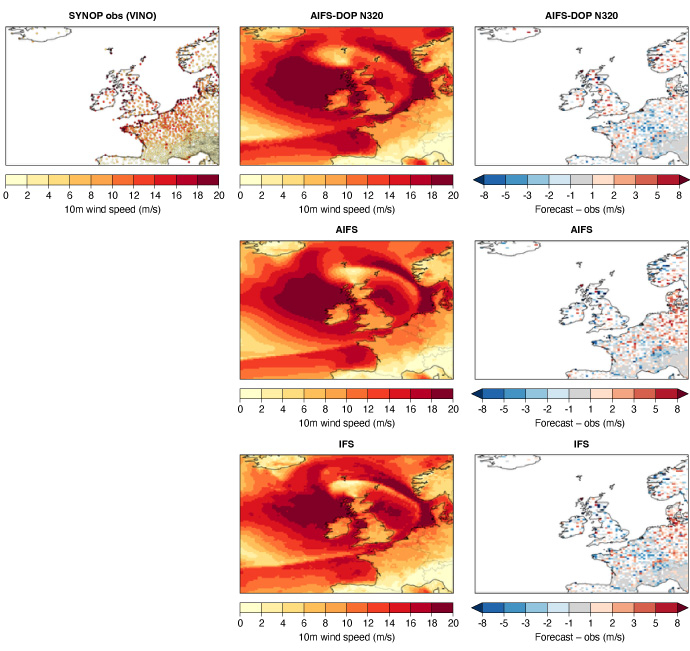
Figure 4: Storm Boelo, 10-metre wind speed at T+72h, valid 25 October 2026 at 00 UTC. Top left: SYNOP observations. Rows, top to bottom: AIFS-DOP, AIFS and IFS, each showing the forecast situation.
Here we look at Storm Boelo, which crossed the British Isles and north-western Europe on 24–25 October 2026. Three days ahead (initialised on 22 October at 00 UTC), AIFS-DOP already had a realistic picture of the storm, with the right structure. Figure 4 shows the broad band of strong winds wrapping around the southern and western flanks of the low across Ireland, the Irish Sea and northern Britain. It also shows the quieter centre and strong winds reaching the Channel and southern North Sea coasts. Compared with SYNOP observations, the wind errors are mostly small and of mixed sign, and unlike AIFS and IFS, AIFS-DOP was not too windy along the North Sea, Danish and German coasts.
During the night of 24–25 October, the storm pushed a tongue of very mild air, above 15°C, over Brittany and western France towards Belgium and the Netherlands, with a sharp boundary against cooler air further east. In the same forecast, AIFS-DOP reproduced the shape and north-eastward extent of this warm tongue well, as shown in Figure 5.
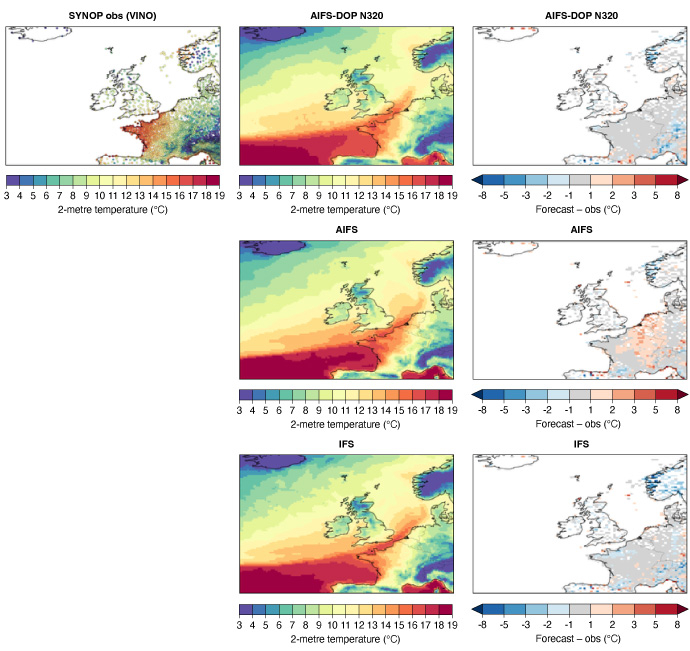
Figure 5: Storm Boelo, 2-metre temperature at T+72h, valid 25 October 2026 at 00 UTC. Top left: SYNOP observations. Rows, top to bottom: AIFS-DOP, AIFS and IFS, each showing the forecast (middle) and the forecast minus observation at the stations (right). Stations whose nearest grid point is over the sea are excluded.
These results are encouraging for a model that has never seen an atmospheric analysis. Three days ahead, before the low-pressure system formed over the Atlantic, AIFS-DOP forecasted its genesis, winds and mild air at least as well as two operational systems. We will keep monitoring real-time forecasts like this one as the system develops, alongside the quality control and observing-system experiments described above.
Authors: