
Machine-learning models can now produce highly skilful weather forecasts. For example, AIFS-CRPS (which now runs operational as AIFS ENS at ECMWF), GenCast, FourCastNet 3 and Aurora demonstrate that data-driven systems can generate skilful probabilistic predictions at medium-range timescales.
At the same time, machine learning can increase the spatial and temporal resolution of existing forecasts.
Spatial downscaling models such as Anemoi-D² learn to generate fine-scale atmospheric structure from coarse-resolution inputs. Temporal downscaling models such as HourGlass reconstruct realistic hourly evolution between forecast states that are available only every six to 12 hours.
Forecasting, spatial downscaling and temporal downscaling can be treated as separate problems, allowing each component to be evaluated and improved independently. They can also be combined in different ways.
Here, we explore one such combination: spatial and temporal downscaling are performed by a single machine-learning model, which can then be coupled to a separately trained machine-learning forecasting model.
Adding detail in space and time
The spatio-temporal downscaler is a flow-matching model, a generative machine learning technique, trained using the Anemoi framework, co-developed by ECMWF and several national meteorological services across Europe.
The spatio-temporal downscaler transforms fields with low spatial and temporal resolution into higher-resolution, hourly sequences. It is trained on ERA5, ECMWF’s fifth-generation global reanalysis.
Input data is provided to the model on an O96 grid, which corresponds to a horizontal resolution of approximately 100 km, at six-hourly intervals.
The model then generates outputs on the N320 ERA5 native grid, which corresponds to a horizontal resolution of approximately 30 km, with one-hourly time steps, in chunks of five steps at a time. It therefore performs two tasks at once:
- spatial downscaling from 100 km to 30 km
- temporal downscaling from six-hourly to hourly fields
Through flow matching, the model learns a conditional distribution of fine-scale spatial and temporal features that are consistent with the coarse input state.
During training, it receives the coarse input together with a high-resolution ERA5 target that has been corrupted with Gaussian noise at a randomly selected noise level. It learns the direction in which this intermediate state must change to recover the noise-free target. By training across many examples and noise levels, the model learns a path from noise to the distribution of high-resolution fields.
Generating a sample from this distribution requires an iterative sampler. Instead of producing the output fields in a single model call, the sampler evaluates the model multiple times as it transforms noise into an output sample, as shown in Figure 1.
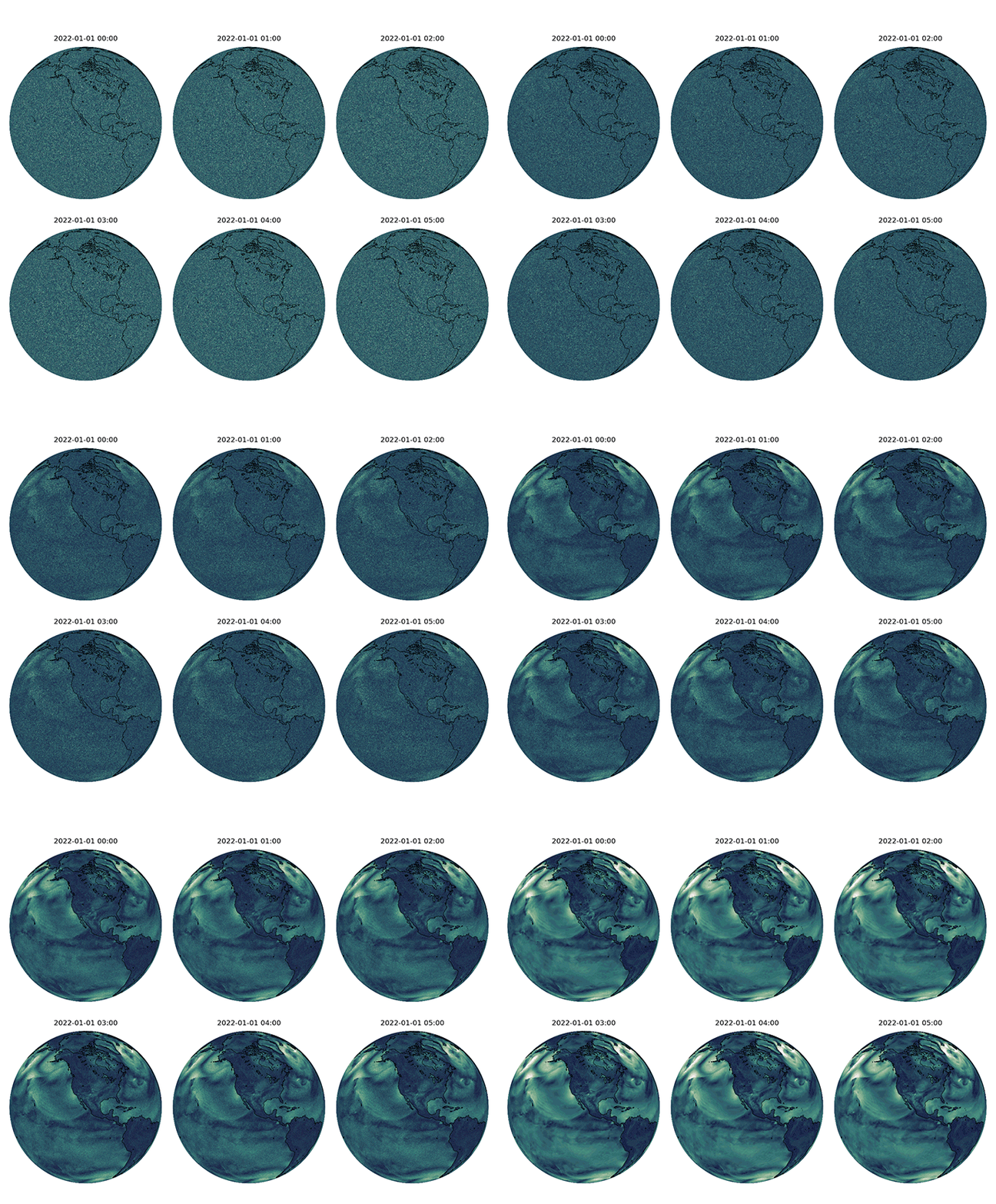
Figure 1: Visualisation of how the flow matching model generates a 10 m wind speed prediction via the sampler. The model creates multiple hourly forecast steps at a time.
Flow-matching and diffusion-style models can also be viewed as a form of spectral autoregression, in which large-scale structure tends to emerge before finer detail. When the target is strongly noised, the model relies mainly on the coarse input; as the noise decreases, it can add finer features consistent with the emerging weather systems. The atmospheric counterpart is scale-dependent predictability: large-scale structures generally remain predictable for longer, while smaller-scale details lose predictability more quickly.
The animations in Figure 2 show the low-resolution input, the high-resolution ERA5 target, and the samples generated by the model.
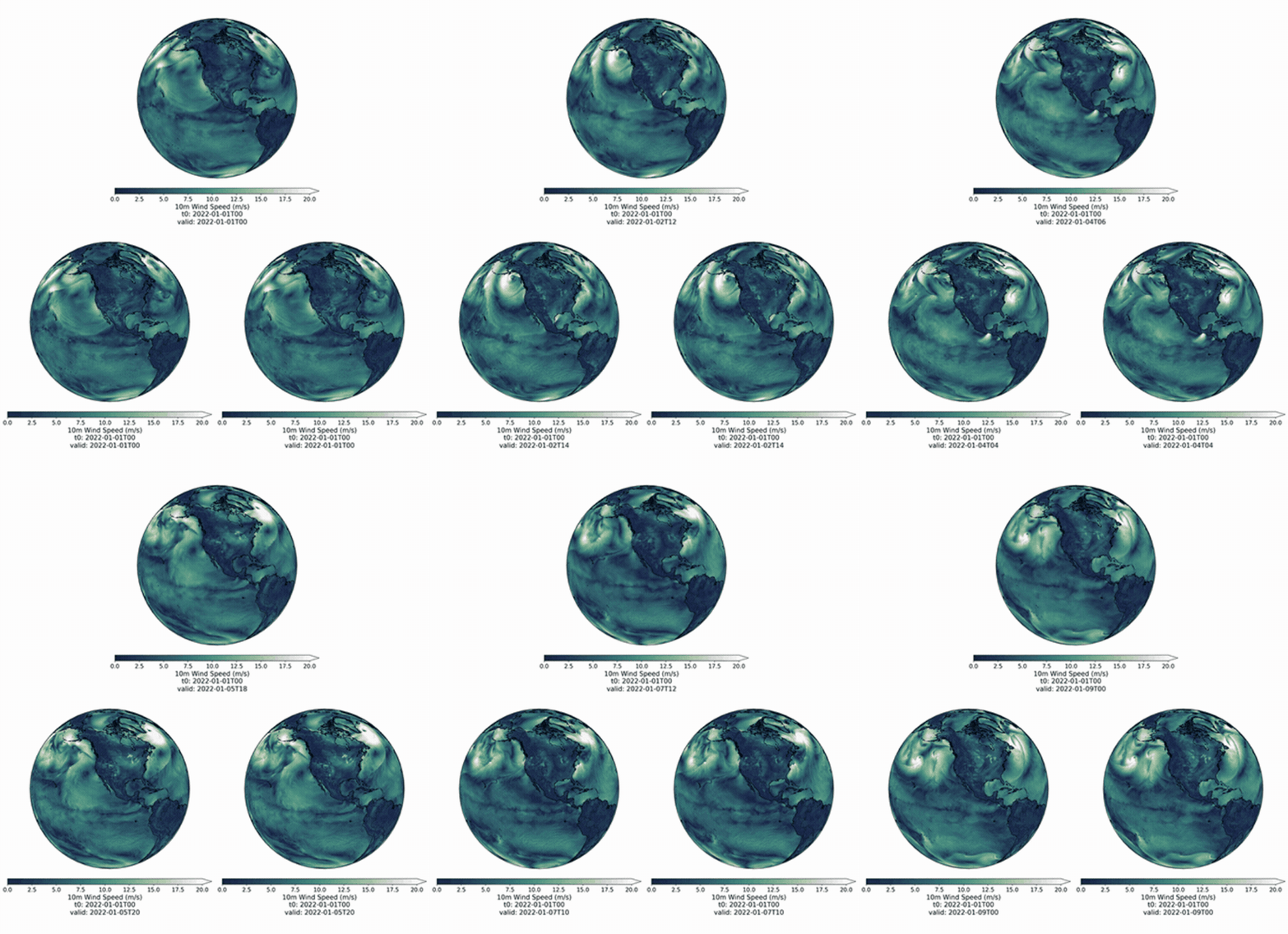
Figure 2: Top: Low-resolution ERA5 input (~100 km, 6-hourly). Bottom left: ERA5 target (~30 km, 1-hourly). Bottom right: prediction of the spatio-temporal downscaler. All panels show 10 m wind speed over a 15-day period beginning on 1 January 2022.
Coupling independently trained models
Because the spatio-temporal downscaler consumes low-resolution ERA5 states, it can be coupled to another machine-learning model trained on the same low-resolution dataset. In this example, we couple it to a low-resolution version of the AIFS ENS ensemble forecasting model.
Here, AIFS ENS was trained on ERA5 with a probabilistic loss objective and predicts the evolution of the atmosphere at six-hourly intervals. The spatio-temporal downscaler then transforms these forecasts into a higher-resolution, hourly sequence. The two models were coupled without any additional fine-tuning.
The animations in Figure 3 show the resulting 10 m wind speed output after coupling the two models.
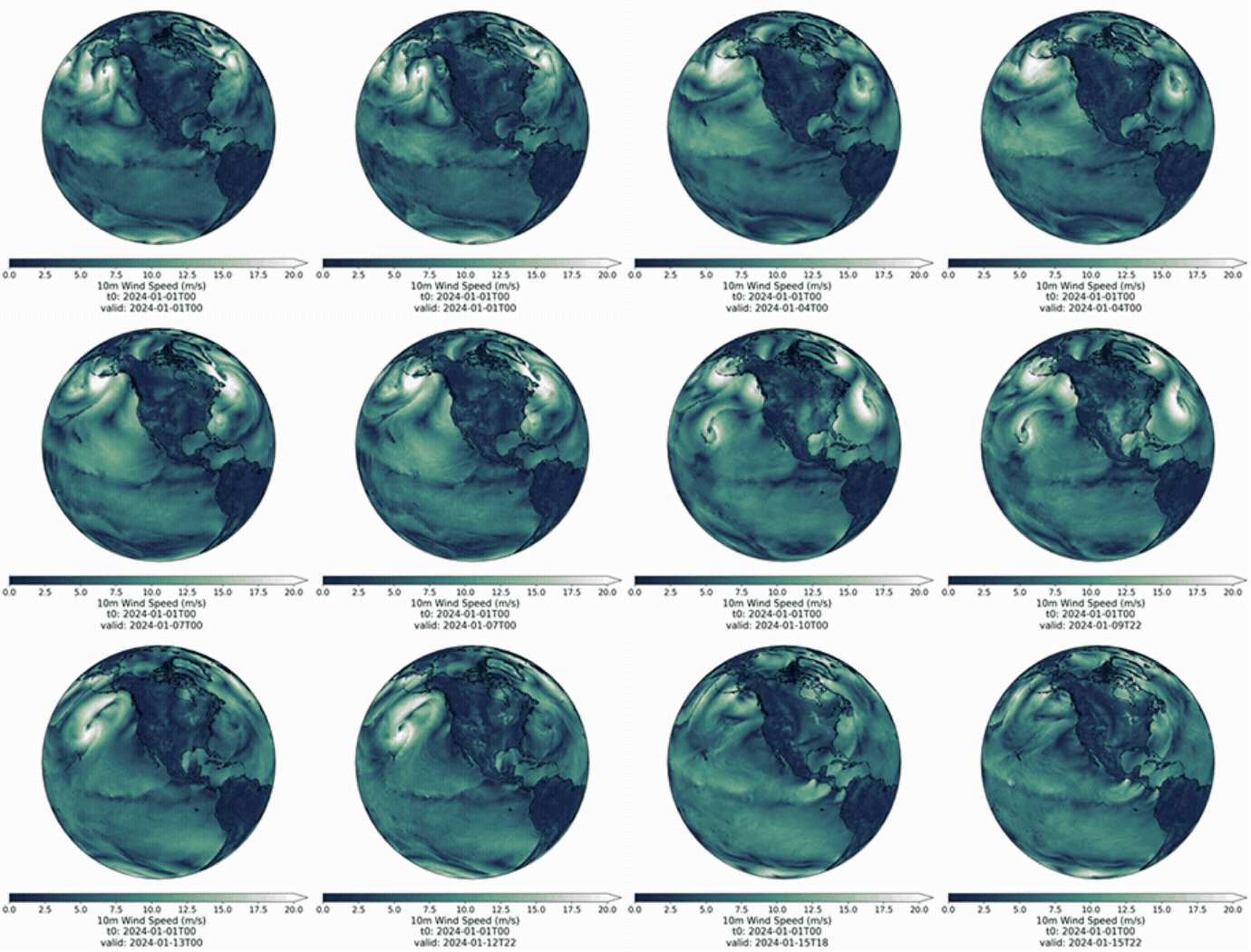
Figure 3: Left: output from the low-resolution AIFS-ENS forecasting model (~100 km, 6-hourly). Right: prediction of the spatio-temporal downscaler. Both panels show 10 m wind speed over a 15-day forecast initialised on 1 January 2024, 00 UTC.
This coupling illustrates how shared ERA5 inputs and outputs can serve as an interface between independently trained models. The same spatio-temporal downscaler could be combined with any other forecasting model that produces compatible fields.
Another direction currently explored at ECMWF is to train machine-learning models directly from observations: AIFS for direct observation prediction (AIFS-DOP), for example, produces medium-range forecasts from observations alone, without using reanalysis or any other fields of a physics-based numerical weather prediction model for training.
A prototype global reanalysis generated from observations using machine learning has also been demonstrated.
In principle, machine-learned observation-driven forecasting or reanalysis systems could also produce fields in a reanalysis-compatible format, which would make it possible for them to be combined with downstream models, like the spatio-temporal downscaler, trained on such fields.
Next steps
Our example of a spatio-temporal downscaler shows that data-driven atmospheric predictions can be enhanced by combining machine-learning models in different ways, and that independently trained models can be coupled when their input and output variables are compatible.
Next steps involve investigating which approach will work best in practice, how the flexibility offered by specialised models can be used most effectively, and when more tightly integrated methods may be preferable.
Flow matching and diffusion-style methods are versatile approaches to generative modelling, and Anemoi now supports training such models within a common framework.