
A forecast valid at noon and another at 18:00 can tell us where the weather is going, but not everything that happens in between.
Storms develop, move and weaken continuously, yet many state-of-the-art artificial intelligence (AI) weather forecasting systems provide forecasts only every six hours.
While this resolution is sufficient for many applications, finer temporal detail is essential for applications such as flood forecasting and renewable energy, as well as for rapidly evolving weather events.
Producing hourly forecasts directly is possible but can lead to error accumulation and temporal inconsistencies.
HourGlass is our new data-driven probabilistic temporal downscaling method developed through a collaboration between MET Norway and ECMWF to address this challenge.
Rather than replacing the underlying forecast, HourGlass reconstructs the likely evolution of the atmosphere between forecast times, generating coherent hourly forecasts that remain consistent with the original prediction.
The collaboration combines MET Norway's expertise in regional AI weather forecasting with ECMWF’s expertise in global AI weather forecasting, demonstrating that the same approach can be successfully applied across forecasting scales.
Following successful evaluation in both global and regional forecasting systems, HourGlass will become part of ECMWF's operational forecasting system later this year.
As part of the Artificial Intelligence Forecasting System (AIFS) v3, it will provide hourly forecasts of key surface variables for both AIFS Single and AIFS Ensemble (AIFS ENS), bringing high-temporal-resolution AI forecasts to operational users.
At MET Norway, HourGlass is already running in near-real time and is available to forecasters for evaluation, with plans to implement it operationally to produce hourly forecasts for the Bris ensemble forecasting system.
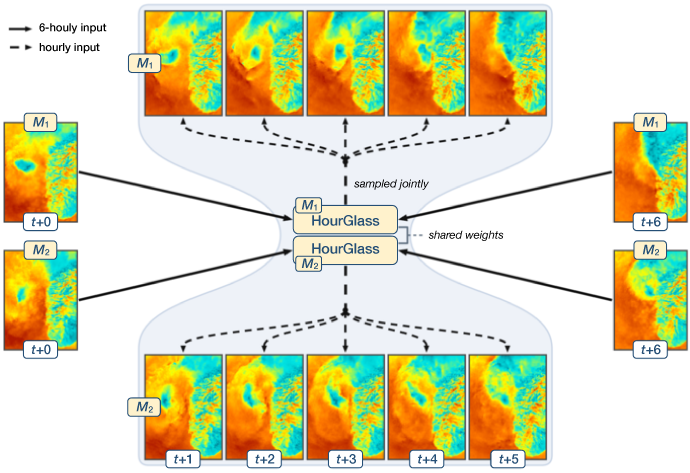
How HourGlass generates hourly forecasts from six-hourly inputs. M₁ and M₂ represent different ensemble members.
HourGlass is implemented within the Anemoi framework, providing a pathway to apply temporal downscaling to other data-driven forecasting systems and enabling the wider weather forecasting community to use and further develop the approach.
Preserving variability and consistency
This operational capability is made possible by two key features of HourGlass.
Existing temporal downscaling methods have typically been trained deterministically, which can lead to overly smooth forecasts, particularly near the centre of the temporal window.
HourGlass instead uses variants of the continuous ranked probability score (CRPS) to help preserve small-scale variability, as well as additional loss terms to encourage temporal consistency.
Another important innovation is the use of forecast trajectories as training data. Unlike reanalysis and analysis datasets, which may contain temporal inconsistencies and are not always available at hourly resolution, forecast trajectories provide a temporally consistent evolution of the atmosphere, allowing HourGlass models to learn how forecasts evolve between output times.
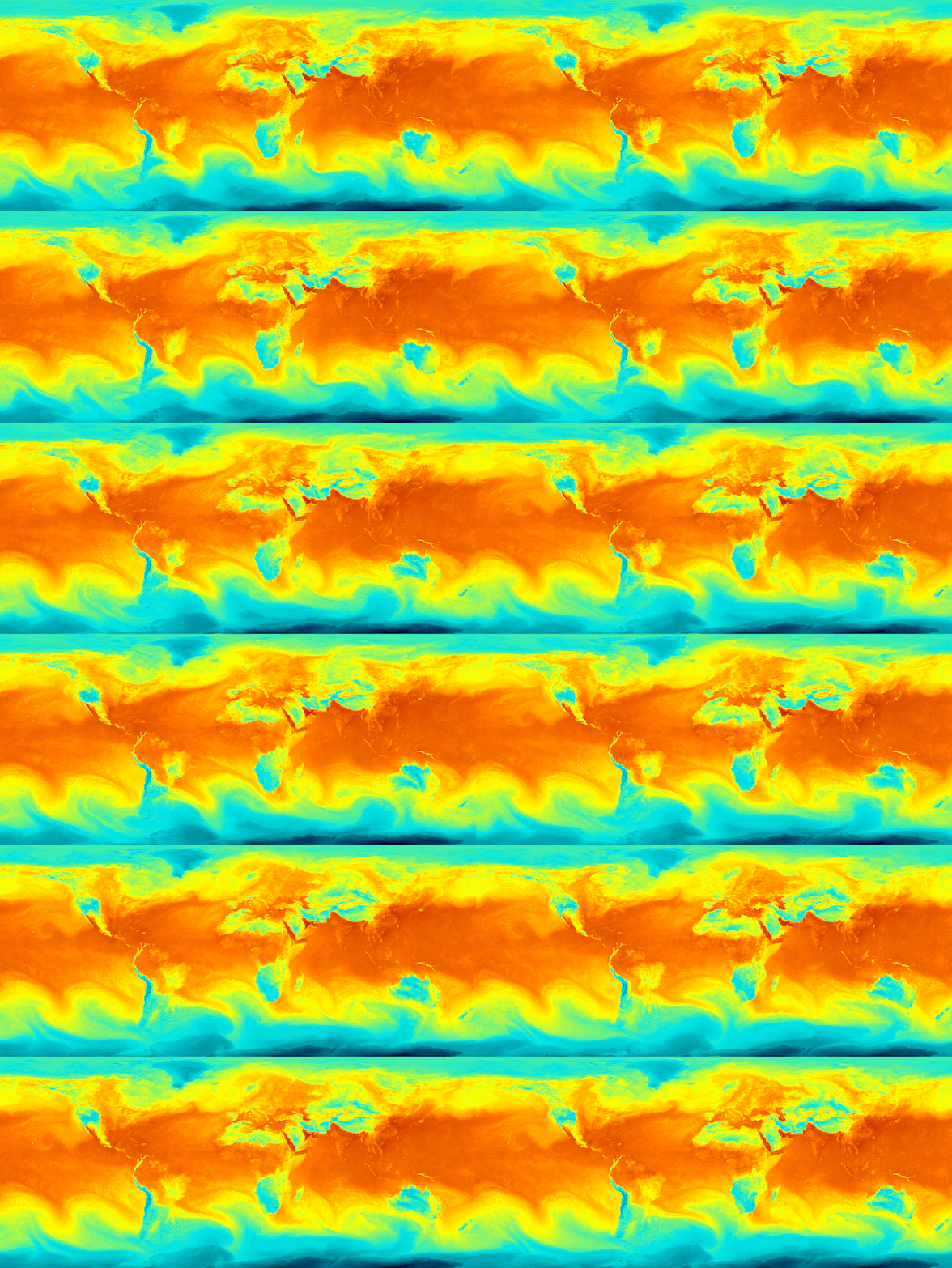
Hourly evolving 2 m dew point temperature produced by HourGlass (top) using the 6-hourly forecast from one member of the AIFS ENS (bottom).
Applying HourGlass across forecasting systems
HourGlass has been successfully applied to both ECMWF's AIFS Single and AIFS ENS and to MET Norway's Bris regional forecasting system.
Verification against observations shows that these models preserve the skill of the underlying forecasting systems while producing temporally coherent hourly forecasts with realistic small-scale variability.
The value of this approach is particularly clear during rapidly changing weather events.
For example, during Storm Amy, Bris-HourGlass (Figure 1) reconstructed a physically consistent hourly evolution of the storm as it developed, providing a more detailed view of the changing weather between the original forecast times. Similar behaviour was observed in AIFS-HourGlass and for other challenging events, including organised convection.
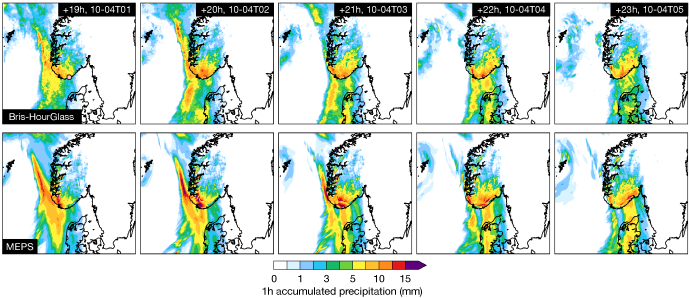
Figure 1: Hourly evolution of precipitation during Storm Amy on 4 October 2025 (01–05 UTC). The top row shows a single member of Bris-HourGlass and the bottom row shows the MetCoOp Ensemble Prediction System (MEPS), with both forecasts initialised at 06 UTC on 3 October 2025.
Hourly precipitation remains one of the biggest challenges for AI weather forecasting.
While HourGlass improves the realism of precipitation fields, predicting the most intense rainfall extremes remains difficult.
Nevertheless, HourGlass demonstrates the potential of probabilistic temporal downscaling to bridge the gap between six-hourly AI forecasts and the hourly products required by many operational applications.
This work highlights how collaboration between national meteorological services and ECMWF can help extend the capabilities of AI forecasting systems from research through to operational implementation.
As AI weather prediction continues to develop, approaches like HourGlass can help make forecasts more useful for applications requiring timely, high-resolution weather information.
To learn more about the science behind HourGlass, read the preprint on arXiv.