
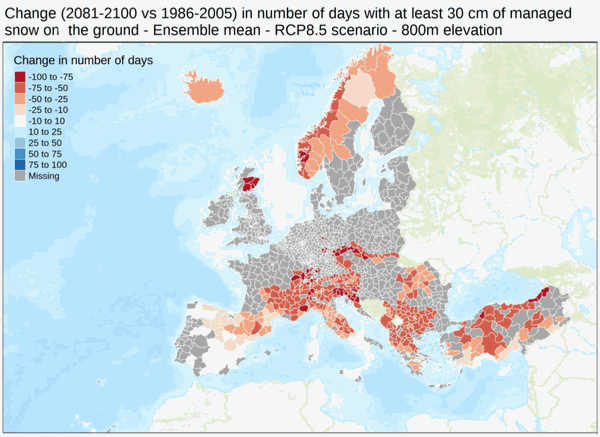
This dataset provides meteorological and snow indicators for Europe, characterizing operating conditions of winter ski resorts under past and future climate scenarios. The dataset consists of 39 indicators of atmospheric and snow conditions computed in a similar manner for all mountain regions in Europe at the scale of NUTS-3 regions (Nomenclature of Territorial Units for Statistics) and by steps of 100 m elevation. The snow indicators are generated using the Crocus snowpack model, a multi-layer snowpack model embedded in the land surface model, SURFEX (Surface Externalisée). In order to assess the impact of climate change, the model is run for four different climate scenarios: the present climate (labelled 'historical'), and three Representative Concentration Pathway (RCP) scenarios that correspond to an optimistic emission scenario where emissions start declining beyond 2020 (RCP2.6), a further optimistic emission scenario where emissions start declining beyond 2040 (RCP4.5) and a pessimistic scenario where emissions continue to rise throughout the century, often called the high emission scenario (RCP8.5). In order to simulate these climate scenarios the SURFEX model is forced with atmospheric fields provided by adjusted EURO-CORDEX ensemble climate projections (European branch of the Coordinated Downscaling Experiment). Regional climate models downscaled from global climate models are used to provide the high resolution, pan-European, indicators required to assess the snow reliability for all mountainous regions across Europe. In addition to the climate scenarios, a reanalysis dataset is computed using UERRA reanalysis.
A total of 39 indicators are made available in this dataset, divided into seven distinct groups:
Start and end date of snow season
Annual amount of machine made snow produced
Precipitation
Snow depth
Snow water equivalent
Air temperature
Potential snow making hours
The Crocus model makes it possible to account for both snow grooming and mechanical snow-making based upon the physical representation of these snow management practices, adding further value to the end-user by providing indicated snow management requirements under future climate conditions. However, it is not designed to replace higher resolution products available in some European regions that provide a more detailed view of ski conditions; for example, accounting for slope, local meteorological phenomena and local snow management practices. Instead this dataset presents a homogenous product at a pan-European level and hence its main goal is to compare the main features of past and future snow conditions across Europe or to compare distant destinations; for example, Scandinavia and Eastern Europe (for a given elevation and time horizon).
This dataset was produced on behalf of the Copernicus Climate Change Service.
A total of 39 indicators are made available in this dataset, divided into seven distinct groups:
Start and end date of snow season
Annual amount of machine made snow produced
Precipitation
Snow depth
Snow water equivalent
Air temperature
Potential snow making hours
The Crocus model makes it possible to account for both snow grooming and mechanical snow-making based upon the physical representation of these snow management practices, adding further value to the end-user by providing indicated snow management requirements under future climate conditions. However, it is not designed to replace higher resolution products available in some European regions that provide a more detailed view of ski conditions; for example, accounting for slope, local meteorological phenomena and local snow management practices. Instead this dataset presents a homogenous product at a pan-European level and hence its main goal is to compare the main features of past and future snow conditions across Europe or to compare distant destinations; for example, Scandinavia and Eastern Europe (for a given elevation and time horizon).
This dataset was produced on behalf of the Copernicus Climate Change Service.
Interval
-
DOI
10.24381/cds.2fe6a082
Portal
Climate Data Store
Product Family
Data
Product Type
Climate projections
Spatial Coverage
Europe
Temporal Coverage
Past
Future
Variable Domain
Land (hydrology)
Sector
Tourism