
Recent media coverage and contributors from parts of the scientific community have highlighted the possibility of a strong El Niño event developing later this year – raising expectations of widespread climate impacts.
Much of this reporting draws on seasonal forecasting data, including from ECMWF’s SEAS5, issued in March and April, and the multi-system ensemble of the Copernicus Climate Change Service (C3S). Together, these systems suggest conditions that could favour the development of El Niño.
El Niño, the cyclical warming of surface waters in the central and eastern Pacific, and its counterpart, La Niña – the cooling phase – together form the El Niño–Southern Oscillation cycle (ENSO), a key driver of global weather.
While at ECMWF we can assess the likelihood and possible evolution of ENSO conditions, official ENSO status updates are issued by the World Meteorological Organization (WMO).
Early forecast signals such as those seen this spring often attract attention, but they do not guarantee a particular outcome. Understanding where confidence is justified, and where uncertainties remain, is important for interpreting current El Niño headlines responsibly.
Given the considerable interest in the latest seasonal outlooks, here we provide a set of key considerations that should inform any interpretation of ENSO-related seasonal forecasts.

Map of sea-surface temperature anomaly in ECMWF contribution to C3S Seasonal Forecast issued in March 2026 and valid for June, July and August. Credit: C3S / ECMWF
Uncertainty inherent to seasonal forecasts
There are a few basic features of seasonal forecasts that are worth bearing in mind from the outset. The future is inherently uncertain, and ensemble forecasts from any single model provide an estimate of the uncertainty in what will happen. This uncertainty is readily seen in the plots of sea-surface temperature (SST) indices, also known as “Niño plumes”, which display how different ensemble members evolve over time within a defined region of the equatorial Pacific.
For example, if we look at the NINO3.4 region SST anomalies predicted for September by individual ensemble members of the ECMWF contribution to C3S in April, they range from about 1.7 ºC to 3.3 ºC (Figure 1). This is a substantial range of values for the possible amplitude of El Niño, and a more precise value cannot be reliably given.
Larger uncertainty at this time of year
Forecast uncertainty is often larger at this time of year, due to what is called the "spring predictability barrier". Changes in the climate system in the tropical Pacific during March to May are naturally less predictable than at other times of year. The ensemble forecasts capture some of this additional uncertainty, but may still struggle to accurately forecast through this period.
We typically gain much clearer insight between late May and June, once interactions between the ocean and atmosphere strengthen. This coupling – such as weakening trade winds and warming of the central Pacific – provides the physical evidence needed for confidence to increase.
Uncertainty inherent in the models
Although each forecasting ensemble represents a range of outcomes, the forecasts are typically not reliable, in the statistical sense of accurately representing the probabilities of what might happen.
Rather, a single model is typically overconfident, and the eventual outcome can sometimes lie outside the predicted range. This is one reason why C3S provides a multi-system ensemble. The range of values predicted by a set of different forecasting systems is larger and has a better chance of capturing the eventual outcome.
The total spread is typically very large. For April 2026, the C3S ensemble provides individual anomalies ranging from just 0.2 ºC up to 3.3 ºC. This is made up of a large majority of systems that are highly confident that anomalies will be above 1 ºC, and two systems that consider values down to 0.5 ºC or below by the end of the summer to be possible.
There is, therefore, a strong consensus that El Niño conditions are likely to develop and be maintained, but not unanimity that this outcome is certain and estimates of the range of likely values differ.
Figure 1 shows forecasts from four of the systems contributing to C3S, including the three for which we have the longest record of operational plots available, plus one which considers it just possible that positive anomalies below 0.5 ºC might be possible by the end of summer.
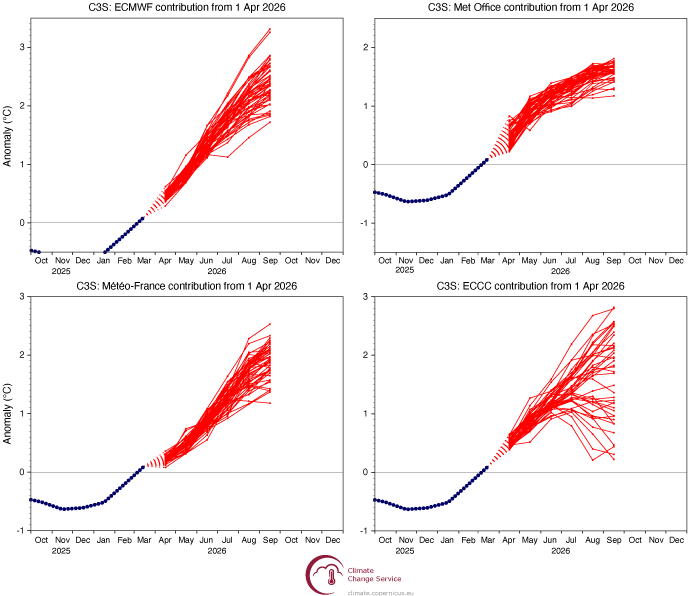
Figure 1: April 2026 forecasts of NINO3.4 SST anomaly from four of the eight available contributors to the C3S multi-system ensemble (ECMWF, Met Office, Météo-France and Environment and Climate Change Canada (ECCC)). Monthly mean anomalies relative to ERA5 1981–2010 climatology. C3S forecasts are both bias- and variance-corrected: the variance correction is designed to improve the amplitude of predicted anomalies.
How can we assess the credibility of our real-time forecasts in this context?
There are perhaps two main approaches. One is to monitor the evolving situation from observations and compare with the details of the forecast. For example, monitoring of recent and predicted tropical zonal wind anomalies shows that a westerly wind burst developed at the end of February and persisted throughout March. An important question is whether all forecast systems and all ensemble members captured this development. Further westerly winds are predicted for at least the first half of April.
It is worth noting that while some C3S systems use a “burst mode”, incorporating atmospheric initial conditions from the start of each month, others use a “lagged-start mode” and will have at least some members which have less up-to-date initial conditions. This may not matter in most cases, but if chance real-world developments lead to a change in expected future evolution, then older initial conditions may give less well-informed forecasts. While C3S does not presently offer a detailed running commentary on the observed evolution of ENSO and the detailed fit to the forecasts, the data is openly available, and individual assessments can be made .
The experience from previous forecasts
A second approach to assess credibility is to step back and consider the larger picture of ENSO forecasts, looking at past performance and any known factors which might lead us to modify our expectations. C3S provides limited scores for historical ENSO performance over the 1993–2016 reference period and only in terms of correlation. However, examining past analogous years can be particularly informative.
The most recent analogue was in March and April 2023 (Figure 2), when many forecast systems were predicting a moderately well-defined and substantial warming signal. The overall signal was weaker than that of 2026, more so when comparing the March forecasts. The eventual warming was slightly stronger than the average of the April forecasts, with anomalies reaching 2 ºC by the end of the year.
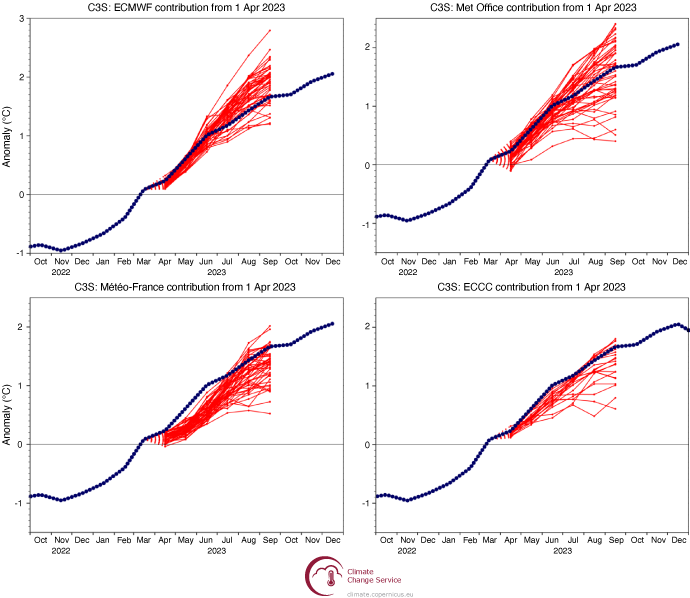
Figure 2: April 2023 real-time forecasts of NINO3.4 SST, from the same contributors as above. Monthly mean anomalies relative to ERA5 1981–2010 climatology. The forecast signal was fairly consistent but weaker than in 2026, and a substantial El Niño developed.
Another analogy is March/April 2017 (Figure 3). At that time, C3S was still developing its multi-system forecasts, and only three systems are available in the real-time archive. They suggested that El Niño conditions later in the year were fairly likely, with even a large event possible, although the spread was relatively wide and all models gave a small chance of anomalies being zero.
The NINO3.4 region did warm up in the middle of the summer, but then started to cool, resulting in La Niña conditions by the winter. Using today’s operational systems to re-forecast 2017 does not improve the outcome. The 2017 forecast signal was much less strong and focused than the signal seen in 2026, but the development of moderate La Niña conditions outside the predicted range of these three systems is a reminder that it is possible for the real world to develop in unexpected ways. Notably, in 2017, it was not until June or July that the possibility of even a moderate La Niña event became apparent. We still don’t fully understand why forecast systems found it so hard to represent the transition from warming to cooling that occurred in 2017.
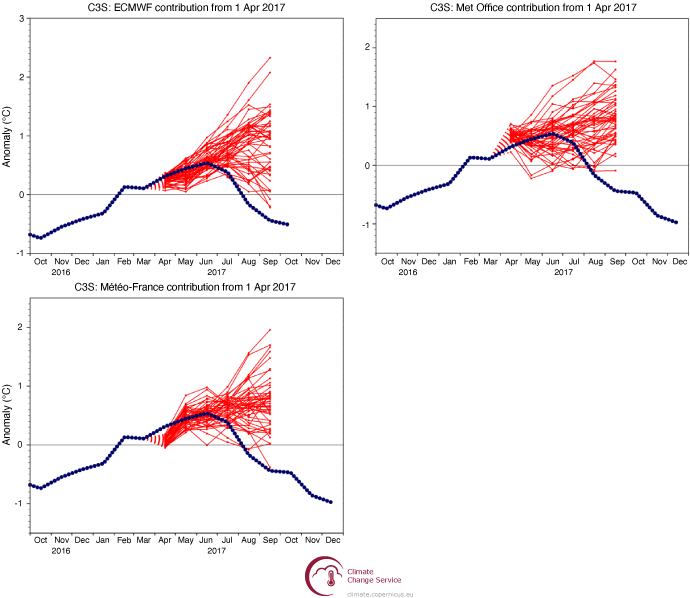
Figure 3: April 2017 real-time forecasts of NINO3.4 SST, from the available three contributors. Monthly mean anomalies relative to NCEP Olv2 1981–2010 climatology. The mean forecast anomaly was weaker than 2023 and the spread was wider. After some initial warming, SSTs cooled and La Niña conditions developed.
For SEAS5, looking at 33 years of retrospective and real-time forecasts from 1993 to 2025, March 2017 is the worst March ENSO forecast on record. Forecast busts of this magnitude are not common but are possible. The signal in the ocean sub-surface, illustrated by the section of temperature anomalies along the Equator in Figure 4, was much less coherent in March 2017 than it is now. One might speculate that the stronger, more coherent signal of 2026, already propagating across the Pacific, will be harder to blow off course than was the case in 2017. How the evolution of the 2026 signal might compare with that of 2023 is not easy to predict.
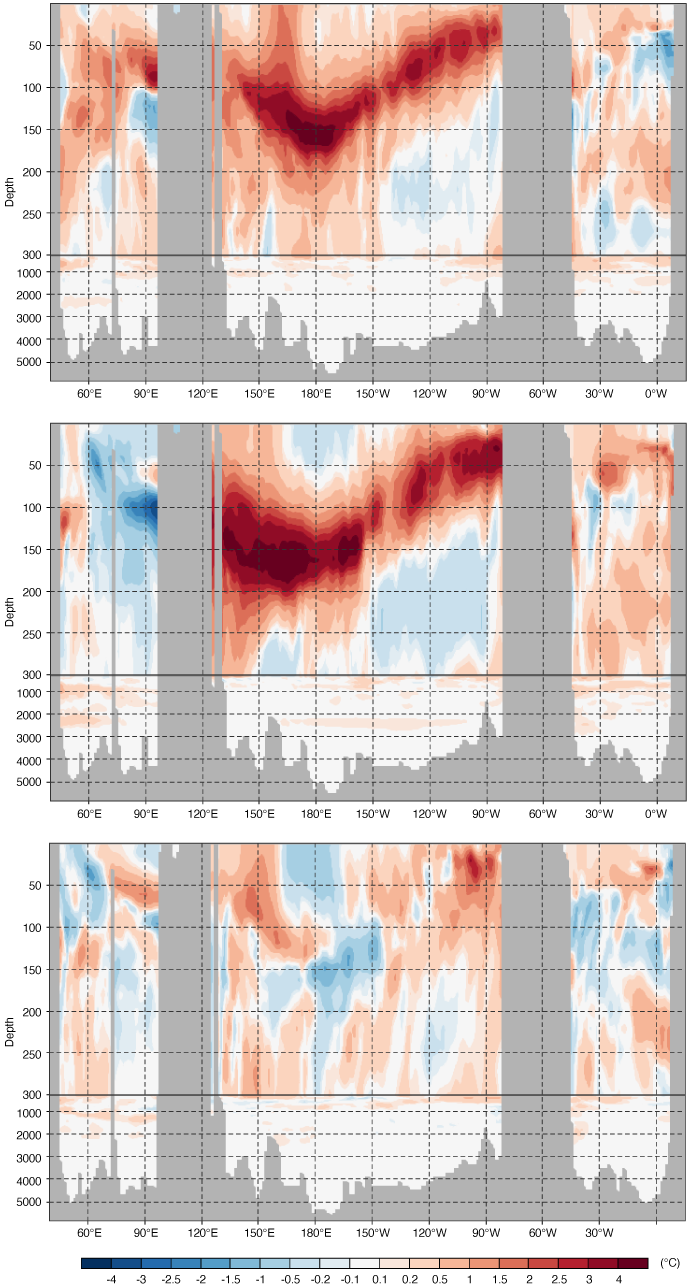
Figure 4: Monthly mean temperature anomalies along the equator for March 2026 (top), March 2023 (middle) and March 2017 (bottom), according to the ECMWF ORAS5 ocean analysis. Mean anomalies relative to the 1993–2016 climatology. The weaker sub-surface signal in 2017 may account for the greater uncertainty and error in the forecast.
How does climate change affect ENSO prediction?
Climate change adds further complexity to ENSO prediction. Sea-surface temperatures both globally and in the west Pacific were warmer in early 2026 than in early 2023, and the radiative forcing from greenhouse gases continues to rise.
Our models are physics-based and are designed to cope with the climate system moving into uncharted territory due to global warming. But climate-relevant processes, such as cloud feedbacks and aerosol interactions, are not represented perfectly, and the resulting uncertainties in radiative forcing trends may introduce small biases in the real-time forecasts.
More generally, systematic model errors may interact non-linearly with the evolving climate change signal, leading to imperfections in our bias-correction and calibration methods. It is thus possible that our 2026 forecast is slightly less accurate than expected from past performance.
Climate change also complicates the definition of El Niño amplitude. NINO3.4 SST anomalies are traditionally measured relative to average SST values over a specified past period. If overall temperatures are rising, as they are, then it is not surprising that NINO3.4 values now tend to be slightly warmer than in the past, making it easier to reach larger temperature values. The value of the anomaly will depend on how recent a reference period is chosen.
The situation is further complicated by the non-uniform nature of the warming of tropical SST in recent decades, such that the impact of a given NINO3.4 anomaly, even if local warming trends are accounted for, may differ from the past. One way to account for this is to change the definition of El Niño to depend on relative SST anomalies, that is the temperature of NINO3.4 relative to SST averaged over the tropics as a whole. This is the approach now taken at the Climate Prediction Center in the USA, and can have a bigger impact than just changing the reference period.
What difference these ways of measuring El Niño amplitude might make in 2026 is not yet known – it will depend on temperatures outside of the tropical Pacific, as well as those within it.
Finally, climate change also affects the impact of an El Niño event. The shifted climate background and existence of non-linearities in the climate system mean that impacts of future El Niño events may differ in some ways from past impacts. Furthermore, shifts in weather patterns caused by El Niño may combine with the background features of a warmer climate (higher baseline temperatures, stronger evaporation and moisture transports) to produce stronger impacts of El Niño, amplifying extremes.
What should we expect later this year?
Right now, models show a wide range of potential SST anomalies for later in the year. This spread is typical at this long lead time. The range usually narrows as time progresses, and the eventual evolution of El Niño will depend on how strongly the winds across the equatorial Pacific respond to the overall pattern of SST anomalies.
Models indicate that a moderate El Niño is likely, and many allow for the possibility of a strong event, but it is too early to assign high confidence to those outcomes. We currently have no compelling reason to discount the model guidance, but we should remember that the forecasts are not guaranteed to be reliable. Climate change does not necessarily make El Niño events stronger or more frequent, but it does increase absolute SSTs, meaning that impacts of El Niño may be amplified.
If an El Niño event develops, forecast systems will do their best to account for changes in the tropical Pacific, other anomalies in the initial conditions, and the changed climate background. They will not do this perfectly, but a multi-system physics-based approach should provide a powerful tool to help assess risks and possibilities.
Further information
All the data archives and charts are available from the C3S Seasonal Forecasts page, and on the ECMWF charts page for ECMWF seasonal forecasts.