Learn about the various data sources, and strategies to find climate data: processing, choosing projections, scenarios, ensembles and variables.
This lesson teaches about sources of uncertainty in climate projections, what robust signals are, and when we can be confident in a change.
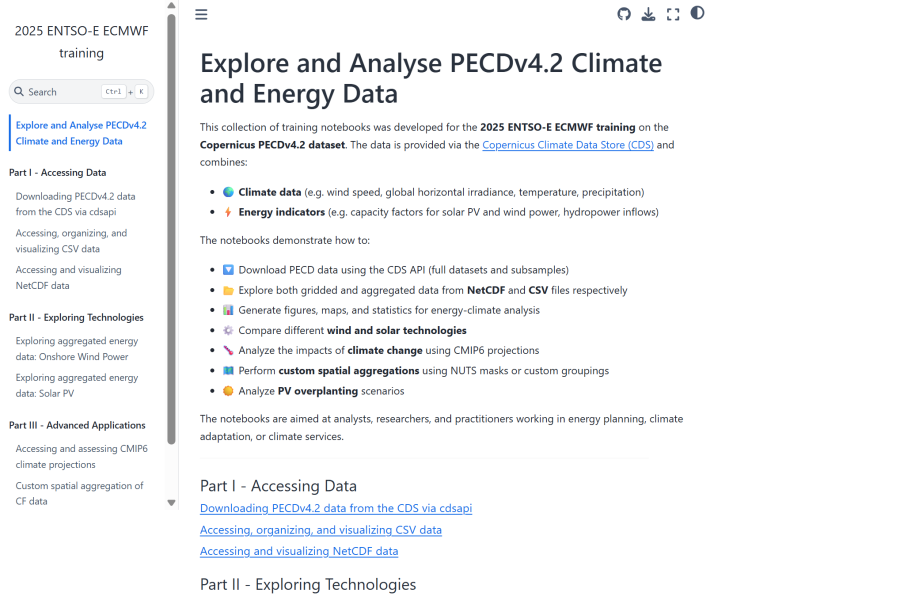
Learn how climate change will affect the energy sector, which energy-related data and indicators are available from the CDS, and how these can be used in applications.
This lesson focuses on ECGATE - ECMWF's server allocated for users' tasks, from submitting jobs to correcting errors.
This lesson provides an overview of Metview's main features to analyse and edit input data for the single-column model.
This lesson describes the web services used to visualise geographical data and outlines what OGC and INSPIRE are.
The Meteorological Archival and Retrieval System (MARS) enables access to ECMWF data. Explore its computing capability
ecCodes is an application programming interface developed by ECMWF to decode and encode in WMO GRIB format.
This lesson is focused on how to gain flexibility and control when handling GRIB data using advanced ecCodes tools.
Introduction to calculating seasonal forecast anomalies. Visualisation as spatial maps, time series and interactive plot
Access hindcast data of 2-metre temperature; Compute anomalies, averages and verification metrics.