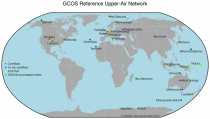
The Global Climate Observing System (GCOS) Reference Upper-Air Network (GRUAN) is an international reference observing network, established in 2006, of sites measuring essential climate variables above Earth's surface, designed to fill an important gap in the current global observing system. GRUAN measurements are providing high-quality climate data records from the surface, through the troposphere, and into the stratosphere.

calendar_today Interval/period: Sun, 01/01/1978 - Wed, 10/17/2018
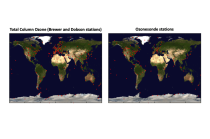
This dataset provides access to two types of ozone observations: total column ozone estimates and vertical profiles of ozone concentration.
The total ozone estimates are based on solar UV radiation measurements made by ground-based spectrophotometers (Dobson or Brewer type spectrophotometers).
The vertical profiles of ozone concentration are estimated primarily using ozonesonde observations.
Data are available for 159 Dobson stations, 109 Brewer stations and 135 ozonesondes stations.

calendar_today Interval/period: Tue, 01/01/1924 - Sat, 05/09/2026
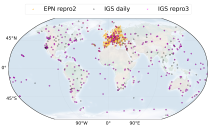
This dataset provides estimates of water vapour derived from atmospheric delays in Global Navigation Satellite System
(GNSS) radio signals.
The initial data is collected from two in situ ground-based network of GNSS receivers – the International GNSS Service
(IGS) and EUREF Permanent Network (EPN). The IGS collects, archives, and freely distributes GNSS data from a
cooperatively operated global network of more than 500 ground-based GNSS stations since 1994. The EPN is a European

calendar_today Interval/period: Mon, 01/01/1996 - Sat, 05/09/2026
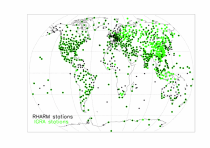
This catalogue entry provides access to vertical profiles of standard meteorological variables. It includes two archives.
The first is version 2 of the Integrated Global Radiosounding Archive (IGRA) from 1978 which incorporates global
radiosounding profiles of temperature, humidity and wind from a large number of data sources,
which is 30% larger than the previous version 1. IGRA v2 is the result of quality assurance procedures applied to the

calendar_today Interval/period: Sun, 01/01/1978 - Sat, 05/09/2026
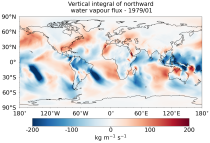
This dataset provides monthly means of mass-consistent, vertically integrated, atmospheric energy and moisture budget quantities derived from 1-hourly ERA5 reanalysis data.
The vertically integrated budget diagnostics include the tendencies and lateral fluxes of total energy, water vapour, and latent heat (with the latent heat of vaporization varying with temperature). In addition, the divergences of the lateral fluxes are provided.

calendar_today Interval/period: Mon, 01/01/1979 - Sat, 05/09/2026
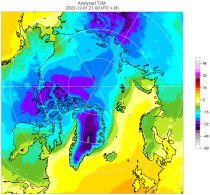
The C3S Arctic Regional Reanalysis second generation (CARRA2) dataset contains daily and monthly meteorological variables at 2.5 km resolution. These variables are specified at single levels (including surface) and also at soil, height, pressure and model levels. These daily and monthly data are pre-calculated and have the following types depending on the variables: daily and monthly averages, extremes and totals.

calendar_today Interval/period: Wed, 01/01/1986 - Sun, 12/31/2023
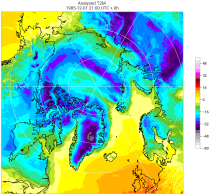
The C3S Arctic Regional Reanalysis second generation (CARRA2) dataset contains 3-hourly analyses at 2.5 km resolution. These variables are specified at single levels (including surface) and also at soil, height, pressure and model levels. Additionally, hourly forecasts are available between the analysis times and particularly forecasts up to 18 hours initialised from the analyses at 00 and 12 UTC.

calendar_today Interval/period: Wed, 01/01/1986 - Sun, 12/31/2023
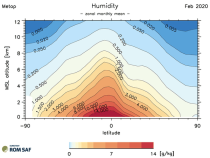
This dataset provides monthly and zonally averaged tropospheric humidity profiles derived from globally distributed GPS radio occultation (RO) measurements from EUMETSAT's Metop polar-orbiting satellites. Humidity plays an important role in the Earth's climate system, due to the strong greenhouse effect of water vapour but also for its role in the global energy transport, vertically in the atmosphere and horizontally between different geographical regions.

calendar_today Interval/period: Fri, 12/01/2006 - Mon, 12/01/2025
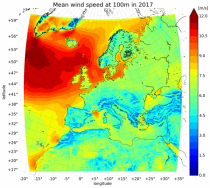
The present UERRA dataset contains analyses of atmospheric variables on height levels, from 1961 to 2019.

calendar_today Interval/period: Thu, 10/18/2018 - Wed, 07/31/2019
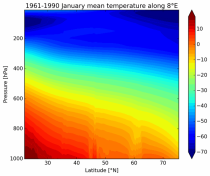
The present UERRA dataset contains analyses of atmospheric variables on pressure levels, from 1961 to 2019.
It has been generated using the UERRA-HARMONIE system by combining model data with observations into a complete and consistent dataset using the laws of physics.

calendar_today Interval/period: Thu, 10/18/2018 - Wed, 07/31/2019
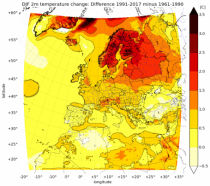
This UERRA dataset contains analyses of surface and near-surface essential climate variables from
UERRA-HARMONIE and MESCAN-SURFEX systems. Forecasts up to 30 hours initialised
from the analyses at 00 and 12 UTC are available only through the CDS-API (see Documentation).
UERRA-HARMONIE is a 3-dimensional variational data assimilation system,
while MESCAN-SURFEX is a complementary surface analysis system.
Using the Optimal Interpolation method, MESCAN provides the best estimate of daily accumulated precipitation

calendar_today Interval/period: Thu, 10/18/2018 - Wed, 07/31/2019
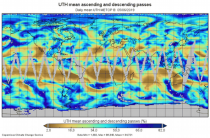
Upper Tropospheric Humidity (UTH) is of key importance to the Earth’s greenhouse effect and understanding of climate change. It is considered an Essential Climate Variable (ECV) because it controls key atmospheric processes, including those involved in water vapour and cloud feedbacks, that can amplify the climate system’s response to increases in other greenhouse gases. The Upper Tropospheric Humidity is defined as the integrated amount of Water Vapour in the atmospheric layer between ~500 hPa and ~200 hPa.

calendar_today Interval/period: Tue, 07/05/1994 - Sun, 02/28/2021

The DestinE Digital Twin for Weather-Induced Extremes (Extremes DT) supports responding and adapting to extreme events in a changing world by providing a capability to produce tailored simulations and address what-if scenarios related to extreme events in a past, present and future climate, complementing existing capabilities at national and European level.

calendar_today Interval/period: N/A

The Sub-seasonal To Seasonal dataset (S2S) consists of global ensemble real-time forecasts and reforecasts from thirteen numerical weather prediction (NWP) and research centres.
S2S project behind the dataset started in 2013 as a joint initiative of the World Weather Research Programme (WWRP) and the World Climate Research Programme (WCRP).
The goal of S2S project was to improve sub-seasonal forecast skill through combining multiple forecasting systems, enable multi-model evaluations and enhance knowledge sharing between operational centres.

calendar_today Interval/period: Thu, 01/01/2015 - Wed, 05/06/2026
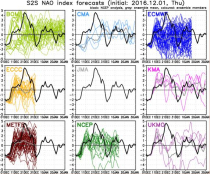
The Sub-seasonal To Seasonal dataset (S2S) consists of global ensemble real-time forecasts and reforecasts from thirteen numerical weather prediction (NWP) and research centres.
S2S project behind the dataset started in 2013 as a joint initiative of the World Weather Research Programme (WWRP) and the World Climate Research Programme (WCRP).
The goal of S2S project was to improve sub-seasonal forecast skill through combining multiple forecasting systems, enable multi-model evaluations and enhance knowledge sharing between operational centres.

calendar_today Interval/period: Tue, 03/01/2011 - Tue, 06/09/2026
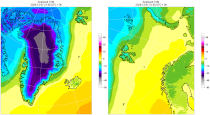
The daily and monthly data of the C3S Arctic Regional Reanalysis (CARRA) dataset contains daily and monthly meteorological variables at 2.5 km resolution. This includes fields at the single levels (including surface) and on pressure, height, soil and model levels.
These daily and monthly data are pre-calculated and have the following types depending on the variables: daily and monthly averages, extremes and totals.

calendar_today Interval/period: Sat, 09/01/1990 - Sat, 02/28/2026
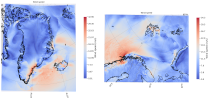
The C3S Arctic Regional Reanalysis (CARRA) dataset contains hourly data including 3-hourly analyses and hourly short term forecasts of atmospheric height level meteorological variables (temperature, humidity, wind, and other thermodynamic variables) at 2.5 km resolution. Additionally, forecasts up to 30 hours initialised from the analyses at 00 and 12 UTC are available.

calendar_today Interval/period: Sat, 09/01/1990 - Sat, 02/28/2026
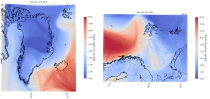
The C3S Arctic Regional Reanalysis (CARRA) dataset contains hourly data including 3-hourly analyses and hourly short term forecasts of atmospheric model level meteorological variables (temperature, humidity, wind, cloud, precipitation and turbulent kinetic energy) at 2.5 km resolution. Additionally, forecasts up to 30 hours initialised from the analyses at 00 and 12 UTC are available.

calendar_today Interval/period: Sat, 09/01/1990 - Sat, 02/28/2026
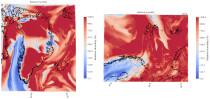
The C3S Arctic Regional Reanalysis (CARRA) dataset contains hourly data including 3-hourly analyses and hourly short term forecasts of atmospheric pressure level meteorological variables (temperature, humidity, wind, and other thermodynamic variables) at 2.5 km resolution. Additionally, forecasts up to 30 hours initialised from the analyses at 00 and 12 UTC are available.

calendar_today Interval/period: Sat, 09/01/1990 - Sat, 02/28/2026
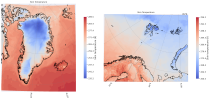
The C3S Arctic Regional Reanalysis (CARRA) dataset contains 3-hourly analyses and hourly short term forecasts of atmospheric and surface meteorological variables (surface and near-surface temperature, surface and top of atmosphere fluxes, precipitation, cloud, humidity, wind, pressure, snow and sea variables) at 2.5 km resolution. Additionally, forecasts up to 30 hours initialised from the analyses at 00 and 12 UTC are available.

calendar_today Interval/period: Sat, 09/01/1990 - Sat, 02/28/2026
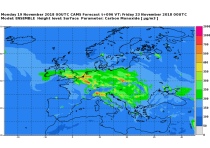
This dataset provides daily air quality analyses and forecasts for Europe.

calendar_today Interval/period: N/A

This dataset provides annual air quality reanalyses for Europe based on both unvalidated (interim) and validated observations.

calendar_today Interval/period: N/A

CAMS produces global forecasts for atmospheric composition twice a day. The forecasts consist of more than 50 chemical species (e.g. ozone, nitrogen dioxide, carbon monoxide) and seven different types of aerosol (desert dust, sea salt, organic matter, black carbon, sulphate, nitrate and ammonium aerosol). In addition, several meteorological variables are available as well.

calendar_today Interval/period: N/A

Emissions of atmospheric pollutants from biomass burning and vegetation fires are key drivers of the evolution of atmospheric composition, with a high degree of spatial and temporal variability, and an accurate representation of them in models is essential.

calendar_today Interval/period: N/A

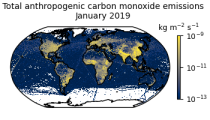
This data set contains gridded distributions of global anthropogenic and natural emissions.

calendar_today Interval/period: N/A