
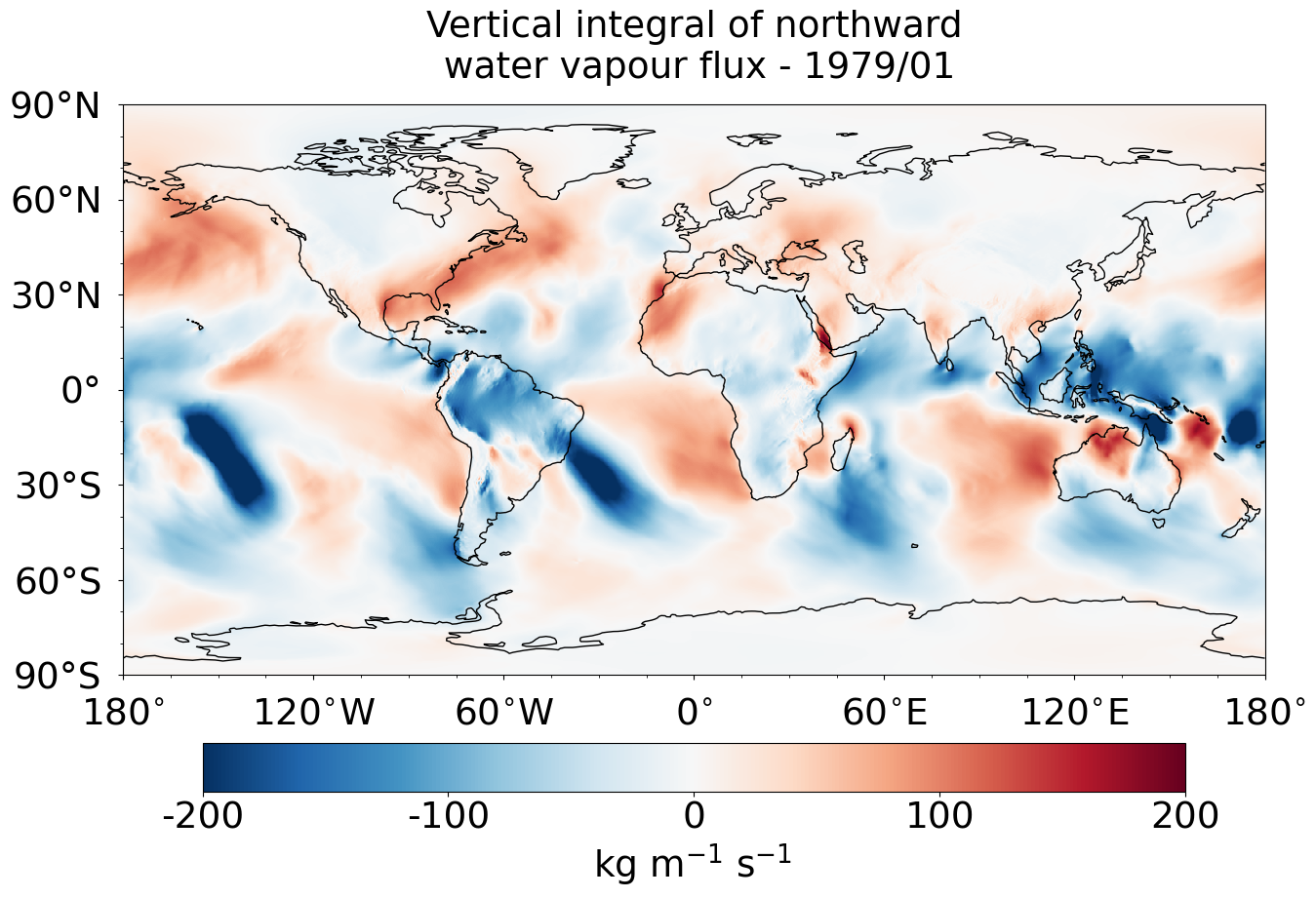
This dataset provides monthly means of mass-consistent, vertically integrated, atmospheric energy and moisture budget quantities derived from 1-hourly ERA5 reanalysis data.
The vertically integrated budget diagnostics include the tendencies and lateral fluxes of total energy, water vapour, and latent heat (with the latent heat of vaporization varying with temperature). In addition, the divergences of the lateral fluxes are provided.
These divergences and fluxes are also available in the ERA5 archive, but do not employ mass-consistent horizontal wind fields and are contaminated with numerical noise. In the present dataset, mass consistency is achieved by iteratively adjusting the horizontal wind field at every time step.
The divergence and tendency terms from this dataset can be combined to indirectly estimate mass-consistent surface flux terms of the atmospheric energy and moisture budget. In the energy budget, horizontal and vertical enthalpy fluxes associated with water and snow are neglected. This framework allows for unambiguous estimation of net surface heat fluxes (sum of radiative and turbulent heat fluxes) when combined with net radiative fluxes at the top of the atmosphere (not included in this dataset). The divergence and tendency term of the atmospheric moisture budget can be combined to indirectly estimate surface freshwater fluxes (P+E) which have an unbiased global mean.
In addition, this dataset allows the computation of the following:
The divergence of total energy flux with temperature-independent latent heat of vaporization is obtained by subtracting the divergence of latent heat flux and add the divergence of water vapour flux multiplied by Lᵥ = 2.5008 J kg⁻¹ instead (this works analogously for tendency and transport terms).
Divergence fields with full spectral resolution can be derived from corresponding east- and northward transports (divergence terms in this dataset are truncated at wave number 180 to reduce artificial noise over high topography).
This dataset is produced on behalf of Copernicus Climate Change Service by the Department of Meteorology and Geophysics, University of Vienna.
The vertically integrated budget diagnostics include the tendencies and lateral fluxes of total energy, water vapour, and latent heat (with the latent heat of vaporization varying with temperature). In addition, the divergences of the lateral fluxes are provided.
These divergences and fluxes are also available in the ERA5 archive, but do not employ mass-consistent horizontal wind fields and are contaminated with numerical noise. In the present dataset, mass consistency is achieved by iteratively adjusting the horizontal wind field at every time step.
The divergence and tendency terms from this dataset can be combined to indirectly estimate mass-consistent surface flux terms of the atmospheric energy and moisture budget. In the energy budget, horizontal and vertical enthalpy fluxes associated with water and snow are neglected. This framework allows for unambiguous estimation of net surface heat fluxes (sum of radiative and turbulent heat fluxes) when combined with net radiative fluxes at the top of the atmosphere (not included in this dataset). The divergence and tendency term of the atmospheric moisture budget can be combined to indirectly estimate surface freshwater fluxes (P+E) which have an unbiased global mean.
In addition, this dataset allows the computation of the following:
The divergence of total energy flux with temperature-independent latent heat of vaporization is obtained by subtracting the divergence of latent heat flux and add the divergence of water vapour flux multiplied by Lᵥ = 2.5008 J kg⁻¹ instead (this works analogously for tendency and transport terms).
Divergence fields with full spectral resolution can be derived from corresponding east- and northward transports (divergence terms in this dataset are truncated at wave number 180 to reduce artificial noise over high topography).
This dataset is produced on behalf of Copernicus Climate Change Service by the Department of Meteorology and Geophysics, University of Vienna.
Interval
DOI
10.24381/cds.c2451f6b
Portal
Climate Data Store
Product Family
Data
Product Type
Reanalysis
Provider
Copernicus C3S
Spatial Coverage
Global
Temporal Coverage
Past
Variable Domain
Atmosphere (upper air)