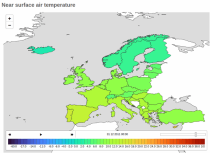
The Copernicus climate change service (C3S) operational energy dataset provides climate and energy indicators for the European energy sector. The climate-relevant indicators for the energy sector considered are: air temperature, precipitation, incoming solar radiation, wind speed at 10 m and 100 m, and mean sea level air pressure. The energy indicators are electricity demand and power generation from various sources: wind (both onshore and offshore), solar and hydro (run-of-river and reservoir) power.

calendar_today Interval/period: Mon, 01/01/1979 - Fri, 05/01/2026
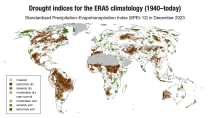
ERA5–Drought is a global reconstruction of drought indices from 1940 to present.
The dataset comprises two standardised drought indices:
- the Standardised Precipitation Index (SPI)
- the Standardised Precipitation-Evapotranspiration Index (SPEI).

calendar_today Interval/period: Mon, 01/01/1940 - Fri, 05/01/2026
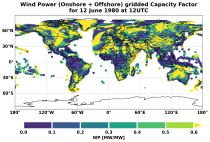
This dataset provides global climate and energy indicators from 1950 to the present at hourly and coarser temporal resolutions, offering a long-term, harmonised data foundation for energy-sector applications. It enables users to analyse energy indicators for the past climate, supporting energy planning, system design, risk assessments, climate impact modelling and model benchmarking.

calendar_today Interval/period: Sun, 01/01/1950 - Wed, 04/01/2026
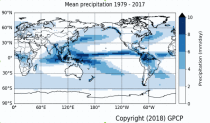
Within the hydrological cycle, precipitation is the main component of water transport from the atmosphere to the Earth’s surface. Precipitation varies strongly, depending on geographical location, season, synopsis, and other meteorological factors. The supply of freshwater through precipitation is vital for many subsystems of the climate and the environment, but there are also hazards related to extensive precipitation or the lack of precipitation.

calendar_today Interval/period: Mon, 01/01/1979 - Mon, 06/30/2025
This entry covers pressure-level data post-processed for bias adjustment on a monthly time resolution.

calendar_today Interval/period: Sun, 01/01/2017 - Mon, 06/01/2026
This entry covers single-level data post-processed for bias adjustment on a monthly time resolution.

calendar_today Interval/period: Sun, 01/01/2017 - Mon, 06/01/2026
This entry covers single-level data and soil-level data at the original time resolution (once a day, or once every 6 hours, depending on the variable).

calendar_today Interval/period: Thu, 01/01/1981 - Mon, 06/01/2026
This entry covers pressure-level data aggregated on a monthly time resolution.

calendar_today Interval/period: Thu, 01/01/1981 - Mon, 06/01/2026
This entry covers single-level data aggregated on a monthly time resolution.

calendar_today Interval/period: Thu, 01/01/1981 - Mon, 06/01/2026
This entry covers pressure-level data at the original time resolution (once every 12 hours).

calendar_today Interval/period: Thu, 01/01/1981 - Mon, 06/01/2026
The Sub-seasonal To Seasonal dataset (S2S) consists of global ensemble real-time forecasts and reforecasts from thirteen numerical weather prediction (NWP) and research centres.
S2S project behind the dataset started in 2013 as a joint initiative of the World Weather Research Programme (WWRP) and the World Climate Research Programme (WCRP).
The goal of S2S project was to improve sub-seasonal forecast skill through combining multiple forecasting systems, enable multi-model evaluations and enhance knowledge sharing between operational centres.

calendar_today Interval/period: Thu, 01/01/2015 - Mon, 06/29/2026
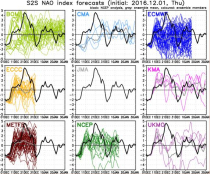
The Sub-seasonal To Seasonal dataset (S2S) consists of global ensemble real-time forecasts and reforecasts from thirteen numerical weather prediction (NWP) and research centres.
S2S project behind the dataset started in 2013 as a joint initiative of the World Weather Research Programme (WWRP) and the World Climate Research Programme (WCRP).
The goal of S2S project was to improve sub-seasonal forecast skill through combining multiple forecasting systems, enable multi-model evaluations and enhance knowledge sharing between operational centres.

calendar_today Interval/period: Tue, 03/01/2011 - Sun, 08/09/2026
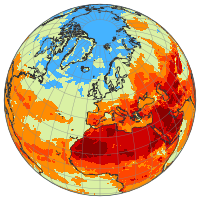
This dataset provides a complete historical reconstruction for a set of indices representing human thermal stress and discomfort in outdoor conditions. This dataset, also known as ERA5-HEAT (Human thErmAl comforT) represents the current state-of-the-art for bioclimatology data record production.
The dataset is organised around two main variables:

the mean radiant temperature (MRT)
the universal thermal climate index (UTCI)

calendar_today Interval/period: Fri, 12/01/1939 - Fri, 06/26/2026
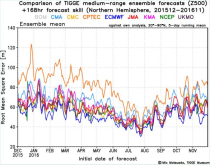
The International Grand Global Ensemble (TIGGE) dataset consists of global medium-range ensemble forecasts from thirteen numerical weather prediction (NWP) centres.
The dataset has been available since October 2006. TIGGE was established as a key component of THORPEX: a World Weather Research Programme to accelerate the improvements in the accuracy of 1-day to 2 week high-impact weather forecasts (THORPEX stands for THe Observing system Research and Predictability EXperiment)

calendar_today Interval/period: Sun, 10/01/2006 - Mon, 06/29/2026