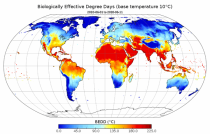
This dataset provides agroclimatic indicators used to characterise plant-climate interactions for global agriculture. Agroclimatic indicators are useful in conveying climate variability and change in the terms that are meaningful to the agricultural sector. The objective of this dataset is to provide these indicators at a global scale in an easily accessible and usable format for further downstream analysis and the forcing of agricultural impact models.

calendar_today Interval/period: Mon, 01/01/1951 - Sun, 07/05/2026

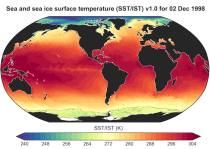
This dataset provides daily and monthly fields of global sea surface temperature (SST) and sea ice surface temperature (IST) from 1982 to the present, using observations from multiple infrared and passive microwave satellite sensors. SST is a key driver of global weather and climate, affecting ocean-atmosphere interactions and driving climate variability.

calendar_today Interval/period: Fri, 01/01/1982 - Tue, 12/31/2024
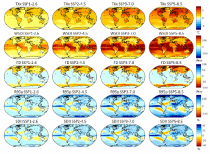
The dataset provides climate extreme indices related to temperature and precipitation as defined by the Expert Team on Climate Change Detection and Indices (ETCCDI), as well as selected heat stress indicators (HSI). The indices are provided for historical and future climate projections (SSP1-2.6, SSP2-4.5, SSP3-7.0, SSP5-8.5) included in the Coupled Model Intercomparison Project Phase 6 (CMIP6) and used in the 6th Assessment Report of the Intergovernmental Panel on Climate Change (IPCC).

calendar_today Interval/period: N/A

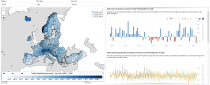
This dataset provides a series of climate indices derived from reanalysis and model simulations data hosted on the Copernicus Climate Data Store (CDS). These indicators describe how climate variability and change of essential climate variables can impact sectors such as health, agriculture, forestry, energy, tourism, or water and coastal management.

calendar_today Interval/period: Mon, 01/01/1940 - Fri, 12/31/2100
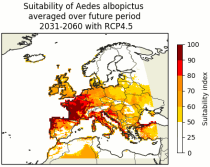
This dataset contains climatic suitability indicators for the Aedes albopictus (tiger mosquito) for Europe produced within the C3S European Health service. The provided indicators are the climatic suitability for the presence of Aedes albopictus and the season length of presence of Aedes albopictus. This mosquito transmits vector-borne diseases, such as dengue and chikungunya.

calendar_today Interval/period: N/A

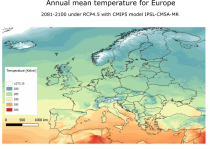
The dataset provides bioclimatic indicators derived from CMIP5 climate projections at 1 km x 1 km resolution for selected regions; Europe, Northern Brazil and Central Africa. This comprehensive set of bioclimatic indicators is specifically relevant for applications within the biodiversity and ecosystem services community.

calendar_today Interval/period: Sun, 01/01/1950 - Thu, 12/31/2099
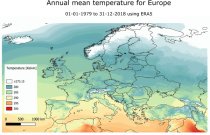
This dataset provides a historical reconstruction of bioclimatic indicators at 1 x 1 km resolution for Europe, Northern Brazil and Central Africa. These bioclimate indicators describe how the climate affects ecosystems, the services they deliver, and nature’s biodiversity. They are specifically relevant for applications within the biodiversity and ecosystem services community.

calendar_today Interval/period: Mon, 01/01/1979 - Mon, 12/31/2018
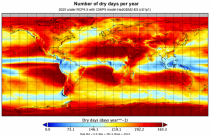
This dataset provides global bioclimatic indicators derived from CMIP5 climate projections. These bioclimatic indicators describe how the climate affects ecosystems, the services ecosystems deliver and nature’s biodiversity. They are specifically relevant for applications within the biodiversity and ecosystem community.

calendar_today Interval/period: Sun, 01/01/1950 - Thu, 12/31/2099
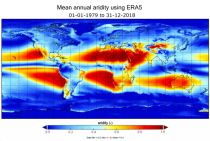
This dataset provides a historical global reconstruction of bioclimatic indicators derived from ERA5 reanalysis on a latitude-longitude grid. These bioclimate indicators describe how the climate affects ecosystems, the services they deliver, and nature’s biodiversity. They are specifically relevant for applications within the biodiversity and ecosystem services community.

calendar_today Interval/period: Mon, 01/01/1979 - Mon, 12/31/2018
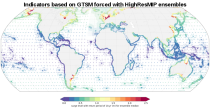
This dataset provides statistical indicators of tides, storm surges and sea level that can be used to characterize global sea level in present-day conditions and also to assess changes under climate change. The indicators calculated include extreme-value indicators (e.g. return periods including confidence bounds for total water levels and surge levels), probability indicators (e.g. percentile for total water levels and surge levels).

calendar_today Interval/period: Mon, 01/01/1951 - Sat, 12/31/2050
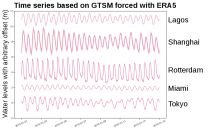
This dataset provides time series of global sea level related variables including tides, storm surges and sea level rise from 1950 to 2050 based on hydrodynamic modelling. The dataset provides a basis for studies, for instance, aiming to evaluate sea level variability, coastal flooding, coastal erosion, and accessibility of ports.

calendar_today Interval/period: Sun, 01/01/1950 - Sat, 12/31/2050
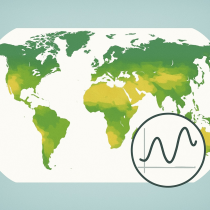
ERA5-Land is a reanalysis dataset providing a consistent view of the evolution of land variables over several decades at an enhanced resolution compared to the
Fifth Generation of the European Centre for Medium-Range Weather Forecasts (ECMWF) Reanalysis (ERA5).
Produced by replaying only the land component of the ECMWF ERA5 climate reanalysis, it benefits from the same physical data-assimilation framework but runs offline at
higher spatial detail (9 km grid) to deliver richer land-surface information.

calendar_today Interval/period: Sun, 01/01/1950 - Thu, 12/31/2026
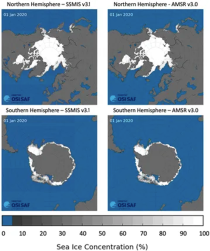
This dataset provides daily gridded data of sea ice concentration for both hemispheres derived from satellite passive microwave brightness temperatures. Sea ice is an important component of our climate system and a sensitive indicator of climate change. Its presence or its retreat has a strong impact on air-sea interactions, the Earth’s energy budget as well as marine ecosystems. It is recognised by the Global Climate Observing System as an Essential Climate Variable.

calendar_today Interval/period: Sun, 10/01/1978 - Mon, 09/29/2025
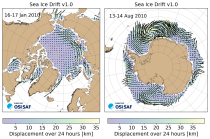
This dataset provides daily gridded fields of sea ice drift vectors for both hemispheres derived from satellite passive microwave brightness temperatures and atmospheric reanalysis data. Sea ice is an important component of our climate system and a sensitive indicator of climate change. Its presence or retreat significantly affects ocean-atmosphere interactions, the Earth’s energy budget as well as marine ecosystems. It is classified as an Essential Climate Variable by the Global Climate Observing System.

calendar_today Interval/period: Tue, 01/01/1991 - Thu, 12/31/2020
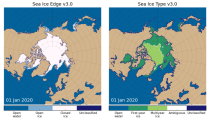
This dataset provides daily gridded data of sea ice edge and sea ice type derived from brightness temperatures measured by satellite passive microwave radiometers. Sea ice is an important component of our climate system and a sensitive indicator of climate change. Its presence or its retreat has a strong impact on air-sea interactions, the Earth’s energy budget as well as marine ecosystems. It is recognized by the Global Climate Observing System as an Essential Climate Variable. Sea ice edge and type are some of the parameters used to characterise sea ice.

calendar_today Interval/period: Wed, 10/25/1978 - Wed, 09/24/2025
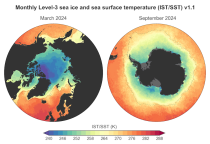
This dataset provides daily and monthly sea ice surface temperature (IST) fields over the polar oceans from 1982 to the present. The data are derived from thermal infrared measurements from a single satellite sensor type: the Advanced Very High Resolution Radiometer (AVHRR) onboard National Oceanic and Atmospheric Administration (NOAA) and Meteorological Operational (MetOp) satellites.

calendar_today Interval/period: Mon, 01/01/1979 - Tue, 09/30/2025
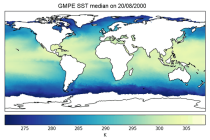
This dataset provides global daily sea surface temperature (SST) data from the Group for High Resolution Sea Surface Temperature (GHRSST) multi-product ensemble (GMPE) produced by the European Space Agency SST Climate Change Initiative (ESA SST CCI). The GMPE system was designed to allow users to compare the outputs from different SST analysis systems and understand their similarities and differences. Although originally intended for comparison of near real time data, it has also been used to compare long historical datasets.

calendar_today Interval/period: Tue, 09/01/1981 - Sat, 12/31/2016
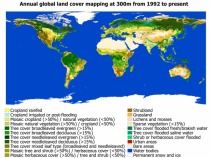
This dataset provides global maps describing the land surface into 22 classes, which have been defined using the United Nations Food and Agriculture Organization’s (UN FAO) Land Cover Classification System (LCCS). In addition to the land cover (LC) maps, four quality flags are produced to document the reliability of the classification and change detection.

calendar_today Interval/period: Wed, 01/01/1992 - Sat, 01/01/2022
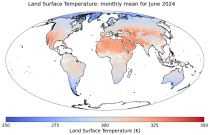
This dataset contains monthly daytime and nighttime clear-sky land surface temperatures (LSTs) and their uncertainty estimates from multiple Infra-Red (IR) instruments on polar orbiting satellites. Daytime and nighttime temperatures correspond to 10:00 and 22:00 local solar time (local solar time is defined as the time in a 24 hour day with 12 noon occurring when the sun is at its highest point at that longitude).

calendar_today Interval/period: Thu, 06/01/1995 - Tue, 12/31/2024
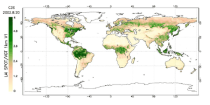
This catalogue entry provides satellite-derived estimates of two related variables: Leaf Area Index (LAI) and fraction of Absorbed Photosynthetically Active Radiation (fAPAR). LAI and fAPAR are both Essential Climate Variables (ECVs) as defined by the Global Climate Observing System (GCOS), meaning they have been designated as essential for contributing to a comprehensive view of Earth’s climate, its variability and trends.

calendar_today Interval/period: Tue, 09/01/1981 - Sun, 12/01/2024
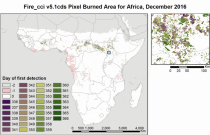
The Burned Area products provide global information of total burned area (BA) at pixel and grid scale. The BA is identified with the date of first detection of the burned signal in the case of the pixel product, and with the total BA per grid cell in the case of the grid product. The products were obtained through the analysis of reflectance changes from medium resolution sensors (Terra MODIS, Sentinel-3 OLCI), supported by the use of MODIS thermal information.

calendar_today Interval/period: Mon, 01/01/2001 - Fri, 04/01/2022
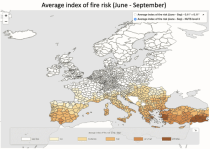
The dataset presents projections of fire danger indicators for Europe based upon the Canadian Fire Weather Index System (FWI) under future climate conditions. The FWI is a meteorologically based index used worldwide to estimate the fire danger and is implemented in the Global ECMWF Fire Forecasting model (GEFF). In this dataset, daily FWI values, seasonal FWI values, and other FWI derived, threshold-specific, indicators were modelled using the GEFF model to estimate the fire danger in future climate scenarios.

calendar_today Interval/period: N/A

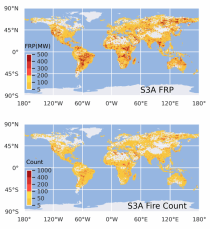
This dataset provides global information on the timing and location of Active Fires (AF) burning on Earth's surface during satellite overpasses, and also records their Fire Radiative Power (FRP) as a measure of strength. FRP relates to a fire's combustion rate, and the rate at which smoke containing greenhouse gases, reactive gases and particular matter is released into the atmosphere. The vast majority of detected hotspots are related to landscape fires, however other high temperature targets such as active volcanoes and gas flares are also present in the data.

calendar_today Interval/period: Wed, 01/01/2020 - Fri, 02/28/2025
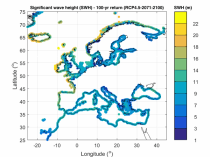
The dataset presents wave climate indicators based upon ocean surface wave parameters computed for a European-wide domain. This dataset provides an understanding of the European wave climate under the impact of climate change. It provides added value for various coastal sectors and studies such as port, shipping, and coastal management.

calendar_today Interval/period: Thu, 01/01/1976 - Fri, 12/31/2100
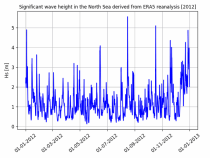
The dataset presents time series of the coastal wave climate based upon ocean surface wave parameters computed for a European-wide domain. This dataset provides an understanding of the wave climate under the impact of climate change for the Northwest European Shelf and Mediterranean Sea. It provides added value for various coastal sectors and studies such as port, shipping, and coastal management.

calendar_today Interval/period: Thu, 01/01/1976 - Fri, 12/31/2100