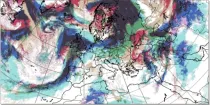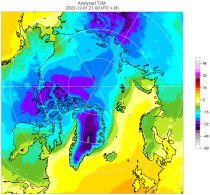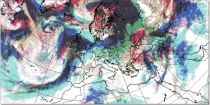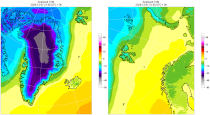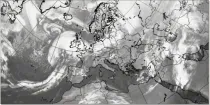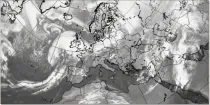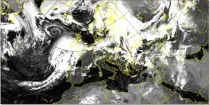
Simulated visible images show simulations of the upward flux of radiation (as would be detected by a weather satellite) derived from information using the model representation of temperatures and cloud layers.

calendar_today Interval/period: N/A

open_in_newview in Open Charts

This display helps with the recognition of clouds of different layers, even when they overlap. Brighter colouring represents greater cloud cover. Cloud-free areas appear white while areas of full cloud cover at all levels appear dark grey (e.g. active fronts)...

calendar_today Interval/period: N/A

open_in_newview in Open Charts
The C3S Arctic Regional Reanalysis second generation (CARRA2) dataset contains daily and monthly meteorological variables at 2.5 km resolution. These variables are specified at single levels (including surface) and also at soil, height, pressure and model levels. These daily and monthly data are pre-calculated and have the following types depending on the variables: daily and monthly averages, extremes and totals.

calendar_today Interval/period: Wed, 01/01/1986 - Sun, 12/31/2023
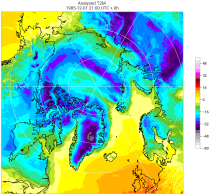
The C3S Arctic Regional Reanalysis second generation (CARRA2) dataset contains 3-hourly analyses at 2.5 km resolution. These variables are specified at single levels (including surface) and also at soil, height, pressure and model levels. Additionally, hourly forecasts are available between the analysis times and particularly forecasts up to 18 hours initialised from the analyses at 00 and 12 UTC.

calendar_today Interval/period: Wed, 01/01/1986 - Sun, 12/31/2023
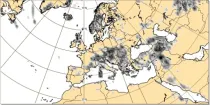
This chart shows probability information regarding visibility near the surface derived from the ...

calendar_today Interval/period: N/A

open_in_newview in Open Charts

This display helps with the recognition of clouds of different layers, even when they overlap. Brighter colouring represents greater cloud cover. Cloud-free areas appear white while areas of full cloud cover at all levels appear dark grey (e.g. active fronts)...

calendar_today Interval/period: N/A

open_in_newview in Open Charts
The daily and monthly data of the C3S Arctic Regional Reanalysis (CARRA) dataset contains daily and monthly meteorological variables at 2.5 km resolution. This includes fields at the single levels (including surface) and on pressure, height, soil and model levels.
These daily and monthly data are pre-calculated and have the following types depending on the variables: daily and monthly averages, extremes and totals.

calendar_today Interval/period: Sat, 09/01/1990 - Sat, 02/28/2026
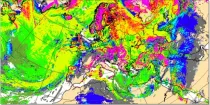
Cloud base height is derived by upwardly searching the structure of the model atmosphere to find the altitude where the cloud fraction becomes >1% and...

calendar_today Interval/period: N/A

open_in_newview in Open Charts
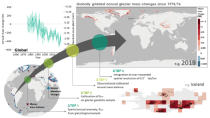
The dataset provides global annual glacier mass changes distributed on a global regular grid at 0.5° resolution (latitude, longitude) based on the Fluctuations of Glaciers (FoG) database of the World Glacier Monitoring Service (WGMS). Glaciers play a fundamental role in the Earth’s water cycles. They are one of the most important freshwater resources for societies and ecosystems and the recent increase in ice melt contributes directly to the rise of ocean levels.

calendar_today Interval/period: Wed, 01/01/1975 - Sat, 05/09/2026
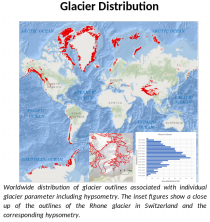
This dataset, commonly known as the Randolph Glacier Inventory (RGI), provides global glacier outlines compiled from maps, aerial photographs and satellite images. The data is provided as a "snapshot" (single time-slice) constructed from images that were mostly acquired in the period 2000-2010.

calendar_today Interval/period: Sat, 01/01/2000 - Sun, 12/31/2000
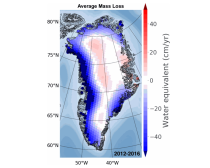
This dataset provides a complete archive of monthly mass change timeseries for the drainage basins of the Antarctic and Greenland Ice Sheets from NASA's Gravity Recovery and Climate Experiment (GRACE) and GRACE Follow On (GRACE-FO) mission, which have operated from 2002 to current data.

calendar_today Interval/period: Wed, 01/01/2003 - Sat, 12/31/2022
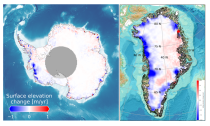
This dataset provides estimates of surface elevation change over the Greenland and Antarctic ice sheets since 1992, utilizing satellite radar altimetry from five missions: ERS-1, ERS-2, ENVISAT, CryoSat-2, and Sentinel-3A. The surface elevation change is modelled over successive, overlapping periods and reported monthly.

calendar_today Interval/period: Wed, 01/01/1992 - Sat, 05/09/2026
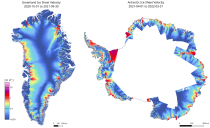
This dataset provides annual ice velocity maps of the Greenland and Antarctic Ice Sheets derived from Sentinel-1 data. The product represents the current state-of-the-art in Europe for satellite-based ice velocity data records. It follows from the European Space Agency (ESA) Climate Change Initiative (CCI) and is guided by the Global Climate Observing System (GCOS) targets for the Ice Sheets Essential Climate Variable (ECV).

calendar_today Interval/period: Sun, 10/01/2017 - Sat, 05/09/2026
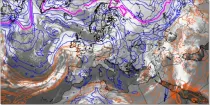
850 hPa wet-bulb potential temperature is commonly used to identify air masses and a strong gradient of wet bulb potential temperature is indicative of fronts between two different air masses...

calendar_today Interval/period: N/A

open_in_newview in Open Charts

The simulated water vapour images generally focus on the upper troposphere. These charts can often indicate dynamical forcing mechanisms (responsible for cyclogenesis) or convective development (related to potential instability)...

calendar_today Interval/period: N/A

open_in_newview in Open Charts

These products display cloud-related fields from the model in a format that is very familiar to forecasters and that they are used to interpreting. They can easily be compared to actual satellite imagery...

calendar_today Interval/period: N/A

open_in_newview in Open Charts

The simulated water vapour images generally focus on the upper troposphere. These charts can often indicate dynamical forcing mechanisms (responsible for cyclogenesis) or convective development (related to potential instability)...

calendar_today Interval/period: N/A

open_in_newview in Open Charts
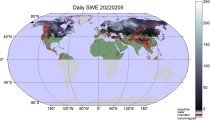
Snow water equivalent (SWE) is an important variable indicating the amount of accumulated snow on land surfaces. SWE describes the amount of liquid water in a snowpack that would be formed if the snowpack was completely melted. This dataset is useful for monitoring snow conditions, freshwater storage, and climate studies. It provides daily estimates of SWE for the Northern Hemisphere from 1979 to present derived from passive microwave radiometer (PMR) measurements onboard polar-orbiting satellites.

calendar_today Interval/period: Tue, 01/02/1979 - Sat, 05/09/2026
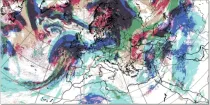
This display helps with the recognition of clouds of different layers, even when they overlap. Brighter colouring represents greater cloud cover. Cloud-free areas appear white while areas of full cloud cover at all levels appear dark grey (e.g. active fronts)...

calendar_today Interval/period: N/A

open_in_newview in Open Charts