
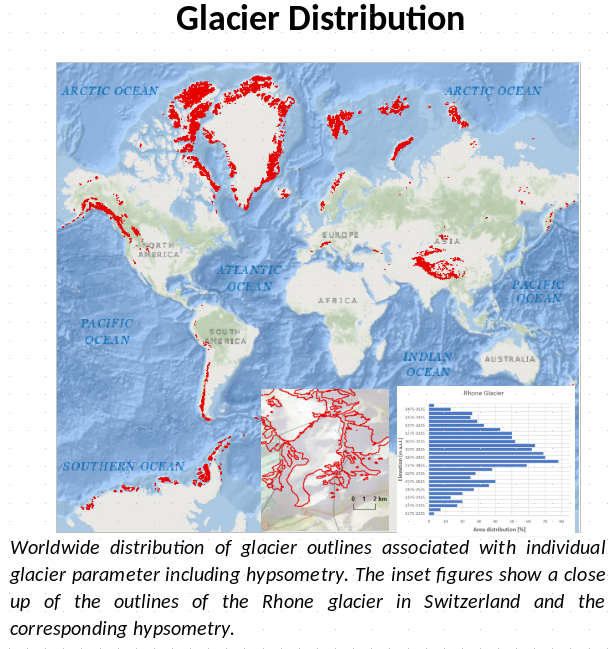
This dataset, commonly known as the Randolph Glacier Inventory (RGI), provides global glacier outlines compiled from maps, aerial photographs and satellite images. The dataset is a snapshot (one outline per glacier) constructed from source data that were mostly acquired in the period 1998-2010.
The dataset represents the latest globally complete and homogenized state-of-the-art glacier outline collection. The regional datasets have been created by scientists from all over the world, including new outlines created within the Copernicus Climate Change Service and were provided to the Global Land Ice Measurements from Space (GLIMS) glacier database at the National Snow and Ice Data Center (NSIDC). Among others, the dataset plays a key role in determining the contribution of glacier melt to global sea-level rise and regional hydrology, as well as modelling of past and future glacier evolution.
The provided RGI is brokered from the NSIDC and consists of three datasets providing:
glacier outlines with attribute information in shape file format
tabular data in csv format describing the area of each glacier in a specific elevation interval, i.e. its hypsometry
a raster field in netCDF format containing the percentage of glacier cover in each grid cell
The RGI data available from NSIDC (shape and csv files) are arranged in 19 first order regions that cover all glacierized regions in the world. The datasets available here include all glaciers in one file. Coordinates are in longitude and latitude with the World Geodetic System 1984 (WGS84) datum.
The RGI glacier outlines provided here are widely used by the glacier community to spatially constrain calculations of the geodetic glacier mass balance - a dataset provided by the World Glacier Monitoring Service (WGMS) and made available in the Copernicus Climate Data Store.
The dataset represents the latest globally complete and homogenized state-of-the-art glacier outline collection. The regional datasets have been created by scientists from all over the world, including new outlines created within the Copernicus Climate Change Service and were provided to the Global Land Ice Measurements from Space (GLIMS) glacier database at the National Snow and Ice Data Center (NSIDC). Among others, the dataset plays a key role in determining the contribution of glacier melt to global sea-level rise and regional hydrology, as well as modelling of past and future glacier evolution.
The provided RGI is brokered from the NSIDC and consists of three datasets providing:
glacier outlines with attribute information in shape file format
tabular data in csv format describing the area of each glacier in a specific elevation interval, i.e. its hypsometry
a raster field in netCDF format containing the percentage of glacier cover in each grid cell
The RGI data available from NSIDC (shape and csv files) are arranged in 19 first order regions that cover all glacierized regions in the world. The datasets available here include all glaciers in one file. Coordinates are in longitude and latitude with the World Geodetic System 1984 (WGS84) datum.
The RGI glacier outlines provided here are widely used by the glacier community to spatially constrain calculations of the geodetic glacier mass balance - a dataset provided by the World Glacier Monitoring Service (WGMS) and made available in the Copernicus Climate Data Store.
Interval
-
DOI
10.24381/cds.553f1387
Portal
Climate Data Store
Product Family
Data
Product Type
Satellite observations
Provider
Copernicus C3S
Spatial Coverage
Global
Temporal Coverage
Past
Variable Domain
Land (cryosphere)