
Datasets

Single prediction that uses
observations prior information about the Earth-system ECMWF's highest-resolution modelHRES Direct model output Products offers "High Frequency products"
Interval/period: N/A
This data set contains net fluxes at the surface, atmospheric mixing ratios at model levels, for carbon dioxide (CO2), methane (CH4) and nitrous oxide (N20).
Interval/period: N/A
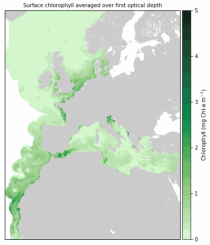
Interval/period: Mon, 01/01/1979 - Mon, 12/31/2018
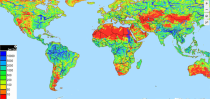
The data are bias adjusted using the Distribution Based Scaling (DBS) method versus the global reference dataset HydroGFD2.0, both bias adjustment method and global reference dataset developed by the Swedish Meteorological and Hydrological Institute (SMHI).
The DBS method is a parametric quantile-mapping variant.
Interval/period: Thu, 10/12/2000 - Thu, 10/18/2018
15-member coupled IFS (cycle 43R1) extended-range reforecast experiment covering the period 1989-2015. The atmosphere is configured with 91 vertical levels and uses the Tco399 cubic octahedral reduced Gaussian grid. The IFS is coupled hourly to the 75 level version of the NEMO v3.4 ocean model and the LIM2 sea-ice model, both of which use the ORCA025 tripolar grid. Coupling follows the implementation used in ECMWF operational forecasts.
Interval/period: N/A
15-member coupled IFS (cycle 43R1) extended-range reforecast experiment covering the period 1989-2015 with bias-corrected sea-surface temperatures (SSTs) in the North Atlantic region. This experiment can be compared with gkzp, which is the relevant control without bias-correction. The atmosphere is configured with 91 vertical levels and uses the Tco399 cubic octahedral reduced Gaussian grid.
Interval/period: N/A
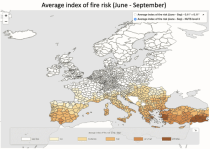
Interval/period: N/A
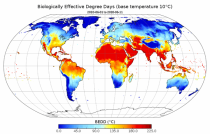
Interval/period: Mon, 01/01/1951 - Mon, 05/11/2026
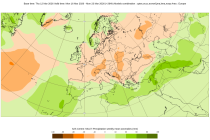
S2S project behind the dataset started in 2013 as a joint initiative of the World Weather Research Programme (WWRP) and the World Climate Research Programme (WCRP).
The goal of S2S project was to improve sub-seasonal forecast skill through combining multiple forecasting systems, enable multi-model evaluations and enhance knowledge sharing between operational centres.
Interval/period: Thu, 01/01/2015 - Wed, 05/06/2026
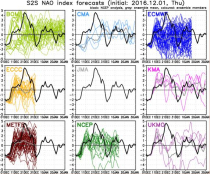
S2S project behind the dataset started in 2013 as a joint initiative of the World Weather Research Programme (WWRP) and the World Climate Research Programme (WCRP).
The goal of S2S project was to improve sub-seasonal forecast skill through combining multiple forecasting systems, enable multi-model evaluations and enhance knowledge sharing between operational centres.
Interval/period: Tue, 03/01/2011 - Tue, 06/09/2026
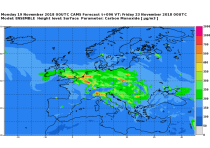
CAMS produces specific daily air quality analyses and forecasts for the European
domain at significantly higher spatial resolution (0.1 degrees, approx. 10km)
than is available from the global analyses and forecasts. The production is
based on an ensemble of eleven air quality forecasting systems across Europe. A
median ensemble is calculated from individual outputs, since ensemble products
Interval/period: Wed, 05/03/2023 - Fri, 05/08/2026
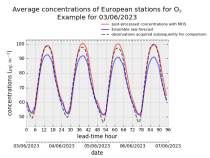
stations after optimisation using a statistical post-processing method called
Model Output Statistics (MOS). The unoptimised "raw" forecasts are also
provided in the same format.
The MOS method uses machine learning with predictive variables including
background air quality observation datasets, ECMWF meteorological forecasts and
the "raw" CAMS European air quality ensemble median forecast. The result is
Interval/period: Wed, 01/17/2024 - Fri, 05/08/2026
Interval/period: Thu, 01/01/2015 - Thu, 05/07/2026
Interval/period: Fri, 03/01/2024 - Thu, 05/07/2026
Interval/period: N/A
Interval/period: Sun, 01/01/1950 - Wed, 12/01/2100
Interval/period: N/A
Interval/period: Mon, 01/01/1940 - Fri, 12/31/2100
Interval/period: N/A
Interval/period: Sun, 01/01/1860 - Mon, 12/31/2300
Interval/period: Wed, 01/01/1800 - Fri, 12/31/2100
Interval/period: Sun, 01/01/1860 - Mon, 12/31/2300
Interval/period: Sun, 01/01/1860 - Mon, 12/31/2300
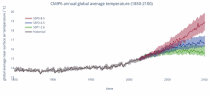
CMIP6 data underpins the Intergovernmental Panel on Climate Change 6th Assessment Report. The use of these data is mostly aimed at:
addressing outstanding scientific questions that arose as part of the IPCC reporting process;
improving the understanding of the climate system;
Interval/period: Sun, 01/01/1860 - Mon, 12/31/2300
Interval/period: Sun, 01/01/1860 - Mon, 12/31/2300