
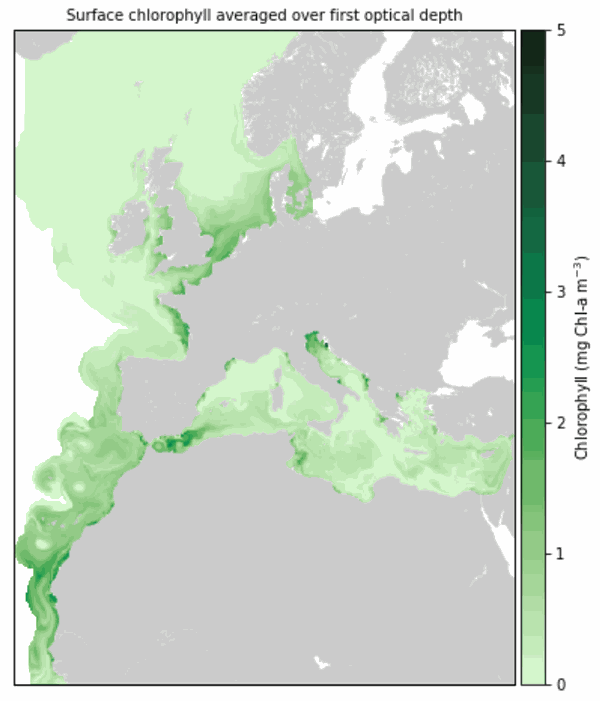
The dataset contains model projections of changes in marine physics and biogeochemistry and the lower trophic levels of the marine food web across the Northwest European Shelf and Mediterranean Sea out to the year 2100. The dataset has been produced using the marine ecosystem model, ERSEM v15.06 (European Regional Seas Ecosystem Model), coupled to the regional ocean circulation models, POLCOMS (the Proudman Oceanographic Laboratory Coastal Ocean Modelling System) and NEMO (Nucleus for European Modelling of the Ocean) using the FABM (Framework for Aquatic Biogeochemical Models) coupler. ERSEM is designed to simulate the cycles of carbon and the major nutrient elements nitrogen, phosphorous and silicon within the marine environment. Organisms at the base of the marine food web – the microscopic aquatic plants known as phytoplankton – play an integral role in these cycles and are explicitly represented in the model. So are the microscopic marine organisms which feed upon them and provide a vital link to commercially exploited species of fish and shell fish higher up the food chain.
POLCOMS and NEMO are well-established physical models with the ability to simulate regions that include both the deep ocean and the continental shelf. They track the movement of water and transfer of energy and momentum in three dimensions, enabling the water temperature, salinity (the salt content of sea water) and currents to be modelled. The coupled POLCOMS/NEMO-ERSEM system makes it possible to include the effects of physical transport and mixing processes on the spatiotemporal distribution of nutrients, phytoplankton, and other components of the marine ecosystem. The dataset includes physical variables, such as horizontal velocity components, temperature and salinity; and a range of biogeochemical variables, including the concentration of dissolved oxygen and the concentration of different nutrients. These variables were simulated under two future scenarios, based on different Representative Concentration Pathways (RCP) for future greenhouse gas emissions: the intermediate scenario, RCP4.5, in which greenhouse gas emissions peak around 2040 before declining; and the business as usual scenario, RCP8.5, in which greenhouse gas emissions continue to rise throughout the century. The hydrodynamic biogeochemical models were each driven by a global climate model generated for the Coupled Model Inter-comparison Project Phase 5 (CMIP5) at the open ocean boundaries, in combination with downscaled atmospheric data generated using the Swedish Meteorological and Hydrological Institute (SMHI) Rossby Centre Regional Atmospheric Model (RCA4).
This dataset was produced on behalf of the Copernicus Climate Change Service.
POLCOMS and NEMO are well-established physical models with the ability to simulate regions that include both the deep ocean and the continental shelf. They track the movement of water and transfer of energy and momentum in three dimensions, enabling the water temperature, salinity (the salt content of sea water) and currents to be modelled. The coupled POLCOMS/NEMO-ERSEM system makes it possible to include the effects of physical transport and mixing processes on the spatiotemporal distribution of nutrients, phytoplankton, and other components of the marine ecosystem. The dataset includes physical variables, such as horizontal velocity components, temperature and salinity; and a range of biogeochemical variables, including the concentration of dissolved oxygen and the concentration of different nutrients. These variables were simulated under two future scenarios, based on different Representative Concentration Pathways (RCP) for future greenhouse gas emissions: the intermediate scenario, RCP4.5, in which greenhouse gas emissions peak around 2040 before declining; and the business as usual scenario, RCP8.5, in which greenhouse gas emissions continue to rise throughout the century. The hydrodynamic biogeochemical models were each driven by a global climate model generated for the Coupled Model Inter-comparison Project Phase 5 (CMIP5) at the open ocean boundaries, in combination with downscaled atmospheric data generated using the Swedish Meteorological and Hydrological Institute (SMHI) Rossby Centre Regional Atmospheric Model (RCA4).
This dataset was produced on behalf of the Copernicus Climate Change Service.
Interval
-
DOI
10.24381/cds.dcc9295c
Portal
Climate Data Store
Product Family
Data
Product Type
Climate projections
Provider
Copernicus C3S
Spatial Coverage
Europe
Temporal Coverage
Present
Future
Variable Domain
Ocean (biology)
Sector
Coastal regions