
Datasets

The SOFF (Systematic Observations Financing Facility) initiative from the WMO is aimed at supporting beneficiary countries to generate and exchange GBON (Global Basic Observing Network) data. These data are critical for improved weather forecasts and climate services.
Interval/period: N/A

The step=0 data from these experiments provides Tco1279 initial conditions derived from ERA5 and IFS CY48R1.1. The type=pf members include perturbations from the ERA5 EDA and singular vectors calculated using IFS CY48R1.1.
Examples
Interval/period: N/A
Coupled ensemble reforecasts using the ECMWF IFS cycle 47r3, configured as follows. The atmosphere is set up with 15 ensemble members, 137 model levels and run on Tco199 cubic octahedral reduced Gaussian grids. The IFS is coupled hourly to a 75-level NEMO v3.4 ocean model and an LIM2 sea ice model, both utilising the ORCA025 tripolar grid with a grid spacing of approximately 0.25 degrees. The ocean and atmosphere are fully coupled throughout the 46-day forecast, producing output every 12 hours. Fifteen reforecasts are used.
Interval/period: N/A
Coupled ensemble reforecasts using the ECMWF IFS cycle 47r3, configured as follows. The atmosphere is set up with 15 ensemble members, 137 model levels and run on Tco199 cubic octahedral reduced Gaussian grids. The IFS is coupled hourly to a 75-level NEMO v3.4 ocean model and an LIM2 sea ice model, both utilising the ORCA025 tripolar grid with a grid spacing of approximately 0.25 degrees. The ocean and atmosphere are fully coupled throughout the 46-day forecast, producing output every 12 hours. Fifteen reforecasts are used.
Interval/period: N/A
Coupled ensemble reforecasts using the ECMWF IFS cycle 47r3, configured as follows. The atmosphere is set up with 15 ensemble members, 137 model levels and run on Tco319 cubic octahedral reduced Gaussian grids. The IFS is coupled hourly to a 75-level NEMO v3.4 ocean model and an LIM2 sea ice model, both utilising the ORCA025 tripolar grid with a grid spacing of approximately 0.25 degrees. The ocean and atmosphere are fully coupled throughout the 46-day forecast, producing output every 12 hours. Fifteen reforecasts are used.
Interval/period: N/A
Coupled ensemble reforecasts using the ECMWF IFS cycle 47r3, configured as follows. The atmosphere is set up with 15 ensemble members, 137 model levels and run on Tco319 cubic octahedral reduced Gaussian grids. The IFS is coupled hourly to a 75-level NEMO v3.4 ocean model and an LIM2 sea ice model, both utilising the ORCA025 tripolar grid with a grid spacing of approximately 0.25 degrees. The ocean and atmosphere are fully coupled throughout the 46-day forecast, producing output every 12 hours. Fifteen reforecasts are used.
Interval/period: N/A
Stratospheric sudden warming 2018 simulation at TCo319L137 resolution for start date 2018020800. This is free-running experiment (i.e., not nudged) described in the paper: "Increased vertical resolution in the stratosphere reveals role of gravity waves after sudden stratospheric warmings" (https://wcd.copernicus.org/articles/4/81/2023/)
Examples
Interval/period: N/A
Stratospheric sudden warming 2018 simulation at TCo319L198 resolution for start date 2018020800. This is free-running experiment (i.e., not nudged) described in the paper: "Increased vertical resolution in the stratosphere reveals role of gravity waves after sudden stratospheric warmings" (https://wcd.copernicus.org/articles/4/81/2023/)
Examples
Interval/period: N/A
Stratospheric sudden warming 2018 simulation at TCo319L91 resolution for start date 2018020800. This is free-running experiment (i.e., not nudged) described in the paper: "Increased vertical resolution in the stratosphere reveals role of gravity waves after sudden stratospheric warmings" (https://wcd.copernicus.org/articles/4/81/2023/)
Examples
Interval/period: N/A
Coupled ensemble reforecasts using the ECMWF IFS cycle 47r3, configured as follows. The atmosphere is set up with 15 ensemble members, 137 model levels and run on Tco639 cubic octahedral reduced Gaussian grids. The IFS is coupled hourly to a 75-level NEMO v3.4 ocean model and an LIM2 sea ice model, both utilising the ORCA025 tripolar grid with a grid spacing of approximately 0.25 degrees. The ocean and atmosphere are fully coupled throughout the 46-day forecast, producing output every 12 hours. Fifteen reforecasts are used.
Interval/period: N/A
Coupled ensemble reforecasts using the ECMWF IFS cycle 47r3, configured as follows. The atmosphere is set up with 15 ensemble members, 137 model levels and run on Tco639 cubic octahedral reduced Gaussian grids. The IFS is coupled hourly to a 75-level NEMO v3.4 ocean model and an LIM2 sea ice model, both utilising the ORCA025 tripolar grid with a grid spacing of approximately 0.25 degrees. The ocean and atmosphere are fully coupled throughout the 46-day forecast, producing output every 12 hours. Fifteen reforecasts are used.
Interval/period: N/A
Stratospheric sudden warming 2006 simulation at TCo639L137 resolution for start date 2006011700. This is free-running experiment (i.e., not nudged) described in the paper: "Increased vertical resolution in the stratosphere reveals role of gravity waves after sudden stratospheric warmings" (https://wcd.copernicus.org/articles/4/81/2023/)
Examples
Interval/period: N/A
Stratospheric sudden warming 2010 simulation at TCo639L137 resolution for start date 2010020500. This is free-running experiment (i.e., not nudged) described in the paper: "Increased vertical resolution in the stratosphere reveals role of gravity waves after sudden stratospheric warmings" (https://wcd.copernicus.org/articles/4/81/2023/)
Examples
Interval/period: N/A
Stratospheric sudden warming 2018 simulation at TCo639L137 resolution for start date 2018020800. This is free-running experiment (i.e., not nudged) described in the paper: "Increased vertical resolution in the stratosphere reveals role of gravity waves after sudden stratospheric warmings" (https://wcd.copernicus.org/articles/4/81/2023/)
Examples
Interval/period: N/A
Stratospheric sudden warming 2006 simulation at TCo639L198 resolution for start date 2006011700. This is free-running experiment (i.e., not nudged) described in the paper: "Increased vertical resolution in the stratosphere reveals role of gravity waves after sudden stratospheric warmings" (https://wcd.copernicus.org/articles/4/81/2023/)
Examples
Interval/period: N/A
Stratospheric sudden warming 2010 simulation at TCo639L198 resolution for start date 2010020500. This is free-running experiment (i.e., not nudged) described in the paper: "Increased vertical resolution in the stratosphere reveals role of gravity waves after sudden stratospheric warmings" (https://wcd.copernicus.org/articles/4/81/2023/)
Examples
Interval/period: N/A
Stratospheric sudden warming 2018 simulation at TCo639L198 resolution for start date 2018020800. This is free-running (i.e, not nudged) experiment described in the paper: "Increased vertical resolution in the stratosphere reveals role of gravity waves after sudden stratospheric warmings" (https://wcd.copernicus.org/articles/4/81/2023/)
Examples
Interval/period: N/A
Stratospheric sudden warming 2006 simulation at TCo639L91 resolution for start date 2006011700. This is free-running experiment (i.e., not nudged) described in the paper: "Increased vertical resolution in the stratosphere reveals role of gravity waves after sudden stratospheric warmings" (https://wcd.copernicus.org/articles/4/81/2023/)
Examples
Interval/period: N/A
Stratospheric sudden warming 2010 simulation at TCo639L91 resolution for start date 2010020500. This is free-running experiment (i.e., not nudged) described in the paper: "Increased vertical resolution in the stratosphere reveals role of gravity waves after sudden stratospheric warmings" (https://wcd.copernicus.org/articles/4/81/2023/)
Examples
Interval/period: N/A
Stratospheric sudden warming 2018 simulation at TCo639L91 resolution for start date 2018020800. This is free-running experiment (i.e., not nudged) described in the paper: "Increased vertical resolution in the stratosphere reveals role of gravity waves after sudden stratospheric warmings" (https://wcd.copernicus.org/articles/4/81/2023/)
Examples
Interval/period: N/A
Stratospheric sudden warming 2018 simulation at TCo639L91 resolution for start date 2018020800. This nudged experiment described in the paper: "Increased vertical resolution in the stratosphere reveals role of gravity waves after sudden stratospheric warmings" (https://wcd.copernicus.org/articles/4/81/2023/)
Examples
Interval/period: N/A
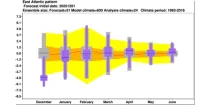
The ECMWF seasonal forecasts (SEAS5) are produced every month with a 51-member ensemble at a ...
Interval/period: N/A
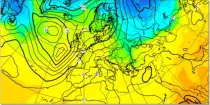
In the northern hemisphere the air rotates anti-clockwise around low contour centres and clockwise around the high contour centres. In the southern hemisphere the air rotates clockwise around low contour centres and ...
Interval/period: N/A
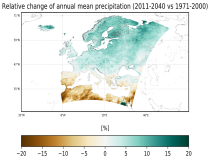
ECV datasets provide the empirical evidence needed to understand the current climate and predict future changes.
CIIs contain condensed climate information which facilitate relatively quick and efficient subsequent analysis. Therefore, CIIs make climate information accessible to application focussed users within a sector.
Interval/period: N/A
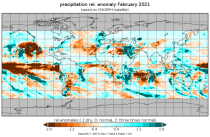
Interval/period: Thu, 01/01/1750 - Fri, 01/01/2021