
Datasets

A pre-operational Data Targeting System (DTS) was developed to assess the feasibility of operational adaptive control of the observing system and as a facility to aid research projects using data targeting. The DTS was developed and hosted at ECMWF. The work was jointly funded by EUCOS and the EC as part of the PREVIEW Integrated Project (work package WP3320) of the EU 6th Framework Programme.
Interval/period: N/A
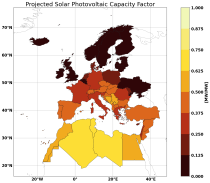
Interval/period: Sun, 01/01/1950 - Wed, 12/01/2100
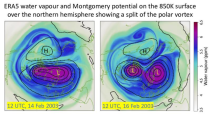
Interval/period: Sat, 01/01/1949 - Mon, 08/10/2026
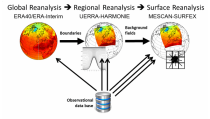
Interval/period: Thu, 10/18/2018 - Wed, 07/31/2019
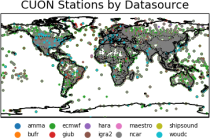
to contain all available observations from balloons ascents through the atmosphere.
The main geophysical variables are temperature, humidity, and wind speed and wind direction,
as functions of atmospheric pressure levels. The observation platforms include pilot balloons, radiosondes, and ozonesondes.
The main observation data sources are:
- the NOAA Integrated Global Radiosonde Archive (IGRA version 2),
- the NCAR Upper-Air Database (UADB), and
Interval/period: Tue, 01/01/1901 - Tue, 12/31/2024
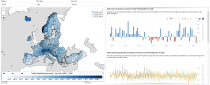
Interval/period: Mon, 01/01/1940 - Fri, 12/31/2100
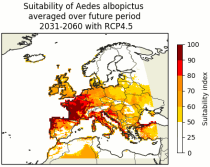
Interval/period: N/A
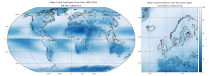
Interval/period: Mon, 01/01/1979 - Mon, 06/30/2025
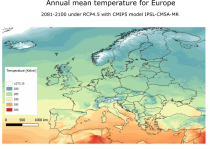
Interval/period: Sun, 01/01/1950 - Thu, 12/31/2099
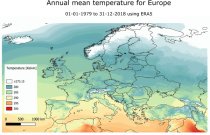
Interval/period: Mon, 01/01/1979 - Mon, 12/31/2018
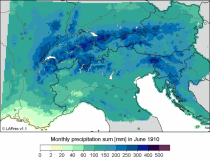
LAPrec1871 starts in 1871 and is based on data from 85 input series;
LAPrec1901 starts in 1901 and is based on data from 165 input series.
Interval/period: Sun, 01/01/1871 - Mon, 08/10/2026
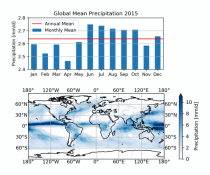
Interval/period: Sat, 01/01/2000 - Sun, 12/31/2017
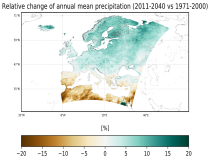
ECV datasets provide the empirical evidence needed to understand the current climate and predict future changes.
CIIs contain condensed climate information which facilitate relatively quick and efficient subsequent analysis. Therefore, CIIs make climate information accessible to application focussed users within a sector.
Interval/period: N/A
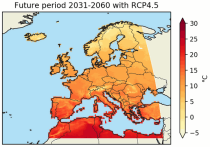
Interval/period: Wed, 01/01/1986 - Mon, 12/31/2085
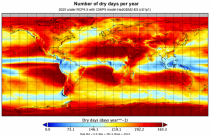
Interval/period: Sun, 01/01/1950 - Thu, 12/31/2099
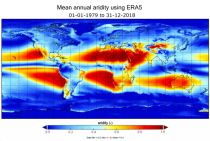
Interval/period: Mon, 01/01/1979 - Mon, 12/31/2018
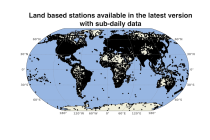
Interval/period: Sat, 01/01/1718 - Thu, 02/26/2026
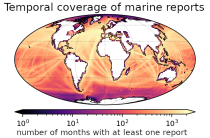
and naval ships, drifting buoys and other platforms and vessels over
the global ocean. Data have been collated and harmonised and quality control checks have been performed, but no attempt
has been made to assess or correct for potential biases.
Data are provided for a range of commonly observed variables.
Interval/period: Tue, 01/01/1850 - Mon, 08/10/2026
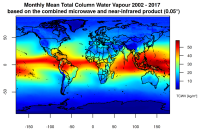
This catalogue entry presents two extensive, high-quality observational datasets of TCWV, specifically tailored for climate analysis and applications.
Interval/period: Tue, 01/01/2002 - Sun, 12/31/2017
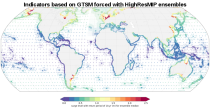
Interval/period: Mon, 01/01/1951 - Sat, 12/31/2050
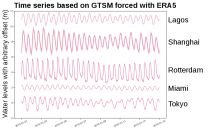
Interval/period: Sun, 01/01/1950 - Sat, 12/31/2050
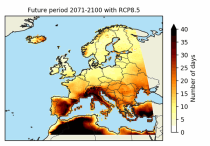
These heat wave and cold spell days are available for different future time periods and use different climate change scenarios.
Interval/period: Wed, 01/01/1986 - Mon, 12/31/2085
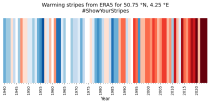
Data is available from 1940 onwards. ERA5 replaces the ERA-Interim reanalysis.
Interval/period: Mon, 01/01/1940 - Fri, 12/06/2024
Fifth Generation of the European Centre for Medium-Range Weather Forecasts (ECMWF) Reanalysis (ERA5).
Produced by replaying only the land component of the ECMWF ERA5 climate reanalysis, it benefits from the same physical data-assimilation framework but runs offline at
higher spatial detail (9 km grid) to deliver richer land-surface information.
Interval/period: Sun, 01/01/1950 - Thu, 12/31/2026
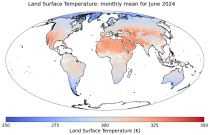
Interval/period: Thu, 06/01/1995 - Tue, 12/31/2024