
Datasets
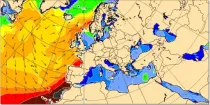
Mean wave period is the spectrally averaged period of the waves. Wave periods are shown in seconds using colour shading – click on the middle icon to the bottom right for the scale...
Interval/period: N/A
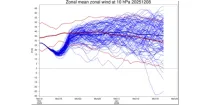
This shows the daily distribution and evolution of mean zonal wind at 10hPa at 60N or 60S. ...
Interval/period: N/A

Interval/period: N/A
Interval/period: N/A
Interval/period: N/A
Interval/period: N/A
Interval/period: N/A
Interval/period: N/A
Interval/period: N/A
Interval/period: N/A
Interval/period: N/A
Interval/period: N/A

Standalone ecWAM wave model CY50R1 with altimeter wave height assimilation forced by corrected ERA5 hourly neutral 10m winds, air density, gustiness and sea ice fraction (2024-2025). Native grid is Tco1279 (9km), 36 directions, 36 frequencies. See Bidlot et al. 2026: Wave Hindcast for ERA6 Preparation and Training Data Driven Models. ECMWF Tech Memo, in preparation, 6-hourly output, many parameters.
Interval/period: N/A
Standalone ecWAM wave model CY50R1 with altimeter wave height assimilation forced by corrected ERA5 hourly neutral 10m winds, air density, gustiness and sea ice fraction (2026). Native grid is Tco1279 (9km), 36 directions, 36 frequencies. See Bidlot et al. 2026: Wave Hindcast for ERA6 Preparation and Training Data Driven Models. ECMWF Tech Memo, in preparation, 6-hourly output, many parameters.
Interval/period: N/A
Standalone ecWAM wave model CY50R1 with altimeter wave height assimilation forced by operational lwda 6-hourly stress equivalent neutral 10m winds, air density, gustiness and sea ice fraction (2016-2018). Native grid is Tco1279 (9km), 36 directions, 36 frequencies. See Bidlot et al. 2026: Wave Hindcast for ERA6 Preparation and Training Data Driven Models. ECMWF Tech Memo, in preparation, 6-hourly output, many parameters.
Interval/period: N/A
Standalone ecWAM wave model CY50R1 with altimeter wave height assimilation forced by operational lwda 6-hourly stress equivalent neutral 10m winds, air density, gustiness and sea ice fraction (2019-2025). Native grid is Tco1279 (9km), 36 directions, 36 frequencies. See Bidlot et al. 2019: Wave Hindcast for ERA6 Preparation and Training Data Driven Models. ECMWF Tech Memo, in preparation, 6-hourly output, many parameters.
Interval/period: N/A
Standalone ecWAM wave model CY50R1 with altimeter wave height assimilation forced by CY50R1 e-suites and operational lwda 6-hourly stress equivalent neutral 10m winds, air density, gustiness and sea ice fraction AND surface currents from ORAS6 (2024-05-02-2026). Native grid is Tco1279 (9km), 36 directions, 36 frequencies, current refraction. See Bidlot et al. 2026: Wave Hindcast for ERA6 Preparation and Training Data Driven Models. ECMWF Tech Memo, in preparation, 6-hourly output, many parameters.
Interval/period: N/A
The step=0 data from these experiments provides Tco1279 initial conditions derived from ERA5 and IFS CY48R1.1. The type=pf members include perturbations from the ERA5 EDA and singular vectors calculated using IFS CY48R1.1.
Examples
Interval/period: N/A
Coupled ensemble reforecasts using the ECMWF IFS cycle 47r3, configured as follows. The atmosphere is set up with 15 ensemble members, 137 model levels and run on Tco199 cubic octahedral reduced Gaussian grids. The IFS is coupled hourly to a 75-level NEMO v3.4 ocean model and an LIM2 sea ice model, both utilising the ORCA025 tripolar grid with a grid spacing of approximately 0.25 degrees. The ocean and atmosphere are fully coupled throughout the 46-day forecast, producing output every 12 hours. Fifteen reforecasts are used.
Interval/period: N/A
Coupled ensemble reforecasts using the ECMWF IFS cycle 47r3, configured as follows. The atmosphere is set up with 15 ensemble members, 137 model levels and run on Tco199 cubic octahedral reduced Gaussian grids. The IFS is coupled hourly to a 75-level NEMO v3.4 ocean model and an LIM2 sea ice model, both utilising the ORCA025 tripolar grid with a grid spacing of approximately 0.25 degrees. The ocean and atmosphere are fully coupled throughout the 46-day forecast, producing output every 12 hours. Fifteen reforecasts are used.
Interval/period: N/A
Coupled ensemble reforecasts using the ECMWF IFS cycle 47r3, configured as follows. The atmosphere is set up with 15 ensemble members, 137 model levels and run on Tco319 cubic octahedral reduced Gaussian grids. The IFS is coupled hourly to a 75-level NEMO v3.4 ocean model and an LIM2 sea ice model, both utilising the ORCA025 tripolar grid with a grid spacing of approximately 0.25 degrees. The ocean and atmosphere are fully coupled throughout the 46-day forecast, producing output every 12 hours. Fifteen reforecasts are used.
Interval/period: N/A
Coupled ensemble reforecasts using the ECMWF IFS cycle 47r3, configured as follows. The atmosphere is set up with 15 ensemble members, 137 model levels and run on Tco319 cubic octahedral reduced Gaussian grids. The IFS is coupled hourly to a 75-level NEMO v3.4 ocean model and an LIM2 sea ice model, both utilising the ORCA025 tripolar grid with a grid spacing of approximately 0.25 degrees. The ocean and atmosphere are fully coupled throughout the 46-day forecast, producing output every 12 hours. Fifteen reforecasts are used.
Interval/period: N/A
Stratospheric sudden warming 2018 simulation at TCo319L137 resolution for start date 2018020800. This is free-running experiment (i.e., not nudged) described in the paper: "Increased vertical resolution in the stratosphere reveals role of gravity waves after sudden stratospheric warmings" (https://wcd.copernicus.org/articles/4/81/2023/)
Examples
Interval/period: N/A
Stratospheric sudden warming 2018 simulation at TCo319L198 resolution for start date 2018020800. This is free-running experiment (i.e., not nudged) described in the paper: "Increased vertical resolution in the stratosphere reveals role of gravity waves after sudden stratospheric warmings" (https://wcd.copernicus.org/articles/4/81/2023/)
Examples
Interval/period: N/A
Stratospheric sudden warming 2018 simulation at TCo319L91 resolution for start date 2018020800. This is free-running experiment (i.e., not nudged) described in the paper: "Increased vertical resolution in the stratosphere reveals role of gravity waves after sudden stratospheric warmings" (https://wcd.copernicus.org/articles/4/81/2023/)
Examples
Interval/period: N/A