
When EarthCARE flew directly over the eye of Hurricane Humberto on 28 September 2025, it captured something never seen before from space: observations of the vertical motion of wind, rain and snow within a hurricane eyewall.
These observations are helping ECMWF scientists understand how hurricanes work, and how to forecast them better.
Every year, around 90 tropical cyclones form over warm tropical waters across the globe. Each one of these has the potential to cause major harm and destruction, particularly if they make landfall in a town or city. According to the World Meteorological Organization (WMO), over the past 50 years, tropical cyclones have caused an estimated USD 1.4 trillion in economic losses. As climate change fuels stronger and more destructive storms, the impacts of tropical cyclones are likely to increase. Accurate forecasts of both cyclone strength and path are therefore crucial to mitigate the socio-economic costs of these high-impact weather events.
The making of a cyclone
Tropical cyclones develop from intense thunderstorms that begin to rotate due to the Coriolis force, a consequence of the Earth’s rotation. Heat from warm oceans and the latent heat release from water vapour condensing into cloud and rain invigorates convection, while conservation of angular momentum drives faster wind speeds around a developing core.
Mature cyclones are typically around 200 to 500 kilometres wide, though some can grow to over 1000 kilometres. Those that form in the western Pacific Ocean are known as typhoons, those formed in the eastern Pacific and Atlantic are known as hurricanes, and those that form in the Indian Ocean and southern Pacific are known as tropical cyclones.
Why hurricanes are so hard to predict
Representing tropical cyclones remains a significant challenge for global numerical weather prediction (NWP) and climate models. Even with today’s powerful supercomputers, operational forecast models typically have horizontal resolutions of 5–20 km. This means that while the broad structure of a cyclone can be captured, turbulent motions that drive convection inside the storm occur at scales too fine for the model’s grid to resolve. These processes must instead be represented by functions of resolved variables known as ‘parametrizations’. Uncertainties in these schemes play an important role in forecasting cyclone intensity and structure. Recent work at ECMWF has found that higher model resolution significantly improves tropical cyclone intensity forecasts while modestly improving track forecasts.
High resolution observations are vital to improve the understanding of physical processes acting at scales below the model resolution and to constrain uncertain parameters within the parametrization schemes. In terms of modelling clouds and convection, satellites are particularly valuable, providing consistent, global measurements. The joint European Space Agency (ESA)-Japan Aerospace Exploration Agency (JAXA) Earth Cloud, Aerosol and Radiation Explorer (EarthCARE) mission is the latest and most advanced for studying clouds, aerosols and precipitation and their effects on radiation.
Launched in May 2024, EarthCARE aims to reduce uncertainties in how clouds and aerosols influence the radiation budget of NWP and climate models. Radiation fundamentally drives weather and climate, so it is crucial to get right for accurate forecasts. To achieve this, onboard are four state-of-the-art instruments: a radar, lidar, multi-spectral imager and radiometer. Working in synergy, these sensors are providing new insights into cloud, precipitation and aerosol processes. One of EarthCARE’s most innovative instruments is its Doppler cloud radar, which can detect the vertical motions of hydrometeors within clouds.
Although EarthCARE had made measurements from within several tropical cyclones previously, it was more than a year into its mission before EarthCARE scored its first ‘direct hit’ of a hurricane eye, offering an unprecedented opportunity to study the internal structure and strength of such a powerful storm.
Bullseye! EarthCARE flies over Hurricane Humberto
At 1830 UTC on 28 September 2025, EarthCARE passed directly overhead the eyewall of Hurricane Humberto. At the time, Humberto was an extremely powerful Category 4 hurricane with sustained wind speeds in excess of 209 km/h, travelling in a north-easterly direction.
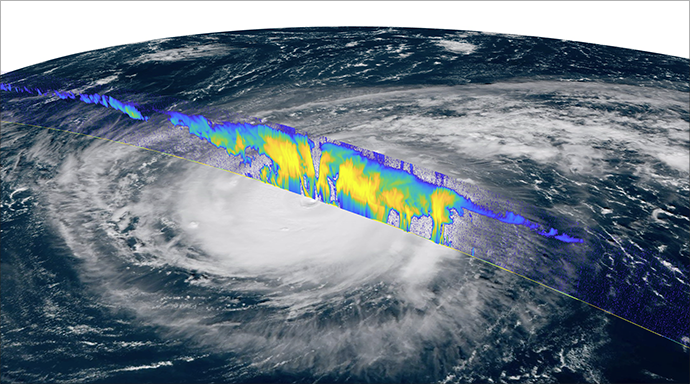
Figure 1: Observations of radar reflectivity from EarthCARE overpassing Category 4 Hurricane Humberto on 28 September 18:30 UTC. Blue and green colours indicate ice cloud and attenuated signal; orange and yellow colours indicate heavy snow and rain.
As shown in Figure 1, visible satellite imagery from the time reveals a narrow eye, less than 20 km across, at the centre of a sprawling 500 km-wide system. High cirrus cloud dominates the image, but the texture of the cloud tops hints at strong convective structures underneath. More insight can be gained from infrared imagery; the white colours in Figure 2 show bands of brightness temperatures of less than -70°C, revealing Humberto’s swirling rain bands. However, it is the EarthCARE observations that allow us to truly dissect the anatomy of Humberto.
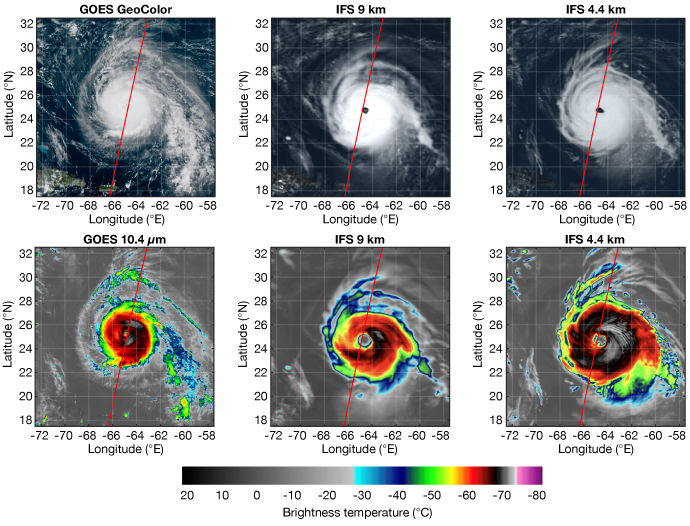
Figure 2: Observed (left) and simulated imagery (centre and right) for Hurricane Humberto on 28 September 18:00 UTC. Top panels show a composite using three visible channels, where brighter colours indicate higher reflectance. Bottom panels show brightness temperatures (°C) from an infrared channel, which are strongly correlated with cloud top temperatures. The red line shows EarthCARE’s track through the hurricane.
Obscured from traditional satellite imagery, EarthCARE reveals a sharp, V-shaped eyewall – characteristic of powerful hurricanes. Using the radar reflectivity structure in Figure 3, we see that the slope is relatively steep at around 45 degrees from vertical. From previous studies (e.g., Hazelton and Hart, 2013), we know that narrower eyes tend to produce steeper walls. Intriguingly, the reflectivity structure also shows a potential eyewall in development between 50–100 km from the centre of the storm. Such a feature suggests the hurricane was undergoing an eyewall replacement cycle. These inner and outer eyewalls are also associated with strong updrafts, as seen in the Doppler velocity (Figure 4). The inner eyewall has greater vertical Doppler velocities, with larger values that exceed 5 m s-1 near the tops of the cloud.
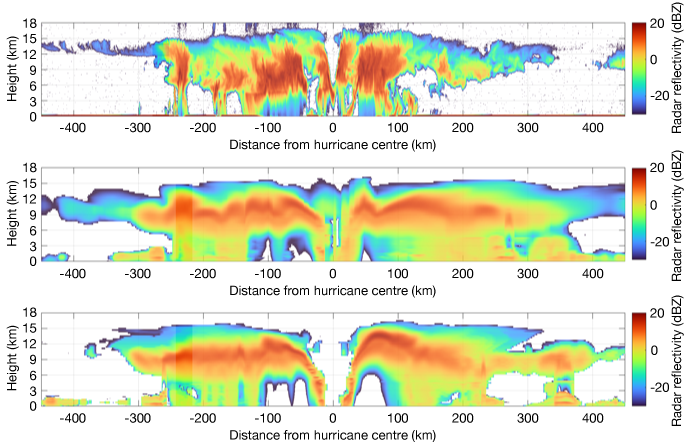
Figure 3: Observed (top panel) and simulated radar reflectivity (9 km horizontal resolution, middle panel; 4.4 km horizontal resolution, bottom panel) along the EarthCARE track as a function of distance from the eye of Hurricane Humberto on 28 September 18:30 UTC.
Putting ECMWF’s forecasts to the test
In order to evaluate the ECMWF model performance, two forecasts were produced, both initialised at midnight on the day of the EarthCARE overpass. The first uses the operational model horizontal resolution of 9 km, while the second uses a 4.4 km resolution, as used in the Destination Earth weather-induced extremes digital twin. Model data were extracted along the EarthCARE track at 1800 UTC and observation simulators are used to produce simulated EarthCARE and satellite imagery observations.
First, the simulated satellite imagery in Figure 2 reveals that both forecasts reproduce similar large-scale cloud structures compared to the GOES observations. The increased horizontal resolution of the 4.4 km model allows it to produce more realistic smaller-scale cloud structures than the 9 km model; for example, it captures multiple cloud bands at the outer edges of the storm. The eye is clearly visible in both the 4.4 km and 9 km models; apparently elongated in the visible imagery for the 4.4 km model due to partial cloud cover over part of the eye. In the infrared imagery, at this particular time, the 4.4 km model has too much ice cloud, particularly in the south-east quadrant of the hurricane.
For both forecasts, radar reflectivity and Doppler velocity are simulated using ‘ZmVar’ (reflectivity model for variational assimilation) – the observation operator that is expected to be used soon to assimilate EarthCARE observations at ECMWF. The increased horizontal resolution of the 4.4 km model clearly helps it to produce more realistic cloud structures. Interestingly, the higher resolution model has an eyewall structure that is very similar to the outer eyewall seen in the EarthCARE observations, but it has not captured the inner eyewall at this stage of the hurricane development. Improving the representation of tropical cyclone eyewall replacement is crucial for the prediction of maximum wind speeds.
New insights from Doppler velocity
A comparison of the observed and simulated Doppler velocities adds a new form of model validation that was never possible before the launch of EarthCARE (Figure 4). The vertical Doppler velocity is the vertical air motion minus the reflectivity-weighted fall speed of rain and snow. When the measurement is positive, it tells us that the vertical motion of air within the cloud is strong enough to overcome the gravitational pull on the rain and snow. Positive vertical Doppler velocities are a strong indicator not only of hail growth, where rain and snow are transported back up through a cloud, but also of lightning.
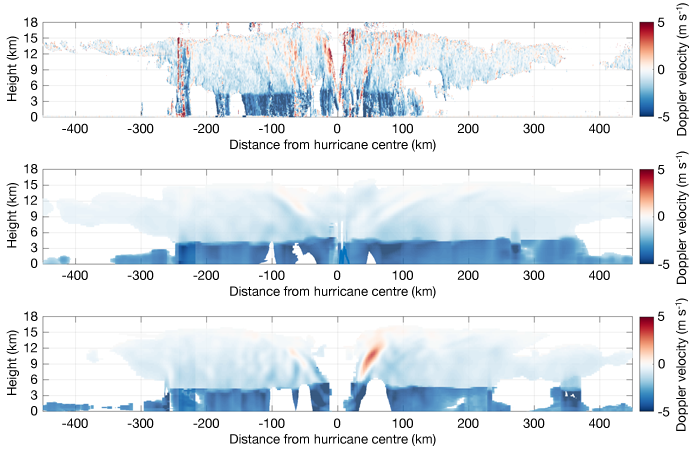
Figure 4: Same as Figure 3, but for observed (top panel) and simulated radar Doppler velocity in the vertical (9 km horizontal resolution, middle panel; 4.4 km horizontal resolution, bottom panel). Positive (negative) values indicate rising (falling) particles.
From the EarthCARE observations, we can see that positive Doppler velocities are present in two regions of the hurricane. Firstly, in the eyewall, rain and snow are lifted from the base of the eyewall, growing and accelerating as moisture condenses up to the very top. These large rain and snow particles then fall down behind the updraft, causing the extreme precipitation outside the eye and eyewall. In this case, the radar signal is attenuated in the heavy rain to the extent that the radar cannot even see the reflection from the surface. Secondly, there is a region of strong updrafts associated with the first rain bands of the hurricane situated 50 km from the eye. The strength and tilt of these updrafts provide further evidence of an eyewall replacement cycle. Using the mean Doppler velocities across these regions, Figure 5 quantifies the difference in particle motion between these updraft regions that drive convection within the hurricane and the rain bands that they produce.
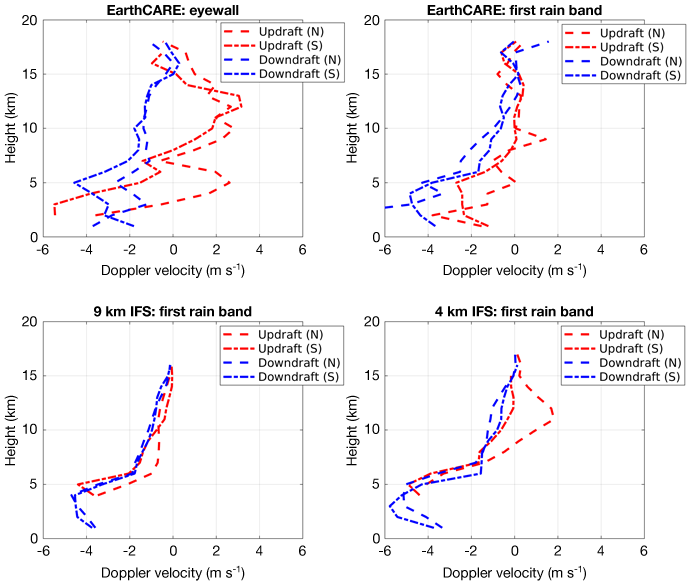
Figure 5: Mean observed and simulated vertical Doppler velocities from within Hurricane Humberto’s eyewall (EarthCARE observations, top left) and the first rain band (EarthCARE, top right; 9 km horizontal resolution IFS, bottom left; and 4 km horizontal resolution IFS, bottom right).
Within the eyewall, mean Doppler velocities are around 2.5 m s-1, peaking at 10-12 km. Outside of these regions, the mean Doppler fall speed towards the ground is around 1.2 m s-1, accelerating to up to 3 m s-1 just above the melting layer. Further down into the cloud, the observations become harder to interpret as multiple scattering can degrade the Doppler velocity measurements. The secondary eyewall – or first rainband – produces weaker updrafts but over a larger area. The mean Doppler velocities in the updrafts are around 0–1 m s-1. Similarly, the Doppler velocity of the precipitation beneath the updrafts is negative, with values between 1 and 2 m s-1 that increase towards the ground as microphysical processes such as aggregation and riming take place.
Both models also show a clear difference in Doppler velocities between the updrafts and surrounding regions. The finer resolution of the 4.4 km model allows it to produce stronger updrafts, leading to positive mean Doppler velocities up to 1 m s-1, showing that rain and snow can be lifted to the top of the hurricane. This leads to large radar reflectivities near cloud top, in agreement with EarthCARE observations. In both forecasts, the increase in negative Doppler velocities as precipitation descends outside of the updrafts also agrees well with EarthCARE observations.
Wider impacts
This analysis only begins to explore the potential for EarthCARE to improve the representation of storms in models. In the hours after this overpass, Hurricane Humberto began to lose intensity as it encountered stronger wind shear and cooler sea surface temperatures. As it travelled north, it merged with Hurricane Imelda and eventually went on to become extratropical cyclone Amy, the first named storm of the season in the UK. Amy was also unusually powerful; its central pressure of 947.9 hPa measured in Shetland was the lowest recorded October pressure in the UK.
A better representation of storms like Humberto will therefore help to improve forecasts of not only hurricanes in the tropics, but also of high-impact weather in Europe.
Top banner image: © Trifonov_Evgeniy/iStock/Getty Images Plus