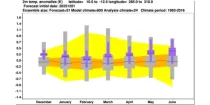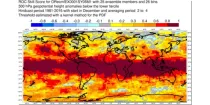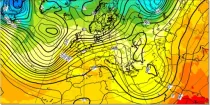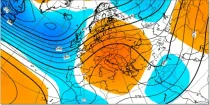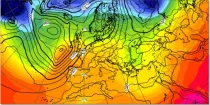
This chart shows 7-day mean anomalies of temperature at 10hPa from the ECMWF Sub-seasonal range ...

calendar_today Interval/period: N/A

open_in_newview in Open Charts

The ECMWF seasonal forecasts (SEAS5) are produced every month with a 51-member ensemble at ...

calendar_today Interval/period: N/A

open_in_newview in Open Charts

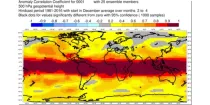
This chart shows the spatial variation in the Anomaly Correlation Coefficient (ACC) for the ...

calendar_today Interval/period: N/A

open_in_newview in Open Charts

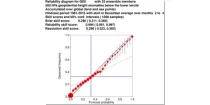
The reliability diagram shows the reliability of the ECMWF seasonal forecast system (SEAS5) with ...

calendar_today Interval/period: N/A

open_in_newview in Open Charts

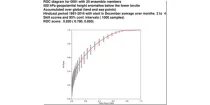
This chart shows the Relative Operating Characteristics (ROC) diagram for the three-month ...

calendar_today Interval/period: N/A

open_in_newview in Open Charts

This chart shows the spatial variation in the Relative Operating Characteristics (ROC) skill ...

calendar_today Interval/period: N/A

open_in_newview in Open Charts

The ECMWF seasonal forecasts (SEAS5) are produced every month with a 51-member ensemble at a ...

calendar_today Interval/period: N/A

open_in_newview in Open Charts

The 850 hPa level is usually just above the boundary layer and at this level the day-night variation in temperature is generally negligible...

calendar_today Interval/period: N/A

open_in_newview in Open Charts

This chart shows 7-day mean anomalies of 500hPa geopotential height from the ECMWF Sub-seasonal ...

calendar_today Interval/period: N/A

open_in_newview in Open Charts

500-1000 hPa thickness is a measure of the mean temperature of a column of the atmosphere between these pressure levels and can be used to distinguish between warm and cold air masses and...

calendar_today Interval/period: N/A

open_in_newview in Open Charts

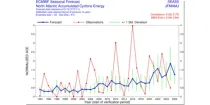
This chart provides information on the verification of forecasts of Accumulated Cyclone Energy ...

calendar_today Interval/period: N/A

open_in_newview in Open Charts

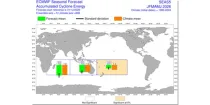
The ECMWF seasonal forecasts (SEAS5) are produced every month with a 51-member ensemble at a ...

calendar_today Interval/period: N/A

open_in_newview in Open Charts

Various thermall comfort parameters showing thermal comfort

calendar_today Interval/period: N/A

open_in_newview in Open Charts

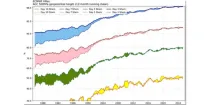
This diagram gives a measure of the effectiveness of the model in forecasting 500 hPa heights at ...

calendar_today Interval/period: N/A

open_in_newview in Open Charts

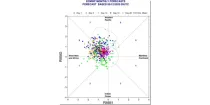
This diagram shows time evolution of a Madden-Julian Oscillation (MJO) index. ...

calendar_today Interval/period: N/A

open_in_newview in Open Charts

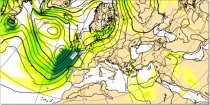
Wind speed at 200 hPa highlights the jet stream (areas of strong winds in the upper troposphere) which can help identify movement and development of depressions...

calendar_today Interval/period: N/A

open_in_newview in Open Charts

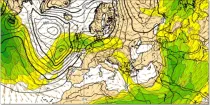
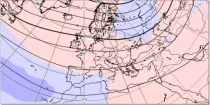
Wind speeds near the surface are roughly proportional to the distance between isobars so closely packed isobars mean strong surface winds...

calendar_today Interval/period: N/A

open_in_newview in Open Charts

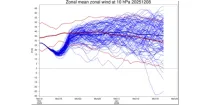
This shows the daily distribution and evolution of mean zonal wind at 10hPa at 60N or 60S. ...

calendar_today Interval/period: N/A

open_in_newview in Open Charts

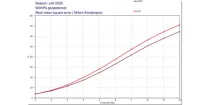
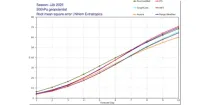
These plots compare recent IFS and experimental AIFS verification scores for 500 hPa ...

calendar_today Interval/period: N/A

open_in_newview in Open Charts

These plots compare recent IFS and experimental AIFS verification scores for 500 hPa ...

calendar_today Interval/period: N/A

open_in_newview in Open Charts
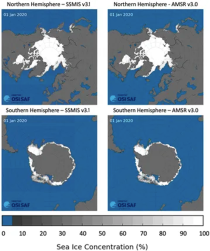
This dataset provides daily gridded data of sea ice concentration for both hemispheres derived from satellite passive microwave brightness temperatures. Sea ice is an important component of our climate system and a sensitive indicator of climate change. Its presence or its retreat has a strong impact on air-sea interactions, the Earth’s energy budget as well as marine ecosystems. It is recognised by the Global Climate Observing System as an Essential Climate Variable.

calendar_today Interval/period: Sun, 10/01/1978 - Mon, 09/29/2025
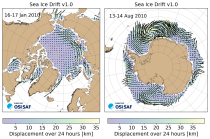
This dataset provides daily gridded fields of sea ice drift vectors for both hemispheres derived from satellite passive microwave brightness temperatures and atmospheric reanalysis data. Sea ice is an important component of our climate system and a sensitive indicator of climate change. Its presence or retreat significantly affects ocean-atmosphere interactions, the Earth’s energy budget as well as marine ecosystems. It is classified as an Essential Climate Variable by the Global Climate Observing System.

calendar_today Interval/period: Tue, 01/01/1991 - Thu, 12/31/2020
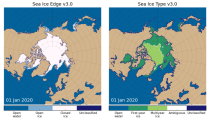
This dataset provides daily gridded data of sea ice edge and sea ice type derived from brightness temperatures measured by satellite passive microwave radiometers. Sea ice is an important component of our climate system and a sensitive indicator of climate change. Its presence or its retreat has a strong impact on air-sea interactions, the Earth’s energy budget as well as marine ecosystems. It is recognized by the Global Climate Observing System as an Essential Climate Variable. Sea ice edge and type are some of the parameters used to characterise sea ice.

calendar_today Interval/period: Wed, 10/25/1978 - Wed, 09/24/2025
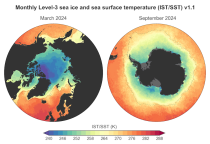
This dataset provides daily and monthly sea ice surface temperature (IST) fields over the polar oceans from 1982 to the present. The data are derived from thermal infrared measurements from a single satellite sensor type: the Advanced Very High Resolution Radiometer (AVHRR) onboard National Oceanic and Atmospheric Administration (NOAA) and Meteorological Operational (MetOp) satellites.

calendar_today Interval/period: Mon, 01/01/1979 - Tue, 09/30/2025
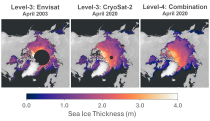
This dataset provides gridded sea ice thickness data for the Arctic, derived from satellite observations. Sea ice plays a vital role in the climate system, influencing air-sea interactions, the Earth’s energy balance, and marine ecosystems. It is recognised by the Global Climate Observing System (GCOS) as an Essential Climate Variable (ECV). Sea ice thickness is a key characteristic used alongside other parameters such as concentration, edge, and type, all available in the Climate Data Store (CDS).

calendar_today Interval/period: Tue, 10/01/2002 - Sat, 04/12/2025