
Datasets

A subset of ECMWF real-time forecast data from the IFS and AIFS models is made available to the public free of charge. Their use is governed by the Creative Commons CC-BY-4.0 licence and the ECMWF Terms of Use.
Interval/period: N/A
Ensemble forecast runs produced by the ECMWF Artificial Intelligence Forecasting System (AIFS) Ensemble model.
4 forecast runs per day (00/06/12/18) 6 hourly steps to 360 (15 days)More information can be found on the implementation page.
X-i: AIFS ENS forecastProduct description
Interval/period: N/A
On 12 May 2026, a new forecast stream will be produced by ECMWF's operational Artificial Intelligence Forecasting System ensemble model (AIFS ENS).
The new forecast stream is for wave forecast runs, marking ECMWF's first operational data-driven wave forecasts.
4 forecast runs per day (00/06/12/18) 6 hourly steps to 360 (15 days)XIII-i: AIFS forecast
Product description
Interval/period: N/A
Single forecast runs produced by the ECMWF Artificial Intelligence Forecasting System (AIFS) deterministic model.
Interval/period: N/A
On 12 May 2026, a new forecast stream will be produced by ECMWF's operational Artificial Intelligence Forecasting System deterministic model (AIFS Single).
The new forecast stream is for wave forecast runs, marking ECMWF's first operational data-driven wave forecasts.
4 forecast runs per day (00/06/12/18) 6 hourly steps to 360 (15 days)XII-i: Deterministic AIFS forecast
Product description
Interval/period: N/A
ECMWF is now running version 2 of its Artificial Intelligence Forecasting System (AIFS). The AIFS consists of a deterministic model, AIFS Single, and an ensemble model, AIFS ENS.
The deterministic model has been running operationally since 25 February 2025 and was upgraded from AIFS Single v1.1 to AIFS Single v2 on 12 May 2026. Further details can be found on the dedicated Implementation of AIFS Single v1 page.
Interval/period: N/A
Ensemble (ENS) of forecasts providing an estimate of the reliability of a single forecast. Currently there are 50 perturbed members in the ensemble.
ENS offers "High Frequency products" until step 144:
Interval/period: N/A
These products are available to the African Center of Meteorological Application for Development (ACMAD) countries.
Based on HRESThe products outlined below are disseminated via EUMETCast
Please refer to WMO Additional products for the equivalent products available on a global domain via the ECMWF's DCPC FTP server.
Interval/period: N/A
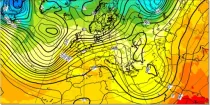
The 850 hPa level is usually just above the boundary layer and at this level the day-night variation in temperature is generally negligible...
Interval/period: N/A
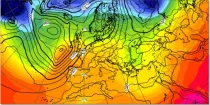
500-1000 hPa thickness is a measure of the mean temperature of a column of the atmosphere between these pressure levels and can be used to distinguish between warm and cold air masses and...
Interval/period: N/A
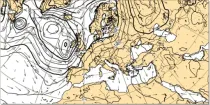
These charts show surface pressure patterns. Areas of high pressure (anticyclones) are usually associated with settled weather...
Interval/period: N/A
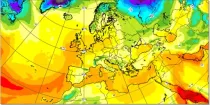
Dew Point Temperature at 2 m above the earth’s surface gives an indication of conditions which a person will experience or feel. High dewpoint temperatures inhibit heat loss from the body by perspriation and...
Interval/period: N/A
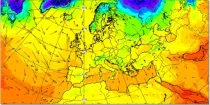
Temperatures at 2 m above the earth’s surface and winds at 10 m above the earth’s surface approximate most closely to the conditions that a person would experience.
Interval/period: N/A
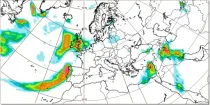
This chart shows probability information regarding point precipitation, as derived from the ...
Interval/period: N/A
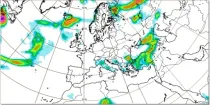
This chart shows probability information regarding point precipitation, as derived from the ...
Interval/period: N/A
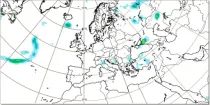
This chart shows probability information regarding point precipitation, as derived from the ...
Interval/period: N/A
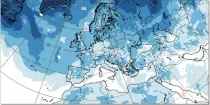
Various thermall comfort parameters showing thermal comfort
Interval/period: N/A
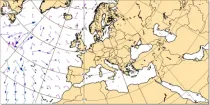
The idea of the plot is to be able to display each spectral partition as an arrow, with the direction being the mean direction, the length of the arrow the significant wave height, the colour of the arrow the mean wave period with the different arrow head for each partitions.
Interval/period: N/A
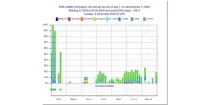
This product is derived from an ensemble of 50 model runs plus Control. Visibility is an ...
Interval/period: N/A
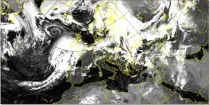
Simulated visible images show simulations of the upward flux of radiation (as would be detected by a weather satellite) derived from information using the model representation of temperatures and cloud layers.
Interval/period: N/A
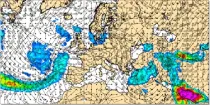
Bulk Wind Shearcharts show the vector value (in wind arrow form) of the shear between the low level, near surface level (10 m) and a mid-tropospheric level (about 6 km)...
Interval/period: N/A
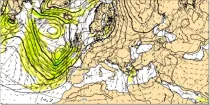
The surface wind is influenced by the roughness of the earth's surface and is likely to be less strong, and a little backed (in the northern hemisphere) or veered (in the southern hemisphere)...
Interval/period: N/A
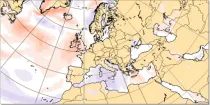
This chart shows the anomaly in the wind speed at 10 m above the earth's surface (in m/s) ...
Interval/period: N/A
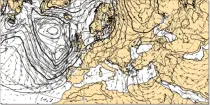
These charts show surface pressure patterns. Areas of high pressure (anticyclones) are usually associated with settled weather...
Interval/period: N/A
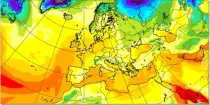
Dew Point Temperature at 2 m above the earth’s surface gives an indication of conditions which a person will experience or feel. High dewpoint temperatures inhibit heat loss from the body by perspriation and...
Interval/period: N/A