
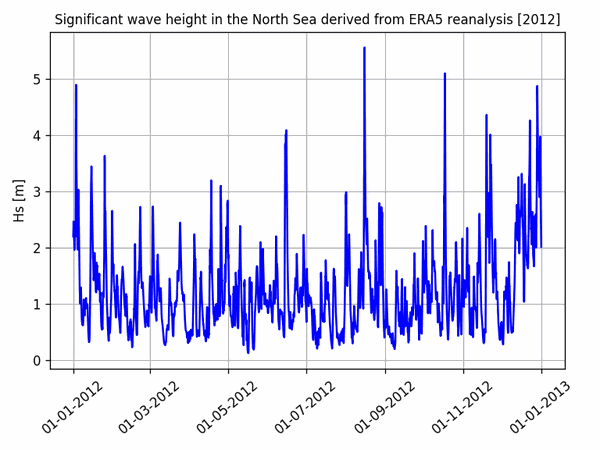
The dataset presents time series of the coastal wave climate based upon ocean surface wave parameters computed for a European-wide domain. This dataset provides an understanding of the wave climate under the impact of climate change for the Northwest European Shelf and Mediterranean Sea. It provides added value for various coastal sectors and studies such as port, shipping, and coastal management.
The ocean surface wave fields are computed using the ECMWF's Wave Model (SAW) forced by surface wind and accounting for ice coverage in polar latitudes. The wave climate is defined by means of the integrated wave spectral parameters such as the significant wave height and the peak wave period. In order to assess the impact of climate change on the ocean's surface wave field, the SAW model is run for three different climate scenarios: the current climate (also termed historical), and two Representative Concentration Pathway (RCP) scenarios that correspond to an optimistic emission scenario where emissions start declining beyond 2040 (RCP4.5) and a pessimistic scenario where emissions continue to rise throughout the century often called the business-as-usual scenario (RCP8.5). The wave climate in these scenarios are simulated using wind forcing from a member of the EURO-CORDEX climate model ensemble - the HIRHAM5 regional climate model downscaled from the global climate model EC-EARTH. Given that the projections of these climate scenarios are based on a single combination of the regional and global climate models, users of these data should take in consideration that there is an inevitable underestimation of the uncertainty associated with this dataset. In addition to the three climate scenarios, the time series are also computed using ERA5 reanlysis wind forcing. This provides the recent historical wave climate that may be used, for example, to look at specific events in the past.
This dataset was produced on behalf of the Copernicus Climate Change Service.
The ocean surface wave fields are computed using the ECMWF's Wave Model (SAW) forced by surface wind and accounting for ice coverage in polar latitudes. The wave climate is defined by means of the integrated wave spectral parameters such as the significant wave height and the peak wave period. In order to assess the impact of climate change on the ocean's surface wave field, the SAW model is run for three different climate scenarios: the current climate (also termed historical), and two Representative Concentration Pathway (RCP) scenarios that correspond to an optimistic emission scenario where emissions start declining beyond 2040 (RCP4.5) and a pessimistic scenario where emissions continue to rise throughout the century often called the business-as-usual scenario (RCP8.5). The wave climate in these scenarios are simulated using wind forcing from a member of the EURO-CORDEX climate model ensemble - the HIRHAM5 regional climate model downscaled from the global climate model EC-EARTH. Given that the projections of these climate scenarios are based on a single combination of the regional and global climate models, users of these data should take in consideration that there is an inevitable underestimation of the uncertainty associated with this dataset. In addition to the three climate scenarios, the time series are also computed using ERA5 reanlysis wind forcing. This provides the recent historical wave climate that may be used, for example, to look at specific events in the past.
This dataset was produced on behalf of the Copernicus Climate Change Service.
Interval
-
DOI
10.24381/cds.572bf382
Portal
Climate Data Store
Product Family
Data
Product Type
Climate projections
Spatial Coverage
Europe
Temporal Coverage
Past
Present
Future
Variable Domain
Ocean (physics)
Sector
Coastal regions