
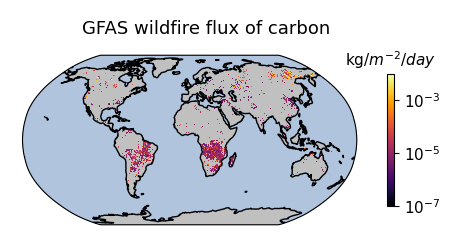
Emissions of atmospheric pollutants from biomass burning and vegetation fires are key drivers of the evolution of atmospheric composition, with a high degree of spatial and temporal variability, and an accurate representation of them in models is essential.
The CAMS Global Fire Assimilation System (GFAS) utilises satellite observations of fire radiative power (FRP) to provide near-real-time information on the location, relative intensity and estimated emissions from biomass burning and vegetation fires. Emissions are estimated by (i) conversion of FRP observations to the dry matter (DM) consumed by the fire, and (ii) application of emission factors to DM for different biomes, based on field and laboratory studies in the scientific literature, to estimate the emissions. Emissions estimates for 40 pyrogenic species are available from GFAS, including aerosols, reactive gases and greenhouse gases, on a regular grid with a spatial resolution of 0.1 degrees longitude by 0.1 degrees latitude.
This version of GFAS (v1.2) provides daily averaged data based on a combination of FRP observations from two Moderate Resolution Imaging Spectroradiometer (MODIS) instruments, one on the NASA EOS-Terra satellite and the other on the NASA EOS-Aqua satellite from 1 January 2003 to present. GFAS also provides daily estimates of smoke plume injection heights derived from FRP observations and meteorological information from the operational weather forecasts from ECMWF.
GFAS data have been used to provide surface boundary conditions for the CAMS global atmospheric composition and European regional air quality forecasts, and the wider atmospheric chemistry modelling community.
The CAMS Global Fire Assimilation System (GFAS) utilises satellite observations of fire radiative power (FRP) to provide near-real-time information on the location, relative intensity and estimated emissions from biomass burning and vegetation fires. Emissions are estimated by (i) conversion of FRP observations to the dry matter (DM) consumed by the fire, and (ii) application of emission factors to DM for different biomes, based on field and laboratory studies in the scientific literature, to estimate the emissions. Emissions estimates for 40 pyrogenic species are available from GFAS, including aerosols, reactive gases and greenhouse gases, on a regular grid with a spatial resolution of 0.1 degrees longitude by 0.1 degrees latitude.
This version of GFAS (v1.2) provides daily averaged data based on a combination of FRP observations from two Moderate Resolution Imaging Spectroradiometer (MODIS) instruments, one on the NASA EOS-Terra satellite and the other on the NASA EOS-Aqua satellite from 1 January 2003 to present. GFAS also provides daily estimates of smoke plume injection heights derived from FRP observations and meteorological information from the operational weather forecasts from ECMWF.
GFAS data have been used to provide surface boundary conditions for the CAMS global atmospheric composition and European regional air quality forecasts, and the wider atmospheric chemistry modelling community.
Interval
-
DOI
10.24381/a05253c7
Portal
Atmosphere Data Store
Product Family
Data
Product Type
Analysis
Spatial Coverage
Global
Temporal Coverage
Past
Present
Variable Domain
Emissions and surface fluxes